LFP Vs NMC Batteries For Commercial EV Fleets: Which Chemistry To Specify In Your Next Order
By YoMobility Team10 min read
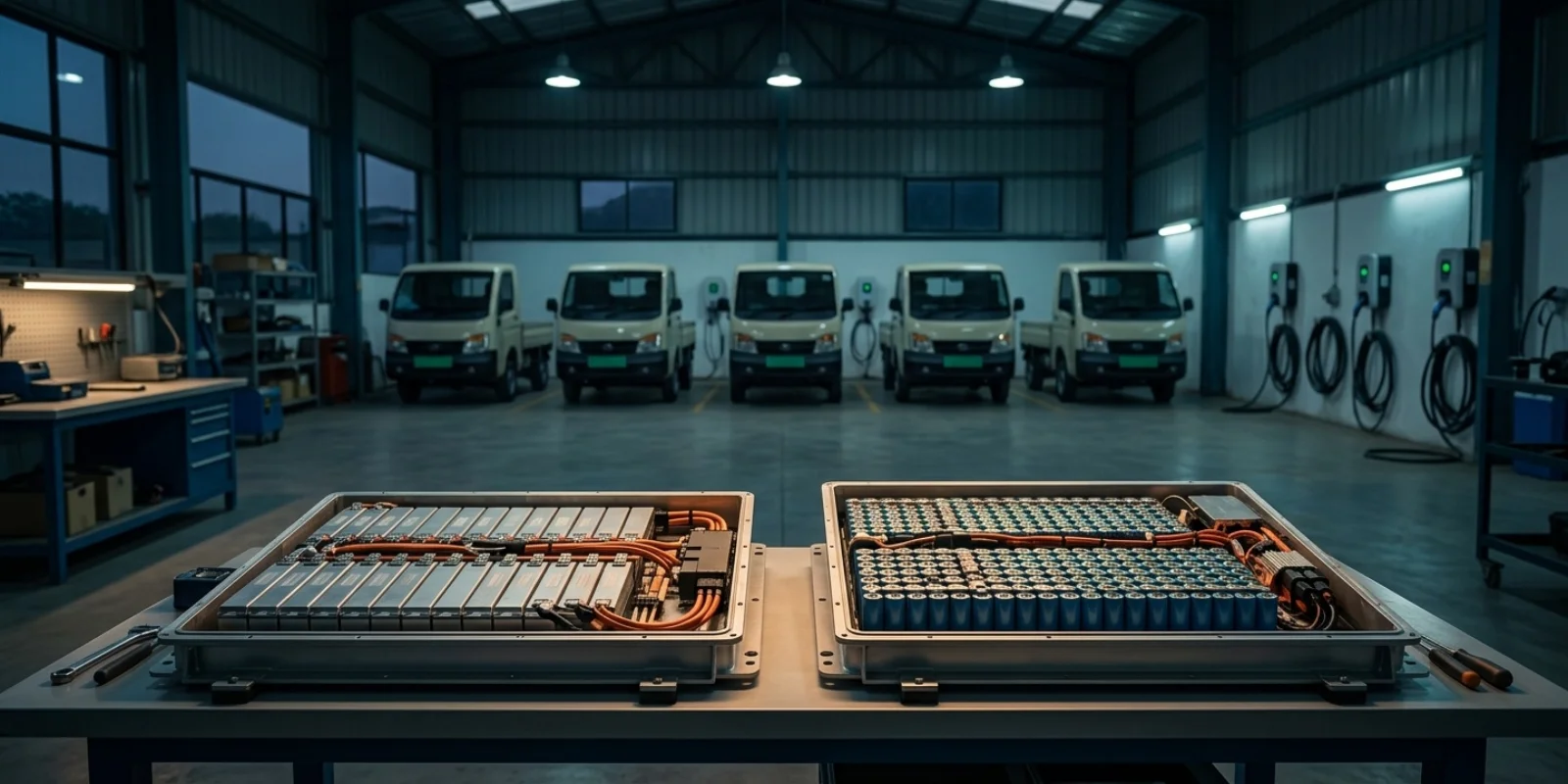
LFP vs NMC: Specifying The Right Battery For Your Fleet
💡 LFP vs NMC For Fleets: Summary
- Most fleets inherit a chemistry from the OEM spec sheet. Choose it on purpose when the duty cycle, the climate or the residual-value model depends on it.
- Cycle life is LFP’s big lead. In Sandia’s lab tests, LFP cells lasted 2,500–9,000 full cycles to 80% capacity. NMC cells lasted 200–2,500.
- Cost favours LFP too. BloombergNEF’s 2025 averages were $81/kWh for LFP packs and $128/kWh for NMC.
- NMC wins on energy per kilogram. That matters for range and payload on heavy or long-range duty, and much less on an urban cargo run.
- Your charging policy should follow the chemistry. LFP needs regular full charges to keep its state-of-charge reading honest. NMC ages faster when it sits at or near 100%.
If you buy commercial EVs for a living, the LFP vs NMC question has probably been settled for you already, on the OEM’s spec sheet. This guide is for fleet procurement and asset managers specifying last-mile three-wheelers, small commercial vehicles, e-buses and corporate cars. It is not for anyone buying a 12V LiFePO4 pack for a caravan.
Inheriting a chemistry is fine as long as your duty cycle, your climate and your residual-value model don’t depend on it. Once they do, the chemistry decides how many cycles you get before the pack is tired, how much weight the battery takes out of your payload, and how far your depot team can trust the state-of-charge gauge. Here is the decision a fleet should actually make.
LFP vs NMC: The Four Trade-Offs That Matter To A Fleet
LFP (lithium iron phosphate) and NMC (nickel manganese cobalt) are both lithium-ion chemistries, named after their cathodes. For an operator the chemistry lecture reduces to four trade-offs, summarised below and explained underneath.
| Trade-off | LFP | NMC | Ask yourself |
|---|---|---|---|
| Cycle life | 2,500–9,000 full cycles to 80% capacity in lab tests | 200–2,500 full cycles to 80% in the same study | How many full cycles will a vehicle do before you sell it? |
| Energy density | Lower: about 95–172 Wh/kg at cell level | Higher: the best cells exceed 300 Wh/kg | Does your load cube out (fill the space) or weigh out (hit the weight limit)? How long are your routes? |
| Heat | More thermally stable cathode. Cycle wear still rises with temperature | Layered oxide cathode releases oxygen when overheated. Ages fastest when held at high charge | Where do the vehicles park on a peak-summer afternoon? |
| Cost per kWh | $81/kWh average pack price, 2025 | $128/kWh average pack price, 2025 | Is the price saving going into the vehicle, or the OEM’s margin? |
Cycle Life Against Your Duty Cycle
The cleanest public comparison comes from Sandia National Laboratories’ multi-year cycling study. It cycled commercial LFP, NMC and NCA cells under the same conditions. To reach 80% capacity, LFP cells took 2,500 to 9,000 equivalent full cycles. NMC cells took 200 to 2,500. Two caveats apply: these were small lab cells rather than vehicle packs, and the gap narrows when you count total energy delivered instead of cycles. The direction is still not in doubt.
Now translate that into your duty cycle. Tata lists the Ace EV 1000 at 21.3 kWh with a certified 161 km range, which works out to about 0.13 kWh per km (Derived). A van covering 120 km a day uses about 0.75 of a full cycle. Over 300 working days that is about 225 cycles a year, or roughly 1,600 across seven years (Derived). Double-shift the same van at 240 km a day and seven years comes to about 3,150 cycles (Derived). That is above the top of the NMC range in the Sandia study and inside the LFP range. Certified range flatters consumption, so real cycle counts will be higher still.
Energy Density Against Payload And Range
NMC packs more energy into each kilogram. Published figures for LFP cells run from about 95 to 172 Wh/kg, while the best NMC cells exceed 300 Wh/kg. Take a 21.3 kWh pack. At those two extremes the cells alone weigh about 124 kg and 71 kg, a gap of roughly 50 kg (Derived, cell level only, and the best case for NMC). For an urban parcel van that cubes out before it weighs out, 50 kg hardly matters. It matters more on long routes, on heavy-duty vehicles, and anywhere the pack has to grow to meet the range.
Thermal Behaviour In An Indian Summer
LFP’s phosphate cathode is the more thermally stable of the two. Layered oxide cathodes like NMC release oxygen when heated, which is why LFP has the reputation as the more forgiving chemistry in a thermal event. Ageing is less simple. Between 15°C and 35°C, Sandia found that LFP’s capacity fade rate rose with temperature while NMC’s fell. When vehicles were parked rather than cycled, heat sped up fade for every chemistry. So LFP does not exempt you from shaded parking or a liquid-cooled pack. Safety certification is a separate question, covered in our AIS 156 battery safety procurement guide.
Cost Per kWh
BloombergNEF’s 2025 survey averaged LFP packs at $81/kWh and NMC at $128/kWh across all segments. Separately, the IEA found LFP more than 40% cheaper than NMC on average in 2025. On a 50-van order of 21.3 kWh packs, the $47/kWh gap is about $50,000, or roughly ₹42–45 lakh at ₹85–90 to the dollar (Derived). That is a factory-gate average, not a price cut you will see on the invoice. How chemistry feeds a replacement quote is covered in our EV battery replacement cost guide.
The Depot Quirk: One Charging Policy Does Not Fit Both
This is the part no one tells the depot. Across most of its working range, an LFP cell’s voltage barely moves. The open-circuit voltage curve is almost flat between roughly 20% and 80% state of charge, so a battery management system (BMS) that estimates charge from voltage has very little signal to work with. The estimate drifts, and the driver’s range gauge drifts with it.
The fix is a periodic full charge, which gives the BMS a known reference point. Tesla, for example, tells owners of its LFP cars to fully charge to 100% at least once per week so the car can accurately determine state of charge and range. NMC needs close to the opposite. In the Sandia data, cycling NMC between 0% and 100% cost 5–10% more capacity than partial cycling, while the state-of-charge window made little difference to LFP. Cells parked at 100% also faded fastest on NMC.
So the policy follows the chemistry. On LFP, schedule a full charge at least weekly and let it top up to 100% when the route needs it. On NMC, set an 80% ceiling for daily work and allow 100% only before long runs. A mixed fleet needs both rules at once, applied per vehicle. Copy one depot’s policy onto the other chemistry and you will either shorten pack life or send drivers out with a gauge they cannot trust. Per-vehicle charge limits are a charging management setting, not something to leave to a laminated sheet on the depot wall.
Which Fleet Segments Lean LFP And Which Lean NMC
Globally, LFP has already taken the majority. The IEA, reported by Mercom, says LFP accounted for over half of EV batteries in 2025 and well over half of electric car sales in emerging and developing economies. India’s small commercial vehicles follow the same pattern. Tata’s Ace EV product note lists lithium iron phosphate chemistry. Mahindra’s ZEO specification table lists LFP cylindrical cells in both its 18.4 kWh and 21.3 kWh packs. For a high-cycle urban cargo van, LFP’s cycle life and price usually outweigh its weight penalty.
NMC holds on where energy per kilogram buys something you can sell. Two-wheelers show this most clearly. Autocar India reports that Ather’s 450 is offered only with NMC packs, while its Rizta now ships a 2.7 kWh LFP pack or a 2.9 kWh NMC pack with the same claimed 123 km range. The buyer cannot choose which; it depends on supply. That is the strongest argument for the next section. If the chemistry can change under the same model name, your purchase order has to pin it down.
LFP vs NMC In The Purchase Order: Three Clauses To Add
1. Chemistry Disclosure, Fixed For The Order
Require the cell chemistry, cell format and cell supplier to be stated for each variant, plus written notice before any substitution during delivery. Your charging policy, depreciation assumptions and resale story all rest on that one line.
2. Warranty In Cycles And Retained Capacity
OEMs write battery warranties in years and kilometres. Mahindra’s ZEO, for example, carries 7 years or 1.5 lakh km. Ask for a retained-capacity floor and a cycle count as well, because those are what a high-cycle fleet actually uses up. How that capacity is measured over the vehicle’s life belongs to our battery state of health guide.
3. BMS Data Access
Get state of charge, state of health, cycle count and cell temperatures in writing, through an API or telematics feed you can read without the OEM’s permission. That is what lets EV vehicle tracking and YoMobility’s fleet management platform enforce chemistry-aware charge limits, catch an LFP pack overdue for its calibration charge, and build the pack history a buyer will ask for at resale. At end of life, LFP recovers less metal value than NMC, as our EV battery recycling guide explains, and India’s black mass export ban now keeps that material with domestic refiners.
A Rule Of Thumb For Your Next Order
If vehicles run high daily kilometres on urban routes, cube out before they weigh out, and stay in the fleet for five years or more, specify LFP and plan a weekly full-charge routine. If range per kilogram is the constraint, such as long routes, heavy loads or premium passenger duty, NMC can earn its higher price, provided the depot holds it to an 80% daily ceiling. Whichever you choose, write it into the order, and make sure your data can prove the battery was looked after.
Frequently Asked Questions
For high-cycle urban duty, usually LFP. In Sandia’s lab tests LFP cells lasted 2,500–9,000 full cycles to 80% capacity against 200–2,500 for NMC, and BloombergNEF’s 2025 average LFP pack cost $81/kWh against $128/kWh for NMC. NMC is the better choice where energy per kilogram limits range or payload.
Yes, regularly. LFP’s flat voltage curve makes state-of-charge estimates drift, so a periodic full charge gives the BMS a reference point. Tesla, for example, advises LFP owners to charge to 100% at least once a week. NMC is different: it ages faster when held at high charge, so an 80% daily ceiling is the usual policy.
In Sandia National Laboratories’ study of commercial cells, LFP reached 80% capacity after 2,500–9,000 equivalent full cycles and NMC after 200–2,500, depending on temperature, depth of discharge and current. These were lab cells, not vehicle packs, so use the ranges to compare the chemistries, not as a warranty figure.
Many do. Tata’s Ace EV product note lists lithium iron phosphate chemistry, and Mahindra’s ZEO uses LFP cylindrical cells in both its 18.4 kWh and 21.3 kWh packs. Always confirm the chemistry for your exact variant in writing, because some manufacturers fit different chemistries under the same model name depending on supply.
Yes. LFP’s cathode is more thermally stable, but Sandia found that between 15°C and 35°C its cycle wear rose with temperature while NMC’s fell. When vehicles were parked rather than cycled, heat sped up wear for every chemistry. Shaded parking and good pack cooling matter whichever you buy.
Sources: Sandia National Laboratories — Degradation of Commercial Lithium-ion Cells (2020) | BloombergNEF — 2025 Battery Price Survey | Mercom India — IEA on the 2025 battery market (Feb 2026) | Tata Motors — Ace EV product note | Mahindra — ZEO launch and specifications | Autocar India — Ather LFP and NMC packs (Jul 2026) | InsideEVs — Tesla LFP charging guidance | Wikipedia — Lithium iron phosphate battery
Manage Your Fleet’s Battery Chemistry Today
Set charge limits per vehicle by chemistry, track LFP calibration charges, and keep a cycle and state-of-health record for every pack.
Book a Free DemoYoMobility EV-FMS
EV fleet management softwareRun every vehicle, driver, charge and payment from one platform. Charge on multiple networks, and get one invoice for all of it.
Resources
Keep reading
Diesel Theft Ends When You Electrify — And The New Energy Leakage That Replaces It
💡 Diesel Theft vs EV Energy Leakage: Key Highlights If you searched for how to stop diesel theft, here is […]

Green Number Plates For Commercial EVs: Registration, Permit Exemption And What Else Changes
💡 Green Number Plate: Key Highlights Green plates with yellow lettering identify commercial battery-electric vehicles; white lettering means private use. […]

Driver Monitoring System For EV Fleets: What The Camera Sees And What It Should Change
💡 Driver Monitoring System: Summary A driver monitoring system is usually bought as a camera and judged on detection: does […]
See YoMobility on your fleet
Tell us how many vehicles you run and where they charge. We'll show you how they'd run on one platform, with one invoice.
Or contact us