
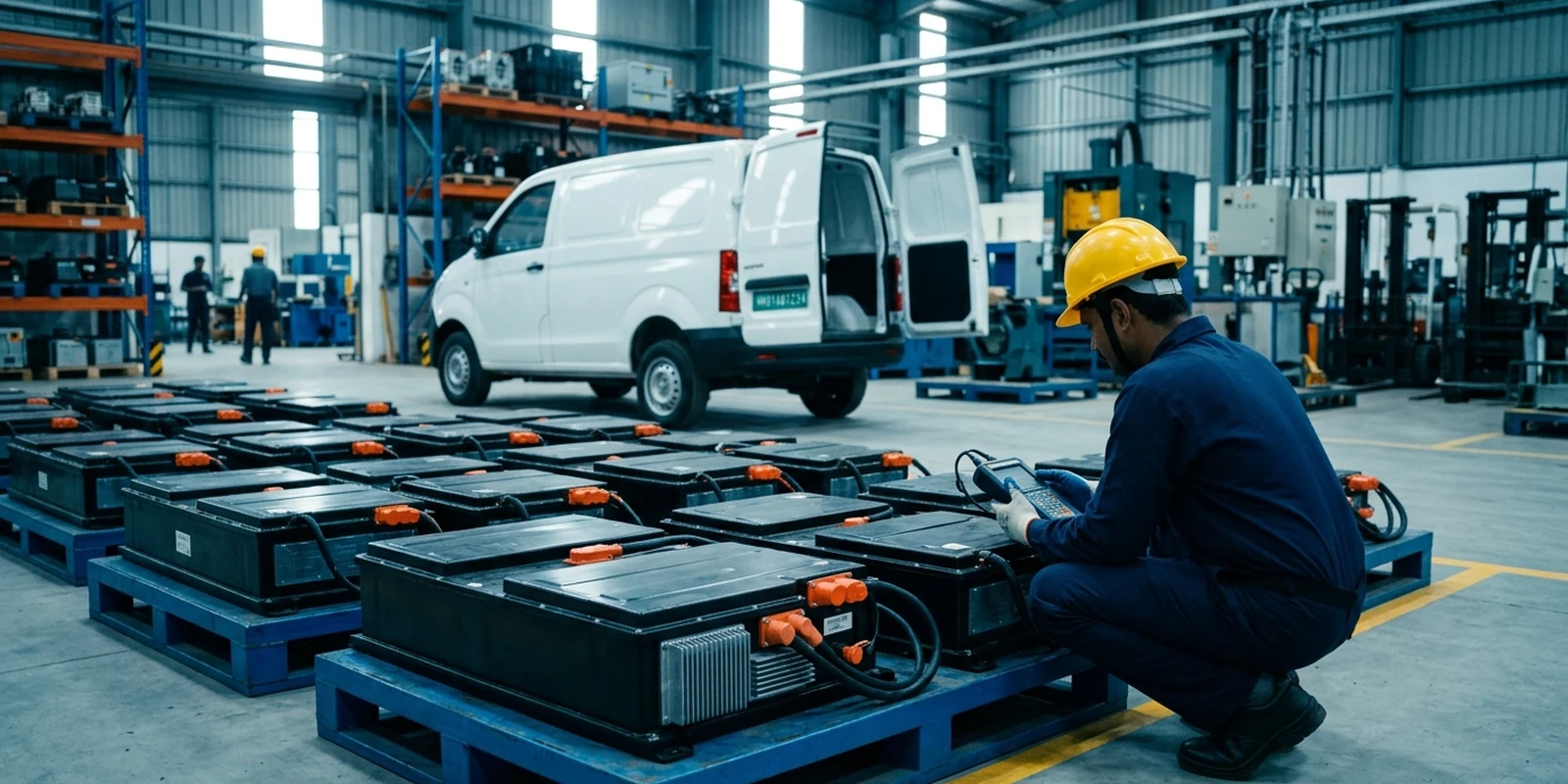
EV Battery Recycling For Fleets
💡 EV Battery Recycling: Key Highlights
- There is no “bulk consumer” in the battery rules. Buy Indian-registered EVs and you are a consumer — two obligations, nothing to file.
- Import a vehicle or a pack and you become a Producer: CPCB registration, EPR plan, annual returns, Schedule II targets.
- 80% state of health is a retirement point, not a scrap point. NITI Aayog models 60% of retiring four-wheeler and bus packs doing four to five further years of grid duty.
- Collection targets on four-wheeler EV batteries start only in FY2029-30. Until then take-back is a contract clause, or nothing.
A fleet EV’s battery stops being useful long before it stops being yours. This is for the two people who meet at that moment: the fleet owner planning the back end of the asset life and the sustainability lead who must put a defensible number against the disposal. Both learn the same lesson on the first retirement — EV battery recycling in India is a regulated handover, not a sale.
If you are still deciding whether to retire a vehicle, EV battery state of health answers that. This post starts the moment the answer is yes.
Before EV Battery Recycling Starts, Work Out Which Role You Hold
First, delete a phrase imported from the wrong rulebook. The Battery Waste Management Rules, 2022, notified by the Ministry of Environment, Forest and Climate Change on 24 August 2022, contain no “bulk consumer” — that belongs to the e-waste rules. They define a consumer as the end user, whose duties are light: segregate waste batteries and hand them to an entity engaged in collection, refurbishment or recycling. Nothing to register, nothing to file. Run 50 electric delivery vans in Delhi and that is you — but two doors lead out of the box.
| Role | What puts you here | What it obliges |
|---|---|---|
| Consumer | Bought Indian-registered EVs domestically. | Segregate; hand to a registered entity. Nothing filed. |
| Producer | Imported a battery, or equipment containing one — a vehicle counts. | CPCB registration (Form 1A), EPR plan (Form 1C), annual returns (Form 3), Schedule II targets, recycled-content minimums from 2027-28. |
| Refurbisher | Repurpose used packs, including your own. | SPCB registration (Form 2A), quarterly returns (Form 4), hazardous waste under the 2016 rules. |
The refurbisher row surprises people. The rules define refurbishment as “re-purposing of used Battery for its second life,” so wheel retired packs into a depot storage wall and you have met that definition. Register before you build it: environmental compensation is levied on entities operating without registration.
Second Life Or Recycling: How To Judge The Fork
A pack that can no longer hold a delivery route can still hold a depot. The question is not whether the battery is dead but whether it is uniform enough to re-engineer. Three variables decide it.
State-of-health band
NITI Aayog takes 80% state of health as the conventional retirement point, and notes such packs usually retain 70–80% of usable energy. That band is the raw material for stationary duty — inverter backup, depot load-shifting, grid storage.
Cycle history and vehicle class
Class shifts the odds sharply. NITI Aayog’s volume model assumes only 25% of retiring two- and three-wheeler packs are worth reusing, for two to three extra years, because they absorb more cycles for their size. For four-wheelers and e-buses it assumes 60%, over four to five further years of grid duty. Run e-rickshaws and make recycling the base case; run vans and plan for reuse.
Pack uniformity
Integrators test at module level and the weakest module caps the whole, so a 78% average across clustered modules beats an 82% average hiding a 55% outlier. No BIS standard covers a repurposed battery — IS 17855:2022 addresses new traction packs, IS 16893 the cells — so quality is set by the contract, not a stamp.
What A Recycler Pays For — And Why Traceability Sets Your Price
Recycling a lithium pack means shredding it into black mass — the concentrate carrying lithium, cobalt, nickel and manganese — then leaching the metals out. The margin sits in that second step, so chemistry drives the quote more than tonnage. NITI Aayog puts mechanical processing near a 1.6 revenue-to-input-cost ratio for both NMC and LFP, but the metal-recovering pyro and hydro routes fall to roughly 1.0 on LFP. Ask your OEM which chemistry your packs use.
The rest of the price is regulatory. Registered recyclers must hit minimum material recovery as a share of dry weight — for EV batteries, 70% in 2024-25, 80% in 2025-26, 90% from 2026-27. CPCB issues EPR certificates against weight processed and recovery achieved; recyclers sell those to producers who need them.
That is why traceability pays. A pallet of unidentified packs is a chemistry gamble a recycler prices defensively; a batch carrying serial numbers, chemistry, in-service dates, cycle counts and state-of-health history is a known input against a known certificate. Keeping that record is ordinary EV vehicle tracking discipline — the least glamorous argument for a fleet operating system like YoMobility. Value you cannot document is whatever the buyer says.
There is a real formal sector to sell into — Attero, Lohum, Gravita and BatX Energies among those at scale — but verify your pick on the CPCB EPR portal first.
Write End Of Life Into The Purchase Or Lease Contract On Day One
Schedule II phases collection targets in by vehicle class, on cycles matched to average battery life. E-rickshaw packs entered a seven-year cycle in 2024-25 and two-wheelers in 2026-27, but for four-wheeler EV batteries the first cycle begins in FY2029-30, on a fourteen-year clock. A four-wheeler fleet buying today has no producer under a statutory duty to collect its packs.
Five clauses worth the argument
- Who owns the pack at retirement. Under battery-as-a-service or leasing you may never own it — fine, if written down not discovered.
- A take-back commitment with a price basis. Name the trigger, who pays transport and how price is set — a formula beats “market rate.” The OEM needs collected volume: that is your leverage.
- Warranty interaction. Establish what opening or repurposing a pack does to the remaining warranty, and confirm it covers commercially registered vehicles. Several passenger-car warranties do not.
- Data handover. BMS logs, cycle counts, fault history and the state-of-health series, readable, at retirement. A refurbisher without them re-tests from zero.
- Transport and storage. Waste lithium packs move under the Hazardous and Other Wastes Rules, 2016. Settle who packs, carries and insures before a damaged casing reaches the yard.
Raise these alongside the service contract — one OEM relationship governs both. Renegotiating EV fleet maintenance terms? Add end of life to the agenda — all of it is negotiable only while the OEM wants your signature.
The Paperwork That Turns A Disposal Into A Reportable Claim
A sustainability report carries only what a receipt defends. Per consignment retain five things: the receiver’s registration certificate (Form 1B for a producer, Form 2B for a recycler or refurbisher); weight by chemistry; pack identifiers; date and transporter; and any EPR certificate reference against your material.
Be precise about what that lets you say: the EPR certificate from your packs belongs to the recycler, not you. What you can state, line by line, is the tonnage routed to registered recyclers, the recovery rate they were bound to, and the share sent to second life.
Capture it in CO₂ tracking as it happens; our fleet sustainability reporting guide covers the disclosure. NITI Aayog expects 128 GWh of recycling volume by 2030, 59 GWh from EVs alone. Operators who settled this at purchase will sell into a mature market; the rest will ring round with undocumented packs.
Frequently Asked Questions
Not as a consumer. A fleet buying Indian-registered EVs domestically need only segregate waste batteries and hand them to a registered collector, refurbisher or recycler. Registration is mandatory only if you import batteries or vehicles containing them, making you a Producer, or repurpose packs, making you a Refurbisher.
Only to a registered entity. The rules bar registered recyclers and refurbishers from dealing with unregistered parties, and environmental compensation is levied on anyone operating without registration. Verify the receiver on the CPCB EPR portal first.
Because the value sits in metals recovered from black mass. NITI Aayog puts mechanical processing near a 1.6 revenue-to-input-cost ratio for both NMC and LFP, but the metal-recovering pyro and hydro routes fall to roughly 1.0 on LFP. Expect a thinner offer there.
Not the EPR certificate — that is generated for the recycler and sold to a producer meeting its own obligation. A fleet can report, with receipts, the tonnage routed to registered recyclers, the recovery targets they are bound to, and how many packs went to second life.
Sources: MoEFCC — Battery Waste Management Rules, 2022 | CPCB — Rules & Notifications | CPCB EPR Battery Portal | NITI Aayog — ACC Battery Reuse and Recycling Market in India | BIS — Performance Standards for EV Batteries
Build The Pack History Before You Need It
Tell us your fleet size, vehicle mix and battery chemistry, and we will show you how pack identity, cycle count and state-of-health history get captured per vehicle from day one.