India’s Lithium-Ion Black Mass Export Ban: What It Means For EV Battery Recycling And Your Fleet’s End-Of-Life Packs
By YoMobility Team7 min read
India Bans Lithium-Ion Black Mass Exports: What Changes For Fleet Batteries
- DGFT Notification No. 49/2026-27, dated 10 November 2026, prohibits exports of lithium-ion battery black mass under ITC(HS) 85491400, with immediate effect and until further orders (Stated).
- The stated aim is to feed India’s under-used recycling and refining capacity and cut critical-mineral imports (Stated).
- It pairs with the ₹1,500 crore recycling incentive scheme, which targets 270 kilotonnes a year of capacity and pays for metal extraction, not black mass alone (Stated).
- Fleet EPR duties, pack buy-back prices and domestic black mass prices are not addressed (Unknown).
- The practical fleet move: keep chemistry and state-of-health records per pack, because every end buyer is now a domestic refiner.
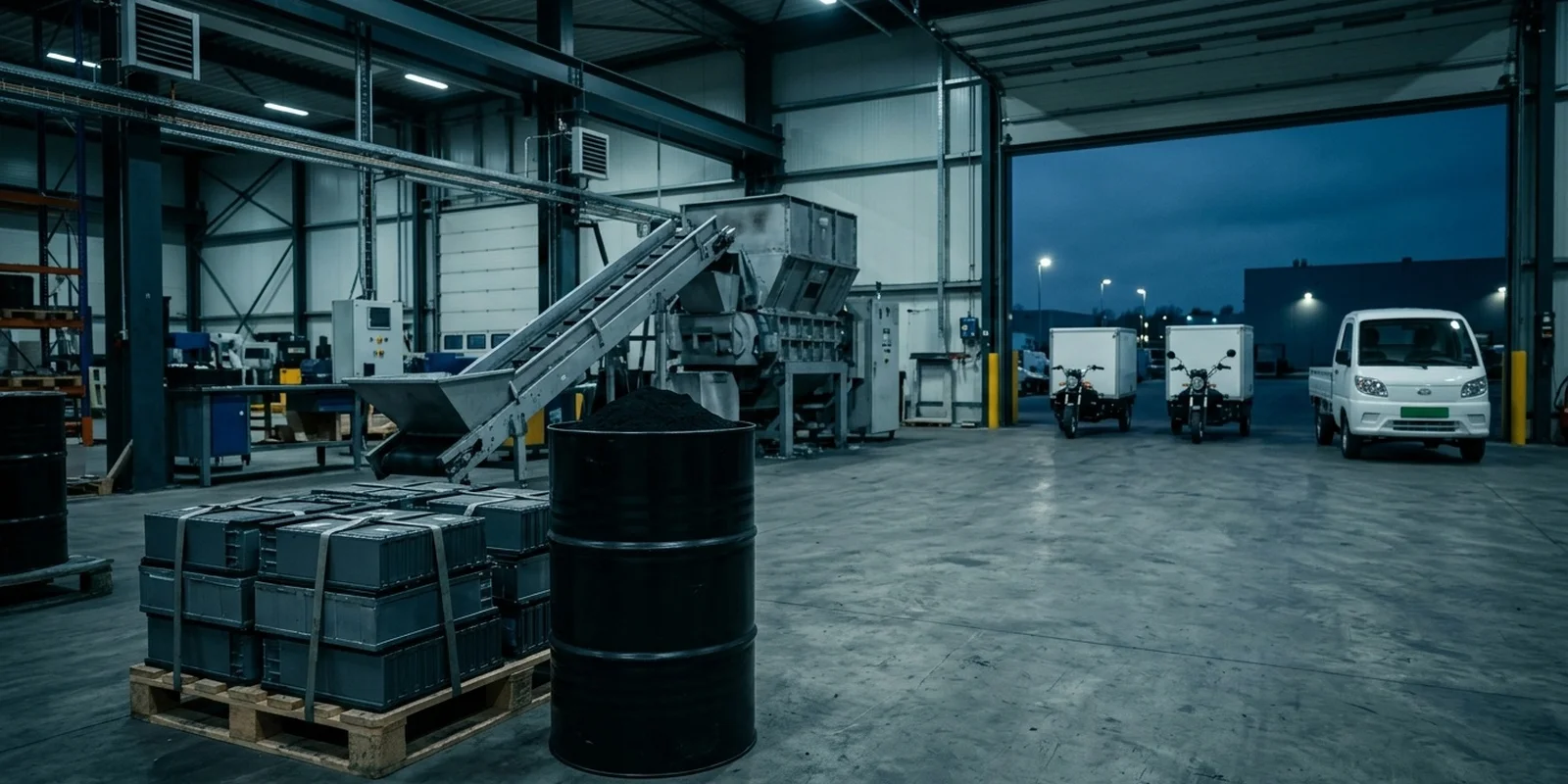
India’s lithium-ion black mass export ban took effect on 10 November 2026. Through Notification No. 49/2026-27, the Directorate General of Foreign Trade (DGFT) moved “Lithium-Ion Battery Black Mass” under ITC(HS) code 85491400 from Free to Prohibited, with immediate effect and until further orders (Stated, DGFT). Black mass is the dark powder left when end-of-life lithium-ion packs and cell-factory scrap are shredded. It holds the lithium, cobalt, nickel and manganese that a refiner can recover.
This piece is written for operations and finance heads running last-mile cargo three-wheelers, e-buses and corporate EV fleets whose first packs are approaching retirement. Our guide to EV battery recycling for fleets already covers the basics: your role under the Battery Waste Management Rules, second life versus recycling, and the contract clauses to sign on day one. This article covers only what the ban adds.
What The Lithium-Ion Black Mass Export Ban Actually Changes
Code 85491400 covers unsorted waste, scrap and spent primary cells, batteries and accumulators that contain no lead, cadmium or mercury. The DGFT notification names lithium-ion black mass specifically. Exports were not open before this. Black mass is classed as hazardous waste, and trade press reported in October 2025 that shipments needed environment-ministry permission and a DGFT licence, with allegations of cargo being declared under other codes. That route is now closed. The only exception is the standard transitional clause, Para 1.05 of the Foreign Trade Policy 2023, which covers export commitments made before a policy change.
Put simply, a retired Indian pack’s life could once end in a refinery abroad. Now it ends in India.
Why The Government Closed The Export Door
The Commerce Ministry’s release is direct about the problem. India’s capacity to recycle battery waste and refine critical minerals “has grown considerably” but runs below capacity for lack of feedstock. Meanwhile, some domestic recyclers have had to import material while Indian black mass left the country.
The lithium-ion black mass export ban is the supply half of a policy whose demand half already exists. The Union Cabinet approved the ₹1,500 crore critical mineral recycling incentive scheme in September 2025. It runs for six years, FY2025-26 to FY2030-31 (Stated), and targets at least 270 kilotonnes of annual recycling capacity, about 40 kilotonnes of critical-mineral output, roughly ₹8,000 crore of investment and close to 70,000 jobs (all Stated). Support per company is capped at ₹50 crore for large entities and ₹25 crore for small ones (Stated).
One detail matters most for anyone holding packs. The scheme pays the part of the value chain that actually extracts critical minerals, not units that only produce black mass. Taken together, the scheme and the ban treat shredding as a midpoint. Policy wants the value captured at domestic refining, where lithium, nickel and cobalt salts are recovered. The release adds that several major economies have taken similar steps to keep battery waste for domestic processing, though it names none.
Where The Value In A Retired Fleet Pack Now Lands
A fleet never ships black mass itself, so the ban acts two handoffs after your depot. Here is the chain, and the one link that moved.
| Stage | Who holds the material | Before 10 Nov 2026 | After |
|---|---|---|---|
| 1. Retirement | Fleet operator | Hand over to a registered entity | Unchanged |
| 2. Second life or collection | Refurbisher or collector | Repurpose or pass on | Unchanged |
| 3. Shredding | Shredder (makes black mass) | Sell in India, or export under permission | Sell in India only |
| 4. Refining | Refiner (recovers metals) | Domestic or overseas | Domestic only |
Domestic refiners are now the only end buyers for Indian black mass. That shifts bargaining power towards them and away from shredders. Whether that lowers what shredders pay, and so what they offer a fleet for a pack, is Unknown. The release says nothing on prices. The opposite pressure is also real: refiners building scheme-funded capacity need steady, well-documented feedstock to justify it.
Chemistry sets the stakes. Many cargo three-wheelers and e-buses run lithium iron phosphate (LFP), whose black mass carries lithium but no cobalt or nickel, so lithium recovery decides its value. Here is how to think about the scale. Take a 200-vehicle cargo three-wheeler fleet in Delhi. At an assumed 10 kWh per pack, that is 2,000 kWh of batteries (Derived). At an assumed 8 kg of pack per kWh, that is roughly 16 tonnes of packs (Derived), all of which will need a registered domestic destination at retirement.
What The Lithium-Ion Black Mass Export Ban Does Not Change Yet
It is easy to read more into the lithium-ion black mass export ban than the notification says. Here is the honest register.
| Question | What the notification and release say | Register |
|---|---|---|
| Do a fleet’s EPR or consumer duties change? | Not mentioned. The existing battery waste rules still apply. | Unknown |
| Will pack buy-back or take-back prices move? | Not mentioned | Unknown |
| Will domestic black mass prices move? | Not mentioned | Unknown |
| Are whole spent packs under the same code caught? | The code covers spent batteries, but the item is described as black mass | Unknown. Ask a customs adviser. |
| How long does the ban last? | “Until further orders” | Stated, open-ended |
In practice, teams should not renegotiate contracts on speculation. They should, however, make sure their paperwork still holds if the policy moves again.
Three Moves For Fleet Operators Before Packs Retire
1. Record chemistry and health for every pack
A domestic refiner pricing feedstock wants to know what it is buying. A fleet that can state chemistry, cell supplier and a battery state of health history for each pack gives the buyer fewer reasons to discount it. That data lives in your EV vehicle tracking records, provided you capture it while the vehicles are running.
2. Add a policy reopener to take-back clauses
The ban is open-ended, which means it can also be revised. Wherever a purchase, lease or take-back agreement fixes a price for retired packs, add a clause that reopens the price if export policy or recycling incentives change. The other end-of-life clauses are covered in the recycling guide.
3. Report recycled tonnage as a domestic outcome
Tonnage sent to registered Indian recyclers is now, by law, material recovered in India. Logged per handover, it becomes a clean line in your fleet reporting and sustainability disclosures.
YoMobility’s EV-FMS keeps state-of-health trends, charging history and vehicle records in one place. Under the lithium-ion black mass export ban, that record is what a domestic buyer prices against, and it should already exist on the day a refurbisher or recycler asks for it.
Frequently Asked Questions
It is the powder produced by shredding end-of-life lithium-ion batteries and battery-manufacturing scrap. It contains recoverable lithium, cobalt, nickel and manganese, depending on the cell chemistry.
DGFT Notification No. 49/2026-27, dated 10 November 2026, made exports of lithium-ion battery black mass prohibited with immediate effect and until further orders. The Commerce Ministry announced it on 11 November 2026.
The notification and the release do not mention EPR. Your role and duties under the Battery Waste Management Rules stay as they were until the rules themselves change.
Yes. The ban stops black mass leaving India, not domestic sales. Retired packs still go to registered refurbishers or recyclers in India, and you should check their registration before handover.
The government says the ban complements the scheme approved in September 2025. The scheme funds new recycling and refining capacity, and the ban keeps Indian black mass available to feed it.
Manage Your Fleet’s Battery End-Of-Life Records Today
See every pack’s chemistry, state-of-health trend and charging history in one fleet record, ready for the day a refurbisher or recycler asks for it.
Source: DGFT prohibits export of Lithium-Ion Battery Black Mass — Ministry of Commerce & Industry (PIB), 11 Nov 2026 (Release ID 2335019) | Notification No. 49/2026-27 — Directorate General of Foreign Trade, 10 Nov 2026.
YoMobility EV-FMS
EV fleet management softwareRun every vehicle, driver, charge and payment from one platform. Charge on multiple networks, and get one invoice for all of it.
Resources
Keep reading
Road Freight Decarbonisation In India: What The NDC-TIA II Pact Means For Electric Truck Fleets
Road freight decarbonisation in India gets a NITI Aayog-GIZ pact under NDC-TIA II. No targets yet; what it signals for e-truck charging and finance.
CAFE Norms 2027-2032 Are Final: What EV Super-Credits Mean For Fleet Buyers
💡 CAFE Norms 2027-2032: Key Highlights India’s CAFE norms 2027-2032 are now final. On 30 September 2026 the Ministry of […]
State EV Policy Scores Just Jumped: What The India Electric Mobility Index 2025 Means For Fleets
💡 India Electric Mobility Index 2025: Key Highlights India’s state EV scorecard moved a long way in twelve months. The […]
See YoMobility on your fleet
Tell us how many vehicles you run and where they charge. We'll show you how they'd run on one platform, with one invoice.
Or contact us