Green Number Plates For Commercial EVs: Registration, Permit Exemption And What Else Changes
By Shaurya Rathore8 min read
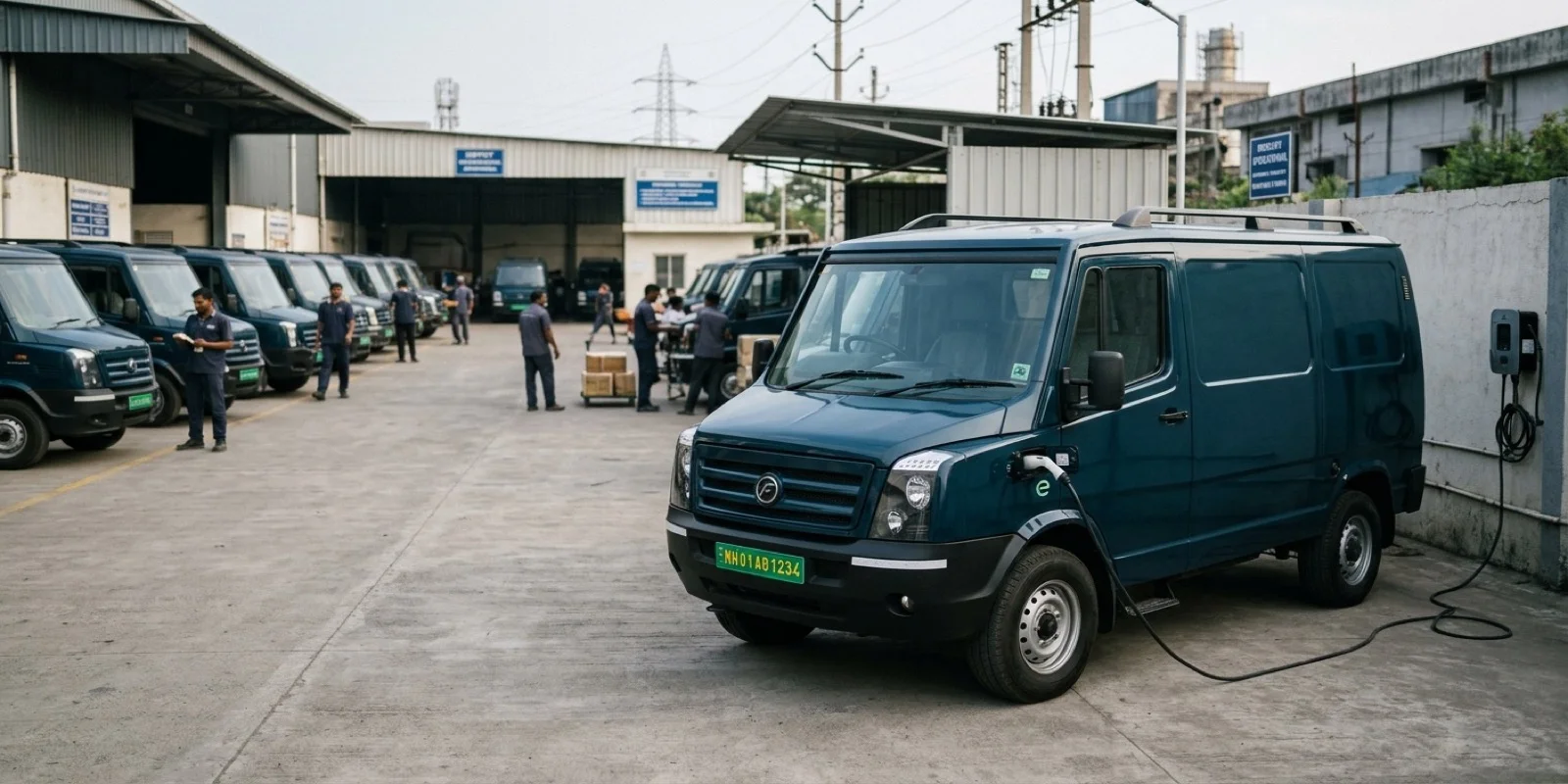
Green Number Plates For Commercial EVs
💡 Green Number Plate: Key Highlights
- Green plates with yellow lettering identify commercial battery-electric vehicles; white lettering means private use.
- Seven-year permit exemption — MoRTH has exempted battery-electric goods and passenger transport vehicles from permit requirements under Section 66 of the Motor Vehicles Act, provided the vehicle carries an AIS-140-compliant VLTD.
- Road tax and registration fee waivers are state-level — Maharashtra and Tamil Nadu currently offer 100% waivers; Karnataka has moved to tiered slabs for four-wheelers; Madhya Pradesh’s waiver lapsed in March 2026.
- The plate does not exempt a commercial EV from fitness certification, commercial insurance, driver licensing requirements, or AIS-140 compliance for permit-category vehicles.
If you are registering one electric car for personal use, here is the short answer: you get a green number plate with white lettering, and most states waive road tax. The rest of this post is for fleet operators — logistics companies, aggregator platforms, and transport-compliance staff — registering commercial EVs for the first time. The green number plate is not decoration. It is the registration marker that places a vehicle in a different regulatory regime, and the yellow lettering says the vehicle is commercial. What follows is a set of real exemptions, the conditions attached to them, and a list of things fleets commonly assume are included but are not.
What The Green Number Plate Is And How The Colour Scheme Works
India introduced a distinct green number plate for battery-electric vehicles following a notification under the Central Motor Vehicles Rules, 1989. The plate follows the same High Security Registration Plate (HSRP) format as every other vehicle — embossed lettering, hologram, chromium strip, laser-etched number. Only the background colour changes.
The Colour Code
The colour of the lettering on a green number plate tells you the vehicle’s use category at a glance:
- Green plate, white lettering — private battery-electric vehicle (personal car, two-wheeler).
- Green plate, yellow lettering — commercial or transport battery-electric vehicle (electric taxi, delivery van, e-rickshaw, e-bus, cargo three-wheeler, or any EV registered for hire or goods carriage).
The distinction mirrors the conventional plate system (white plate for private, yellow plate for commercial), with the green background added for all battery-electric vehicles regardless of use. Hybrids and plug-in hybrids do not qualify — the green plate is strictly for fully battery-powered vehicles.
How A Fleet Gets The Green Plate
For new vehicles, the dealer arranges the green number plate during registration at the Regional Transport Office (RTO). For fleet vehicles purchased before the notification, operators can approach the RTO with the registration certificate and request a plate change. The manufacturing cost is the same as a standard HSRP — typically Rs 400-600 for a set — and no separate “green plate fee” applies.
The Seven-Year Permit Exemption And Its Conditions
The single largest operating advantage attached to the green number plate for commercial fleets is the permit exemption. The Ministry of Road Transport and Highways (MoRTH) notified in July 2026 — acting under Section 66 of the Motor Vehicles Act, 1988 — that goods and passenger transport vehicles powered by battery, ethanol, methanol, or hydrogen are exempt from permit requirements for seven years from the date of the notification.
What The Exemption Covers
Under the conventional system, a commercial vehicle carrying goods or passengers needs a contract carriage, stage carriage, goods carriage, or national permit — depending on route and service type. Each involves an application, a fee, route restrictions, and periodic renewal. The seven-year exemption removes this entire layer for battery-operated commercial vehicles. A fleet deploying electric delivery vans, e-cargo three-wheelers, or electric passenger vehicles does not need individual route or area permits during this period.
Where It Stops
The exemption is not unconditional. Every vehicle claiming it must carry a Vehicle Location Tracking Device (VLTD) that complies with the AIS-140 standard, as amended — real-time tracking, emergency buttons, and backend data transmission to authorised servers. If a vehicle lacks a functional AIS-140-compliant VLTD, the exemption does not apply. The exemption also has a seven-year sunset. Fleets should plan for the possibility that permits may be required again after it expires, and track their vehicle management obligations accordingly.
Road Tax And Registration Fee Exemptions By State
Unlike the permit exemption, road tax and registration fee waivers are a state subject. Each state sets its own percentages, validity periods, and conditions. There is no national blanket exemption. A fleet operating across multiple states faces a patchwork, and the only reliable way to confirm the current position is to check with the RTO where each vehicle is registered.
The table below shows the position in representative fleet states as of October 2026. Policies change — treat the “verified” column as a cross-check date, not a guarantee.
| State | Road Tax on EVs | Registration Fee | Validity / Notes | Verified |
|---|---|---|---|---|
| Maharashtra | 0% (full waiver) | Waived | EV Policy 2025–2030; toll-free on select expressways | Oct 2026 |
| Delhi | 0% (vehicles up to Rs 30 lakh) | Waived | Policy notified Jul 2026, valid till 31 Mar 2030; strong hybrids get 50% only | Oct 2026 |
| Tamil Nadu | 0% (full waiver) | Waived | Extended to 31 Dec 2027; covers transport and non-transport EVs | Oct 2026 |
| Telangana | 0% (full waiver) | Waived | Valid till 31 Dec 2026 — expiring soon | Oct 2026 |
| Rajasthan | 0% (full waiver) | Waived | Active per EV policy; additional per-kWh purchase subsidy | Oct 2026 |
| Karnataka | Tiered: 5% (up to Rs 10L), 8% (Rs 10–25L), 10% (above Rs 25L). Two-wheelers: 0% | Varies | Changed Apr 2026 — no longer a full waiver for four-wheelers | Oct 2026 |
| Uttar Pradesh | 0% only for EVs manufactured in UP; others pay 8–10% | UP-made EVs only | Oct 2025 – Oct 2027; condition limits actual benefit | Oct 2026 |
| Kerala | Tiered: 3–15% depending on price slab | Standard fee | Revised Jun 2026 budget; no blanket exemption | Oct 2026 |
| Madhya Pradesh | Standard rate (waiver lapsed Mar 2026) | Standard fee | E-bus exemption continues till Mar 2027 — fleet four-wheelers and three-wheelers no longer covered | Oct 2026 |
This table reflects published sources as of October 2026. State EV policies change; confirm with your state RTO or dealer before budgeting. For GST treatment on your EV purchase, see GST on electric vehicles and fleet ITC.
The pattern is clear: states with strong EV adoption ambitions (Maharashtra, Tamil Nadu, Delhi) maintain full waivers, while states facing revenue pressure (Karnataka, Madhya Pradesh) are dialling them back. For a fleet registering vehicles in multiple states, the road tax saving can vary from zero to several lakhs per vehicle. Fleet procurement teams must model total cost of ownership state by state rather than assuming a uniform benefit. YoMobility’s EV fleet management software helps track these jurisdiction-specific costs across an entire fleet.
What The Green Plate Does — And Does Not — Change For Your Fleet
Beyond permits and road tax, the green plate carries a few more practical advantages — along with obligations that remain unchanged.
What It Helps With
- City access and no-entry zones. Several cities — Delhi, Mumbai, Bengaluru — grant green-plated EVs exemptions from no-entry-hour restrictions on commercial vehicles. Delhi exempts electric goods carriers from its daytime entry ban. Specifics vary by municipal order.
- Low-emission zone access. As cities pilot LEZs, green-plated vehicles are the first category granted unrestricted access — already relevant for last-mile delivery fleets in dense urban cores.
- Parking and toll concessions. Some municipal corporations offer free or discounted EV parking. Maharashtra’s EV policy includes toll-free passage on select expressways. Both benefits depend on individual state or municipal notifications.
What It Does Not Change
- Fitness certification. Commercial EVs must pass the same periodic fitness tests as any transport vehicle. The green plate does not waive this.
- Insurance. Commercial EVs require third-party and comprehensive insurance at commercial rates. No discount is linked to the plate itself.
- Driver licensing. A transport-category licence is required for heavy goods or passenger vehicles regardless of fuel type.
- AIS-140 compliance. The VLTD requirement is a condition of the permit exemption, not something the exemption waives. The green plate does not remove the need for compliance with the full EV fleet checklist.
- Goods carriage documentation. E-way bills and consignment notes under GST apply identically to electric and conventional commercial vehicles.
Frequently Asked Questions
No. Green number plates are strictly for fully battery-electric vehicles. Mild hybrids, strong hybrids, and plug-in hybrids do not qualify and are registered with standard white (private) or yellow (commercial) plates.
It identifies a commercial battery-electric vehicle — an electric taxi, delivery van, e-bus, cargo three-wheeler, or any EV registered for hire or goods carriage. Green means fully electric; yellow lettering means commercial, mirroring India’s yellow-plate convention.
Currently, no. Battery-electric goods and passenger transport vehicles are exempt from permits under a MoRTH notification (July 2026), valid for seven years. The condition: each vehicle must carry an AIS-140-compliant VLTD. The exemption is time-limited.
No. Road tax is a state subject and varies widely. As of October 2026, Maharashtra, Tamil Nadu, and Delhi offer full waivers; Karnataka uses tiered slabs; UP restricts its waiver to locally manufactured EVs; and Madhya Pradesh’s waiver has lapsed. Always confirm with your state RTO.
The plate itself does not trigger a discount. Some insurers offer marginally lower own-damage premiums for EVs, but third-party liability premiums are set by IRDAI and do not differ by fuel type.
Sources: Autocar Professional — 7-Year Permit Exemption | EVFY — EV Road Tax by State 2026 | Wikipedia — Vehicle Registration Plates of India | Bajaj Allianz — Green Number Plates
Manage Your Fleet’s Registration And Compliance Today
Track every vehicle’s registration status, permit validity, fitness expiry, and state-level tax obligations from one dashboard.
YoMobility EV-FMS
EV fleet management softwareRun every vehicle, driver, charge and payment from one platform. Charge on multiple networks, and get one invoice for all of it.
Resources
Keep reading
Driver Monitoring System For EV Fleets: What The Camera Sees And What It Should Change
💡 Driver Monitoring System: Summary A driver monitoring system is usually bought as a camera and judged on detection: does […]

EV Battery Replacement Cost For Fleets: What Drives The Quote — And When Replacing Is The Wrong Call
💡 EV Battery Replacement Cost: Key Highlights The EV battery replacement cost is the largest single repair bill a fleet […]
Electric Scooter For Delivery Fleets: Specs That Survive A Full Rider Shift
💡 Electric Scooter For Delivery Fleets: Summary An electric scooter for delivery and an electric scooter for commuting are usually […]
See YoMobility on your fleet
Tell us how many vehicles you run and where they charge. We'll show you how they'd run on one platform, with one invoice.
Or contact us