LNG Truck Vs Electric Truck: Which Bet Makes Sense For Heavy-Freight Fleets
By Shaurya Rathore11 min read
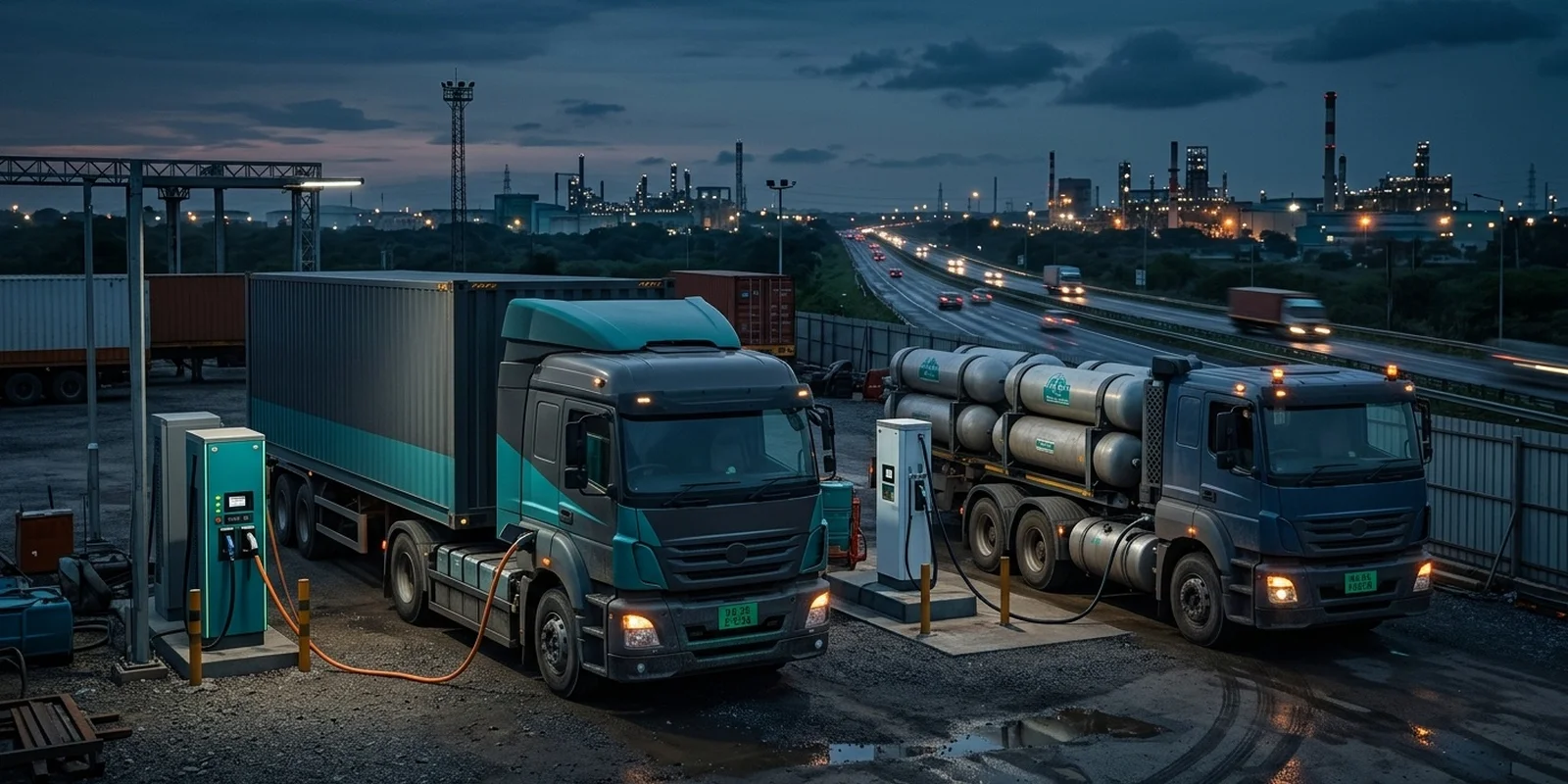
LNG Truck Or Electric Truck? Let Your Lanes Decide
💡 LNG Truck Vs Electric Truck: Key Highlights
- Per unit of energy, LNG is about 22% cheaper than diesel. PNGRB’s December 2025 price build-up puts LNG at ₹85.80/kg and diesel at ₹87.35/litre at the pump.
- Electricity is cheaper again per km. In our illustrative 42-tonne scenario, energy costs about ₹35.5/km on diesel, roughly ₹27.6/km on LNG and about ₹11.9/km on electricity at ₹7/kWh.
- An electric truck costs much more to buy. ICCT’s cost model puts a 705 kWh battery for a 42-tonne e-truck at about ₹1.38 crore.
- Infrastructure is thin for both. India had 39 LNG retail outlets in January 2026. Most heavy e-trucks still charge at depots.
- Lane fit decides it. Fixed, return-to-base shuttles favour electric. Long, unpredictable routes favour LNG, wherever the corridor has a working LNG station.
An LNG truck and a battery-electric truck both promise to cut a heavy-freight fleet’s diesel bill, but they win on different lanes. This guide is for owners and fleet heads of N3 heavy-duty fleets (28 to 55 tonnes) running intercity freight and port, mine and plant routes. If you run light commercial vehicles, read our CNG vs EV comparison for light commercial fleets instead.
Treating the choice as a straight contest misses the point. LNG (liquefied natural gas, stored at about −160°C in insulated tanks) is a diesel-replacement play. It keeps diesel-like range for long, unpredictable routes. Battery-electric trucks deliver the lowest running cost wherever charging is certain, which usually means fixed, shuttle-like lanes that return to base. So the real question is which lanes your fleet actually runs.
LNG Truck Vs Electric Truck: The Per-Km Economics
Start with energy cost per kilometre, the line that decides most heavy-truck business cases. Pump prices alone mislead, because LNG is sold per kilogram, diesel per litre and electricity per kWh, and each carries a different amount of energy.
Fuel and energy prices, from sources
The Petroleum and Natural Gas Regulatory Board (PNGRB) published a bottom-up price build-up in its December 2025 paper on LNG in transport. It worked out an end-consumer price of ₹85.80/kg for LNG and ₹87.35/litre for diesel. On an energy basis, that is about ₹1,863 per MMBTU for LNG against ₹2,390 for diesel, or roughly 22% cheaper. PNGRB’s calculation assumes imported LNG at $10.6/MMBTU and Uttar Pradesh VAT, so the price at your pump will differ.
For electricity, ICCT’s 2024 study of electric truck costs in India cites the Bureau of Energy Efficiency’s state-wise EV tariffs, which range from ₹4 to ₹9 per kWh. ICCT used ₹7/kWh as its base case, and so do we. Swap in the rate from your own state’s tariff order.
An illustrative 42-tonne scenario
ICCT simulated a 42-tonne rigid truck on a 450 km-a-day Kolkata–Ranchi run. The diesel version used 40.6 litres per 100 km. The battery-electric version used 1.61 kWh/km at the battery, which comes to about 1.69 kWh/km at the meter once you allow ICCT’s 95% charger efficiency. No equivalent public figure exists for an Indian LNG truck, so we assume it needs the same energy per km as diesel. That flatters LNG, since a gas engine can need more energy than the diesel it replaces.
| Powertrain | How it is calculated | ₹ per km | ₹ per year (135,000 km) |
|---|---|---|---|
| Diesel | 40.6 L/100 km × ₹87.35/L | ₹35.5 | ₹47.9 lakh |
| LNG (energy parity with diesel) | Diesel cost × (₹1,863 ÷ ₹2,390 per MMBTU) | ₹27.6 | ₹37.3 lakh |
| LNG (needs 10% more energy than diesel) | Sensitivity case | ₹30.4 | ₹41.1 lakh |
| Electric at ₹7/kWh | 1.69 kWh/km at the meter × ₹7 | ₹11.9 | ₹16.0 lakh |
| Electric at ₹9/kWh | Top of the BEE tariff range | ₹15.3 | ₹20.6 lakh |
On these assumptions, an electric truck saves about ₹21 lakh a year in energy over an LNG truck at ₹7/kWh, and about ₹32 lakh over diesel. That gap is real, but the electric truck has to pay back a much higher purchase price.
The purchase-price premium
ICCT’s cost model sized a 42-tonne e-truck for that 450 km day with a 705 kWh battery. At ₹19,546/kWh, the battery alone comes to about ₹1.38 crore, and the modelled ex-showroom price is about ₹2.76 crore at 2023 costs. Shorter lanes need smaller batteries, so the premium falls sharply as daily distance falls. That is why lane length matters more than any other single number in this decision. LNG trucks also cost more than diesel, mainly because of the cryogenic tanks, but no public price for an Indian model was available when we checked.
Lane Fit: Which Routes Suit Each Truck
Four lane characteristics decide most cases: daily distance, how certain the truck is to return to base, how sensitive the cargo is to payload, and how long the truck sits still at loading points.
| Lane type | Daily pattern | Usually fits | Why |
|---|---|---|---|
| Plant, port or mine shuttle | Under 250 km, fixed, back to base | Electric | Depot charging overnight and during loading dwell; a smaller battery keeps the premium down |
| Fixed hub-to-hub intercity | 250–450 km, same depots each day | Electric if both ends can charge; otherwise LNG | Needs charging at both depots, or an LNG station on the route |
| Open long-haul network | 600 km+, destinations change | LNG (or diesel for now) | Range matters most; only works where the corridor has an LNG outlet |
| Weigh-out bulk (cement, steel, coal) | Any distance | Check payload first | ICCT estimates a 20% payload penalty for a 42-tonne e-truck vs diesel |
Payload deserves a closer look. ICCT found the battery’s weight costs a 42-tonne e-truck about 20% of its payload against diesel, falling to 13% if regulators relax gross vehicle weight by 2 tonnes for electric trucks. Lose a fifth of every load on a cement or coal run and you need more trips to move the same tonnage, which eats the energy saving. Volume-limited cargo, which fills the truck before it hits the weight limit, barely notices.
Range sits on the other side of the ledger. Blue Energy Motors lists its LNG heavy-duty truck at up to 1,400 km of range at 55 tonnes gross combination weight, a manufacturer figure. The same company also builds an electric heavy-duty truck with battery swapping, which tells you how one OEM reads the market: different lanes, different powertrains. Tata Motors also lists LNG trucks in its heavy range. For electric model choice, see our guide to the best electric trucks for fleet operators in India.
Fuelling And Charging Infrastructure In 2026
LNG stations
India had 39 LNG retail outlets in January 2026, according to Truck Bus India: 11 run by Indian Oil and 8 by Ultra Gas & Energy. Some had temporarily shut for lack of customers, and state-run refiners planned to pause new outlets in 2026 until existing ones carry more trucks. The same report puts the economics plainly. An outlet needs 20 to 30 regular trucks making 10 to 15 fillings a day to be viable, and India had about 1,309 LNG trucks at the end of 2025, up 75% from 747 in 2024. Policy Circle reported in April 2025 that Indian Oil had shut five of its six LNG stations for lack of business.
Fuel supply is not the constraint; station density on your corridor is. Since a 2020 PNGRB clarification, any entity can set up an LNG station anywhere in the country, and PNGRB now maps small-scale LNG stations on its NHIMS portal, which makes route planning easier.
E-truck charging
Electric trucks are at a similar stage. NITI Aayog Member Rajiv Gauba said in September 2026 that only around 800 heavy-duty electric trucks were sold in 2025, according to Business Today, with more than 3,000 medium and heavy e-trucks estimated to be operating. No national count of truck-capable public chargers is published. In practice, today’s heavy e-trucks charge at their own depots and plants, or swap batteries. NITI Aayog’s new freight-demand platform is meant to plan charging corridor by corridor, as we covered in our report on electric heavy-duty truck deployment and PACT.
The practical difference is who controls the infrastructure. A depot charger is yours to install, schedule and maintain. An LNG truck depends on a third-party outlet staying open on your route. On a fixed shuttle, depot charging removes that dependency. On an open network, LNG’s longer range per fill does the same job.
Policy, Emissions And Residual-Value Risk
Incentives. Electric N2 and N3 trucks now qualify for a purchase incentive under PM E-DRIVE, subject to conditions. Our PM E-DRIVE guide for fleets covers the amounts and eligibility. No equivalent central purchase incentive for LNG trucks was in force when we checked; PNGRB’s paper notes that lenders have been slow to finance LNG vehicles.
Emissions. PNGRB says LNG emits roughly 15–30% less CO₂ than diesel on a well-to-wheel basis and cuts particulates by over 90%. ICCT’s life-cycle analysis of Indian heavy vehicles is more cautious once methane leakage is counted, finding that natural gas trucks provide “at best, modest” greenhouse-gas savings over diesel. For battery-electric trucks, ICCT estimates life-cycle emissions 17–29% lower than diesel on today’s grid, and 78–83% lower on dedicated renewable power. The difference can matter when a shipper scores freight emissions in its tenders.
Price volatility. LNG is largely imported, and PNGRB’s own calculation prices it off Brent-linked import contracts. A crude or spot-gas spike flows through to the pump. Electricity tariffs are set by state regulators and usually revised once a year, which makes an e-truck’s energy cost easier to forecast over a 7-year ownership period.
Residual value. Both are uncertain. With about 1,300 LNG trucks on the road, the second-hand market is thin. For e-trucks, battery health drives resale, and MoRTH Secretary V Umashankar has argued that battery-health transparency would improve resale values and lower financing risk. A fleet that records state of health from day one is in a stronger position at exit.
Hydrogen fuel-cell trucks are the longer-horizon option for the heaviest, longest lanes, but they are still at the pilot stage in India. Our sister site covers the green hydrogen vehicles pilot running buses and trucks.
How To Decide, Lane By Lane
Most heavy fleets will end up running both, with each powertrain on the lanes it suits. A sensible sequence:
- Classify every lane by daily km, return-to-base certainty, payload sensitivity and dwell time, using the table above.
- Put your own numbers into the per-km scenario. Use your state’s EV tariff, your negotiated LNG price and your real diesel consumption.
- Pilot electric on the shortest fixed shuttle first. That lane needs the smallest battery and the lowest premium.
- Check LNG station uptime on long-haul corridors before committing a fleet, not just station locations.
- Measure from day one. Track energy cost per km, charging sessions and utilisation per vehicle, so the second order is based on data.
For the electric side, charging management across depots and public networks and fleet analytics on cost per km are what turn a pilot into a business case. YoMobility’s EV-FMS brings vehicles, drivers, charging and payments into one dashboard, with one consolidated invoice for charging across networks.
Frequently Asked Questions
Usually, yes. PNGRB’s December 2025 build-up priced LNG at ₹85.80/kg and diesel at ₹87.35/litre, which makes LNG about 22% cheaper per unit of energy. The real saving depends on your local LNG price and how efficient the gas engine is on your duty cycle.
It depends on tank size. Blue Energy Motors lists its LNG heavy-duty truck at up to 1,400 km at 55 tonnes gross combination weight. That is a manufacturer figure, and real range falls with load, terrain and driving style.
India had 39 LNG retail outlets in January 2026, according to Truck Bus India, with 11 run by Indian Oil and 8 by Ultra Gas & Energy. Some were temporarily shut for lack of demand, so check that a station is open before you plan a route around it.
On energy, yes. In our illustrative 42-tonne scenario, electricity at ₹7/kWh costs about ₹11.9/km, against about ₹27.6/km for LNG. The electric truck costs far more to buy, though, so it pays back fastest on fixed, return-to-base lanes where a smaller battery is enough.
They cut particulates sharply: PNGRB cites reductions of over 90% against diesel. On greenhouse gases the evidence is mixed: PNGRB cites 15–30% lower CO₂ well-to-wheel, while ICCT finds only modest savings once methane leakage is counted. Battery-electric trucks show larger life-cycle reductions, especially on renewable power.
Sources: PNGRB — An Opportunity for LNG in Transport Sector (Dec 2025) | ICCT — TCO parity between battery electric and diesel trucks in India (Aug 2024) | ICCT — Life-cycle GHG emissions of heavy-duty vehicles in India (May 2024) | Truck Bus India — India’s LNG trucks and fuel market slows (Jan 2026) | Business Today — NITI Aayog launches platforms to scale up electric truck adoption (Sep 2026) | Policy Circle — India may offer cheaper natural gas to revive LNG trucks (Apr 2025) | Blue Energy Motors — LNG heavy-duty truck | Tata Motors — LNG trucks
Manage Your Fleet’s Heavy-Truck Electrification Today
Track energy cost per km, charging sessions and utilisation for every e-truck, across depots and charging networks, with one consolidated invoice.
Book a Free DemoYoMobility EV-FMS
EV fleet management softwareRun every vehicle, driver, charge and payment from one platform. Charge on multiple networks, and get one invoice for all of it.
Resources
Keep reading
ISO 14001 For Logistics And Transport Companies: What The Standard Asks Of Your Fleet
💡 ISO 14001 For Transport Fleets: Key Highlights This guide is for EHS, quality and sustainability leads at 3PLs, transporters […]
LFP Vs NMC Batteries For Commercial EV Fleets: Which Chemistry To Specify In Your Next Order
💡 LFP vs NMC For Fleets: Summary If you buy commercial EVs for a living, the LFP vs NMC question […]
Diesel Theft Ends When You Electrify — And The New Energy Leakage That Replaces It
💡 Diesel Theft vs EV Energy Leakage: Key Highlights If you searched for how to stop diesel theft, here is […]
See YoMobility on your fleet
Tell us how many vehicles you run and where they charge. We'll show you how they'd run on one platform, with one invoice.
Or contact us