
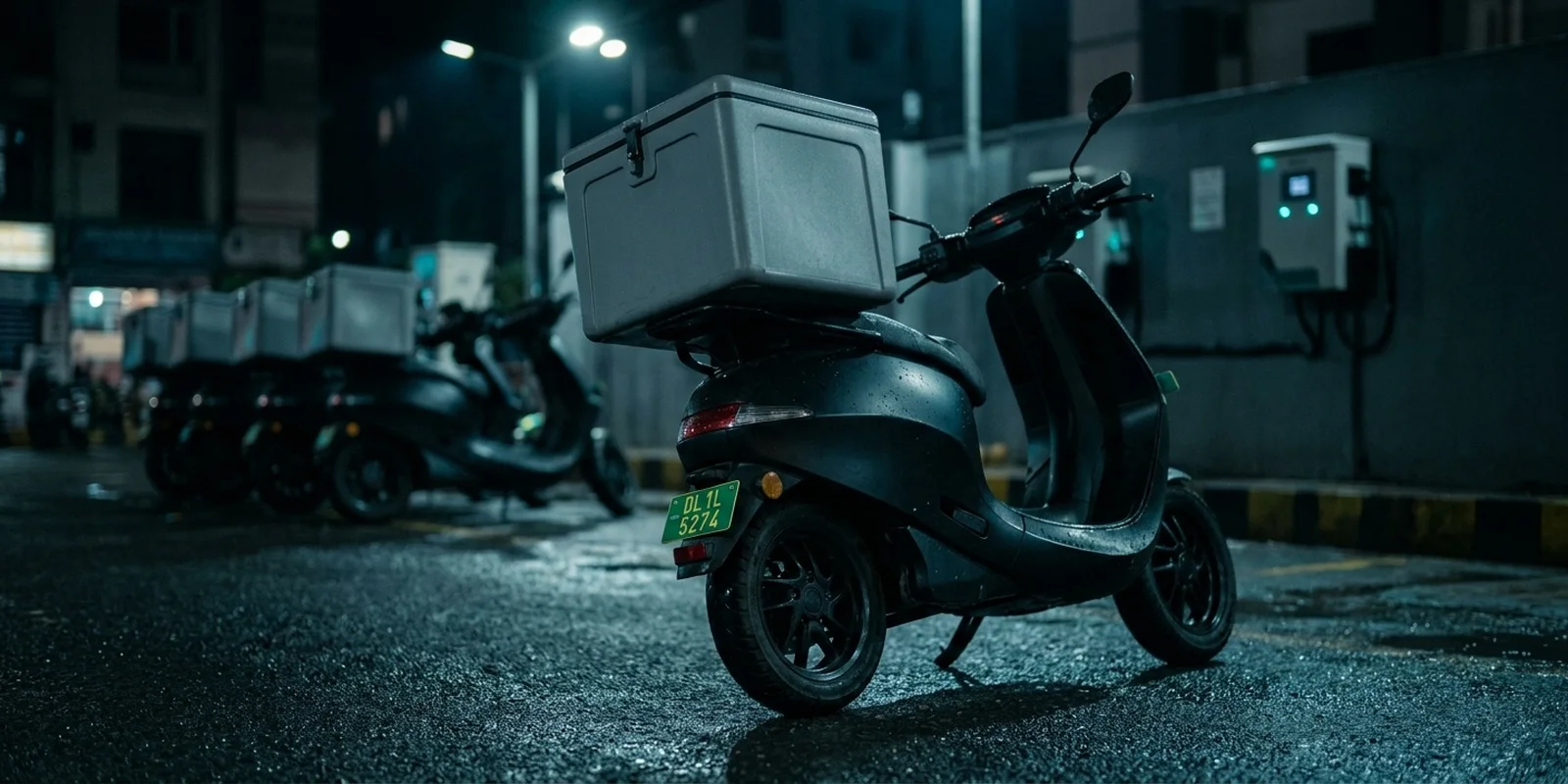
Picking Delivery Scooters That Last A Full Rider Shift
💡 Electric Scooter For Delivery Fleets: Summary
- A delivery scooter works about 3.7x harder than a commuter’s. ICCT models delivery at 115 km a day over a 12-hour shift, 317 days a year: about 36,500 km, against about 10,000 km for personal use.
- Specify range as orders per charge on your routes. The IDC figure on the brochure is a test-cycle number, not a loaded, stop-start, monsoon number.
- Let shift structure decide charge or swap. One shift with a depot dwell suits plug-in. Two or three shifts on one vehicle is where swapping earns its higher energy price.
- Read the warranty in kilometres. At 36,500 km a year, a 3-year/50,000 km battery warranty runs out in about 16 months. A 30,000 km cap runs out in about 10.
- PM E-DRIVE still pays on e-2Ws: ₹2,500/kWh, capped at ₹5,000 per vehicle, for registered scooters up to ₹1.5 lakh ex-factory, until 31 March 2028 or until the fund runs out.
An electric scooter for delivery and an electric scooter for commuting are usually the same product. They are used in two incompatible ways. A commuter rides about 25 km and charges overnight. A delivery fleet runs two or three rider shifts on one vehicle, loaded, in traffic, with no tolerance for a battery that dies mid-shift. Almost every spec that matters follows from that difference, and almost none of it is on the brochure.
The gap is large. The ICCT’s two-wheeler cost study models last-mile delivery at 115 km a day over a 12-hour working day, 317 days a year. That is about 36,500 km a year. Its personal-use case is 37 km a day on 269 days, or about 10,000 km. A delivery scooter does roughly 3.7 years of commuting every year.
This guide is for last-mile operators running rider fleets: quick-commerce, food-delivery and courier businesses, plus the e-2W rental and leasing companies that supply their riders. We covered how these fleets actually run in our hyperlocal delivery duty-cycle analysis. This post is the buying side: what to specify before you sign for 50 or 500 scooters. If your loads have outgrown a scooter box, the next size up is the electric 3-wheeler cargo vehicle.
Usable Range: Specify An Electric Scooter For Delivery In Orders, Not Kilometres
The range on a scooter brochure is an IDC figure, measured on the Indian Driving Cycle. It is useful for comparing models and useless for planning a delivery shift. Four predictable things pull delivery range below it.
- Load. A rider plus a full box weighs much more than a test rider.
- Stop-start riding. Fifteen to twenty pickups and drops a shift means repeated hard acceleration from standstill.
- Speed modes and weather. Riders under SLA pressure use the fastest mode. Monsoon water and heat both cost range.
- The usable window. No fleet runs a pack from 100% to 0%. If riders return at 15% and top up to 90%, they use only 75% of the pack each cycle.
Here is how that plays out on a real spec sheet. TVS lists the iQube 3.5 kWh at 145 km of IDC range. Many fleet teams start planning at around 65% of IDC under delivery load. That is an assumption, and your pilot should replace it. It gives about 94 km. Inside a 90%-to-15% window, that leaves about 71 km per charge. Against ICCT’s 115 km delivery day, the scooter needs at least one top-up every shift. Plan for that from day one.
Better still, stop specifying kilometres at all. Specify orders per charge on your routes. If an average order on your network is a 5 km round trip, 71 usable km is about 14 orders. That is the number a dispatcher can plan a shift around. The way to get it is a two-week pilot. Run three to five candidate models on live routes and log energy used per order, not per km.
That pilot needs EV vehicle tracking with state-of-charge data, not rider estimates. The same data later shows when a pack’s orders per charge starts falling.
| Model (as listed by the OEM) | Battery | IDC range | Charge time listed | Battery warranty listed |
|---|---|---|---|---|
| TVS iQube 2.3 kWh | 2.3 kWh | 114 km | 10–80% in 2 h 25 min | 3 years / 50,000 km |
| TVS iQube 3.5 kWh | 3.5 kWh | 145 km | 10–80% in 3 h 45 min | 3 years / 50,000 km |
| TVS iQube S 4.7 kWh | 4.7 kWh | 175 km | 10–80% in 3 h 15 min | 3 years / 50,000 km |
| Ather Rizta | Not stated on page | 123 km / 161 km | Fast-charge claim only | 3 years / 30,000 km standard |
Charge Or Swap: Let Your Shift Structure Decide
Turnaround is the second spec, and it matters as much as range. The listed 10–80% charge times above run from about 2.5 to almost 4 hours on a standard charger. A swap takes minutes. The real question is whether your fleet can use the hours a swap saves.
The ICCT study puts numbers on that. In its 2021 analysis, swapping cost 23–36% more over five years than plug-in charging for a delivery scooter. The main reason was energy price: about ₹34 per kWh through a swap network against ₹13.7 for plug-in charging. The gap narrowed as daily distance rose, though. In the 150 km-a-day ride-hailing case, swapping was the cheapest option of all. The 2021 prices are dated; the logic is not.
- One shift a day, with a depot or dark-store dwell: plug-in charging. The scooter sits idle anyway, and the energy is cheaper.
- Two or three shifts on one scooter: swapping, or spare packs charged off the vehicle. Every hour on a charger is an hour with no orders.
- Mixed fleets: split by shift pattern, not by model preference.
We set out the full decision framework, including battery ownership and swap-network lock-in, in battery swapping vs plug-in charging. For the network side of the market, sister site YoCharge maps the two-wheeler EV charging station networks. Decide before you order: a fixed-battery scooter cannot join a swap network later.
What To Write Into An Electric Scooter For Delivery Purchase Order
The purchase order is your one point of leverage over the OEM. These four lines are most often left to the brochure.
Payload and carrier mounting
Ask for the rated payload, and for a carrier and box mount approved by the OEM. A welded-on aftermarket rack can void the frame warranty, and an overloaded rear suspension wears fast. Check where the box sits against the charging port and any swap compartment. Riders should not have to unload to charge.
IP rating and monsoon exposure
TVS rates its iQube battery packs at IP67, which means dust-tight and protected against short immersion. Ask for the rating on the pack, the motor and the connectors, not only the pack. A delivery scooter rides through waterlogged streets every monsoon. Pair this with the cell and pack safety evidence covered in our AIS 156 battery safety guide.
Battery warranty in kilometres or cycles, not years
This is where commuter terms fail a fleet most clearly. TVS lists 3 years/50,000 km on the iQube battery. Ather lists 3 years/30,000 km as standard on the Rizta, with longer optional cover. At ICCT’s 36,500 km a year, the 50,000 km cap is used up in about 16 months and the 30,000 km cap in about 10. The “3 years” never applies. Negotiate cover in cycles or kilometres sized to your duty cycle, with a stated state-of-health floor. Then track pack health so you can enforce it; our battery state of health guide explains what to measure.
Telematics and API access
A scooter you cannot read is a scooter you merely own. Specify an onboard telematics unit and open API access to location, state of charge, faults and trip data. Without them, you cannot run the pilot above, enforce the warranty or catch a failing pack. That data feeds YoMobility’s fleet management platform, and the driver mobile app ties each shift, charge and swap to the rider who took it.
Service Reach And Spares Decide Your Uptime
A delivery scooter that is down for a week loses every order it would have carried. For a scooter doing two shifts of about 14 orders per charge, that is roughly 200 orders a week. In practice, e-2W fleets that disappoint usually have a parts problem, not a battery problem: a controller fault that takes days to fix in a city the OEM covers poorly.
- Map service reach before you choose a model. Count authorised service points in each city you operate in, not nationally.
- Put a parts SLA in the contract, with a turnaround time for the parts that fail most often: controllers, chargers, tyres and brake parts.
- Hold a standby pool. Size it from your pilot’s failure rate, not a rule of thumb, and rotate scooters through it so its batteries age at the same rate.
- Ask for diagnostic access so your technicians can read fault codes before a scooter goes to the workshop.
For the wider servicing picture, including preventive schedules, see our EV fleet maintenance guide.
Buy, Lease Or Rent Per Rider
The last decision is who owns the scooter, and rider churn drives it. NITI Aayog counted 7.7 million gig workers in 2020-21 and projected 23.5 million by 2029-30. Riders join fast, move between platforms and leave. An owned scooter whose rider has left earns nothing.
- Buy when you control rider assignment and can keep every scooter on the road. Ownership gives the lowest cost per km only at high utilisation.
- Lease when you want fleet control without the residual-value risk. The trade-offs are in our EV fleet leasing vs buying analysis.
- Rent per rider when churn is high and riders already bring their own vehicles. You hold no idle assets, but you also get the least data and control.
If you buy, PM E-DRIVE still helps. Registered e-2Ws earn ₹2,500 per kWh, capped at ₹5,000 a vehicle, if the scooter costs up to ₹1.5 lakh ex-factory. The scheme site confirms that the e-2W terminal date has moved to 31 March 2028, under an amendment notification dated 10 August 2026. On a 50-scooter order, that is at most ₹2.5 lakh. Welcome, but fund-limited; it should not drive the model choice. Our PM E-DRIVE scheme guide for fleets covers the claim deadlines.
Whichever model you pick, measure two numbers: orders per scooter per day, and the share of scooters available at the start of peak. They will tell you more than any spec sheet.
Frequently Asked Questions
Sources: ICCT, Cost of battery swapping, point charging and ICE two-wheelers in India (Working Paper 2021-38) | NITI Aayog, India’s Booming Gig and Platform Economy (2022) | PIB factsheet, PM E-DRIVE Scheme | Ministry of Heavy Industries, PM E-DRIVE portal | TVS Motor, iQube specifications | Ather Energy, Rizta specifications
Manage Your Delivery Scooter Fleet Today
Run your scooter pilot on real data: state of charge, energy per order, faults and rider assignment for every vehicle, in one dashboard. We can set it up with you in one call.
What happens next ?
Review of your routes, shifts and current scooter mix
Pilot plan to measure orders per charge by model
Charge-versus-swap cost model for your shift pattern
Rollout support for telematics, rider app and reporting