
India’s Electric Water Metro Is Already Sailing
💡 Electric Water Metro India: Key Highlights
- 4 hybrid-electric vessels are already in commercial service — Varanasi, Ayodhya, Patna and Kolkata — plus India’s first hydrogen fuel-cell passenger vessel, also in Varanasi.
- MoPSW is formulating National Water Metro Guidelines, 2026 to standardize safety, financing and zero/low-emission technical norms for water transport nationwide.
- IWAI has completed feasibility studies for 15 of 18 identified Urban Water Metro locations, including Guwahati, Srinagar, Prayagraj, Tezpur and Dibrugarh.
- The hydrogen vessel is a 24-metre catamaran carrying 50 passengers up to 8 hours per hydrogen fill — built by Cochin Shipyard, the same yard behind the Kochi Water Metro.
- Kochi’s own hybrid-electric ferry network has carried over 40 lakh (4 million) passengers since 2023 — the working model this national rollout is scaling up.
India’s push to electrify public transport has mostly meant roads so far — electric buses in city fleets, electric 3-wheelers threading last-mile routes, e-rickshaws swapping fuel tanks for battery packs. A quieter parallel track is now underway on India’s rivers. An electric water metro is no longer a line in a ministry presentation: 4 hybrid-electric vessels are already ferrying passengers in Varanasi, Ayodhya, Patna and Kolkata, alongside India’s first hydrogen fuel-cell passenger vessel — also in Varanasi. Behind them sits a bigger plan: National Water Metro Guidelines, 2026, and feasibility studies for urban water-metro systems at 18 locations nationwide, 15 of which are already complete.
What’s Already Sailing In India’s Electric Water Metro Rollout
The headline number here isn’t a target — it’s a fleet already on the water. India’s electric water metro push has real hardware in revenue service today: since January 2024, the Inland Waterways Authority of India (IWAI), an autonomous body under the Ministry of Ports, Shipping and Waterways (MoPSW), has put 4 hybrid-electric catamarans into commercial service on the Ganga and connected stretches: Varanasi, Ayodhya, Patna and Kolkata. The vessels were built by Hooghly Cochin Shipyard Limited and are operated by Inland and Coastal Shipping Limited (ICSL), a Shipping Corporation of India subsidiary. Four more hybrid-electric vessels are in the pipeline, and IWAI has separately contracted a Knowledge Shipyard-led consortium to build 10 additional hybrid-electric ferries — this is a fleet program, not a one-off pilot.
India’s First Hydrogen Fuel-Cell Passenger Vessel
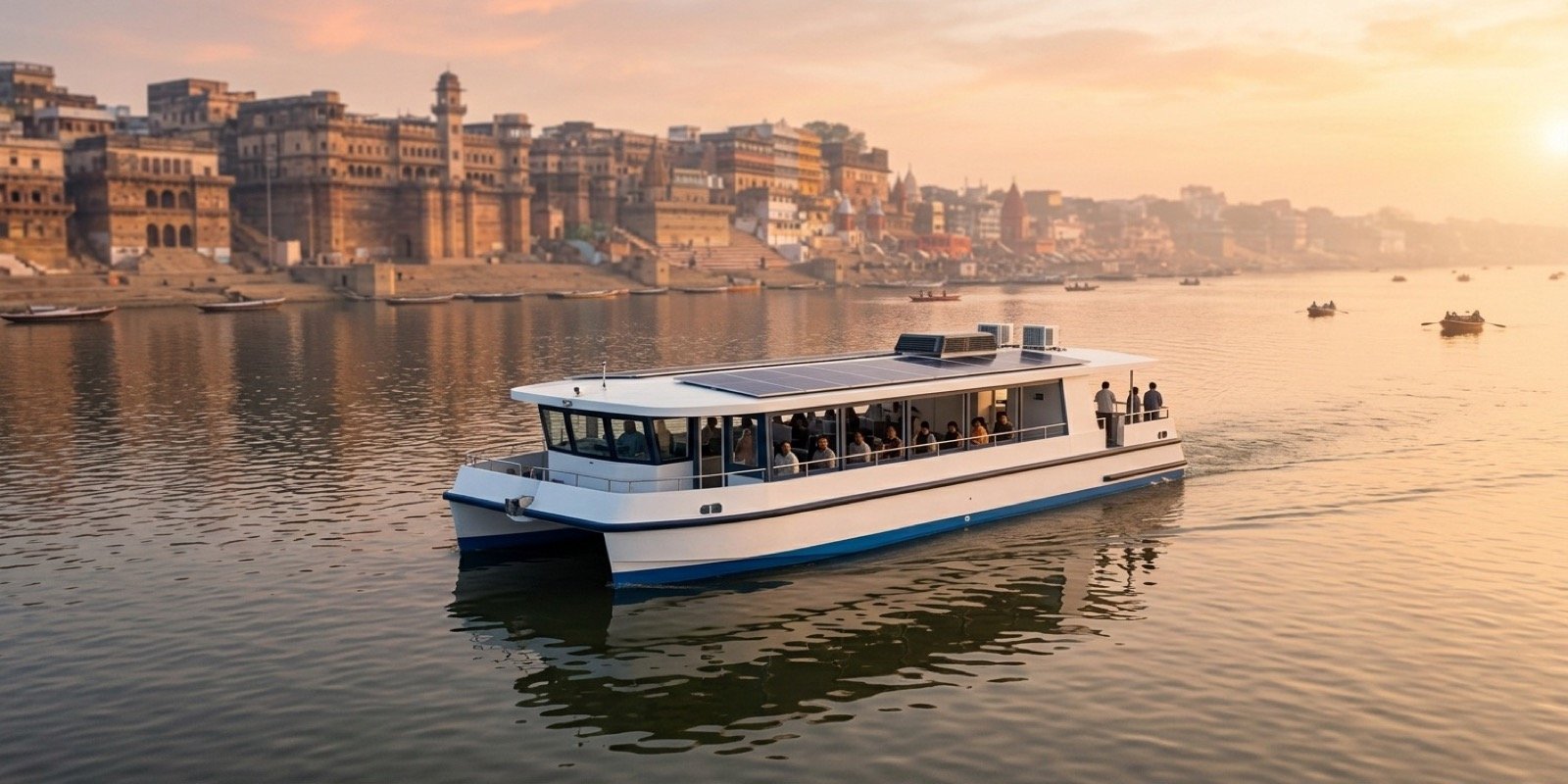
Varanasi also hosts something more novel: India’s first indigenous hydrogen fuel-cell passenger vessel, built by Cochin Shipyard Limited and flagged off from Namo Ghat by Union Minister of Ports, Shipping and Waterways Sarbananda Sonowal. It’s a 24-metre catamaran carrying up to 50 passengers in an air-conditioned cabin at a service speed of 6.5 knots, running on a low-temperature proton-exchange-membrane (PEM) fuel cell that converts stored hydrogen into electricity — water vapour is the only byproduct. A hybrid system combining the fuel cell, batteries and rooftop solar panels gives it up to 8 hours of operation per hydrogen fill, with zero noise and zero tailpipe emissions on one of India’s most heavily used river stretches.
Why Water Transport Electrification Matters Where It Already Exists
Varanasi and Kolkata didn’t need new water routes built — the rivers were already there, already carrying pilgrims, commuters and tourists on diesel launches and rowboats. That’s the practical case for electrifying water transport before building it from scratch elsewhere: dense, congested river cities can move people on water routes that bypass road traffic entirely, without adding a single vehicle’s worth of tailpipe emissions to air quality that’s already under pressure. A hybrid-electric or hydrogen ferry running the same commute produces no local exhaust at all.
This isn’t a hypothetical case study, either — Kochi got there first. The Kochi Water Metro, built by the same Cochin Shipyard on the same hybrid-electric template at a bigger scale, has carried more than 40 lakh (4 million) passengers since it opened in 2023, connecting 10 islands to the mainland, and is described as the largest electric-boat metro system built anywhere in the world. That’s the proof of concept the national rollout is now trying to replicate at speed.
A Second Hydrogen Bet, Alongside India’s Hydrogen Trains
The Varanasi hydrogen vessel isn’t India’s only hydrogen-transport experiment running in parallel. In July 2026, India flagged off its first hydrogen fuel-cell train on the 89-km Jind–Sonipat corridor in Haryana — a 10-coach, 2,600-passenger train running on two 1,200 kW proton-exchange-membrane fuel cells paired with lithium-iron-phosphate batteries. Together, the two projects show India testing hydrogen mobility on rail and water at the same time — both building the hydrogen storage, refuelling and handling infrastructure that any future scale-up depends on more than the vehicles themselves.
The Bigger Plan: National Water Metro Guidelines And 18 Feasibility Studies
What’s sailing today is the visible part of a much larger plan behind India’s electric water metro ambitions. In a Lok Sabha written reply, Union Minister Sarbananda Sonowal confirmed that MoPSW is formulating National Water Metro Guidelines, 2026 — a framework meant to standardize how India plans, builds and regulates urban water transport nationwide. The guidelines cover a zero/low-emission technical framework for vessels, standardization requirements, financing structures, environmental safety, and coordination across the ministries and states that any water-metro project inevitably touches.
Behind the guidelines, IWAI has already completed feasibility studies for 15 of 18 identified Urban Water Metro locations, assessing technical viability, infrastructure needs, and the operational case for water-based transit in each city. Reported Phase I cities include Guwahati, Srinagar, Patna, Varanasi, Ayodhya and Prayagraj, with Tezpur and Dibrugarh in Assam proposed for Phase II — a spread running from the Ganga to the Brahmaputra to the Jhelum.
Early But Real: What Stage This Is Actually At
It’s worth being precise about where this program sits today. 15 of 18 feasibility studies being complete is a planning milestone, not an investment decision — it tells a state or city that a water metro is technically viable, not that funding, vessels and terminals are locked in. The National Water Metro Guidelines are still being formulated, not notified; there’s no single rulebook yet governing how a new city joins this program. And the vessels actually in revenue service today number five, across four cities — a real, working fleet, but still a small one next to the scale of India’s e-bus and e-rickshaw rollouts.
That combination — genuine hardware already carrying paying passengers, plus a much larger planning pipeline behind it — is a fair description of where India’s water-transport electrification stands: early, but no longer speculative.
What It Means
Road transport dominates how most fleet operators think about India’s electrification story, because that’s where the vehicle counts, the incentive schemes and the headlines have mostly been. India’s electric water metro push is a reminder that the strategy is broader: river and coastal cities carry their own decarbonisation lever, running on infrastructure that, in places like Varanasi and Kolkata, already exists. For an AI-powered fleet operating system built to track every mode of India’s fleet electrification as it happens — from e-rickshaws to e-buses to now hybrid-electric and hydrogen vessels — that’s simply one more mode worth watching as the guidelines get notified and the next tranche of feasibility studies clears.
Frequently Asked Questions
It’s a framework the Ministry of Ports, Shipping and Waterways is formulating to standardize how India plans, builds and safely runs urban water transport — covering a zero/low-emission technical framework for vessels, financing structures, and coordination between the central and state agencies involved. As of the latest Lok Sabha update, the guidelines are still being drafted, not notified.
Four hybrid-electric catamarans are already in commercial service — in Varanasi, Ayodhya, Patna and Kolkata — built by Hooghly Cochin Shipyard Limited and operated by Inland and Coastal Shipping Limited. Four more are in the pipeline, and IWAI has separately contracted a consortium for 10 additional hybrid-electric ferries.
It runs on a low-temperature PEM hydrogen fuel cell rather than grid-charged batteries alone — a 24-metre catamaran carrying 50 passengers up to 8 hours per hydrogen fill, combining the fuel cell with batteries and rooftop solar. It’s India’s first indigenous hydrogen fuel-cell passenger vessel, built by Cochin Shipyard.
IWAI has completed feasibility studies for 15 of 18 identified locations. Reported Phase I cities include Guwahati, Srinagar, Patna, Varanasi, Ayodhya and Prayagraj, with Tezpur and Dibrugarh proposed for Phase II.
Not fully. The guidelines governing the program are still being formulated, and while 15 of 18 feasibility studies are complete, that’s a planning milestone rather than a funded, approved rollout in every city. The hybrid-electric and hydrogen vessels already in service run under separate, earlier ministry initiatives.
Kochi is the working proof of concept. Built by the same Cochin Shipyard using the same hybrid-electric ferry model, it has carried more than 40 lakh passengers since 2023 and is described as the world’s largest electric-boat metro system — the template the national guidelines and 18-city feasibility pipeline are now trying to scale.
Tracking Every Mode Of India’s Fleet Electrification
From e-rickshaws to e-buses to hybrid-electric and hydrogen vessels, YoMobility’s AI-powered operating system is built to give fleet operators visibility as every layer of India’s transport electrification comes online.
Source: Lok Sabha reply on National Water Metro Guidelines, 2026 — Ministry of Ports, Shipping and Waterways, PIB, 1 Aug 2026 (PRID 2292400).