Green Logistics: How 3PLs Win Shipper Contracts With An Electric Fleet
By Shaurya Rathore7 min read
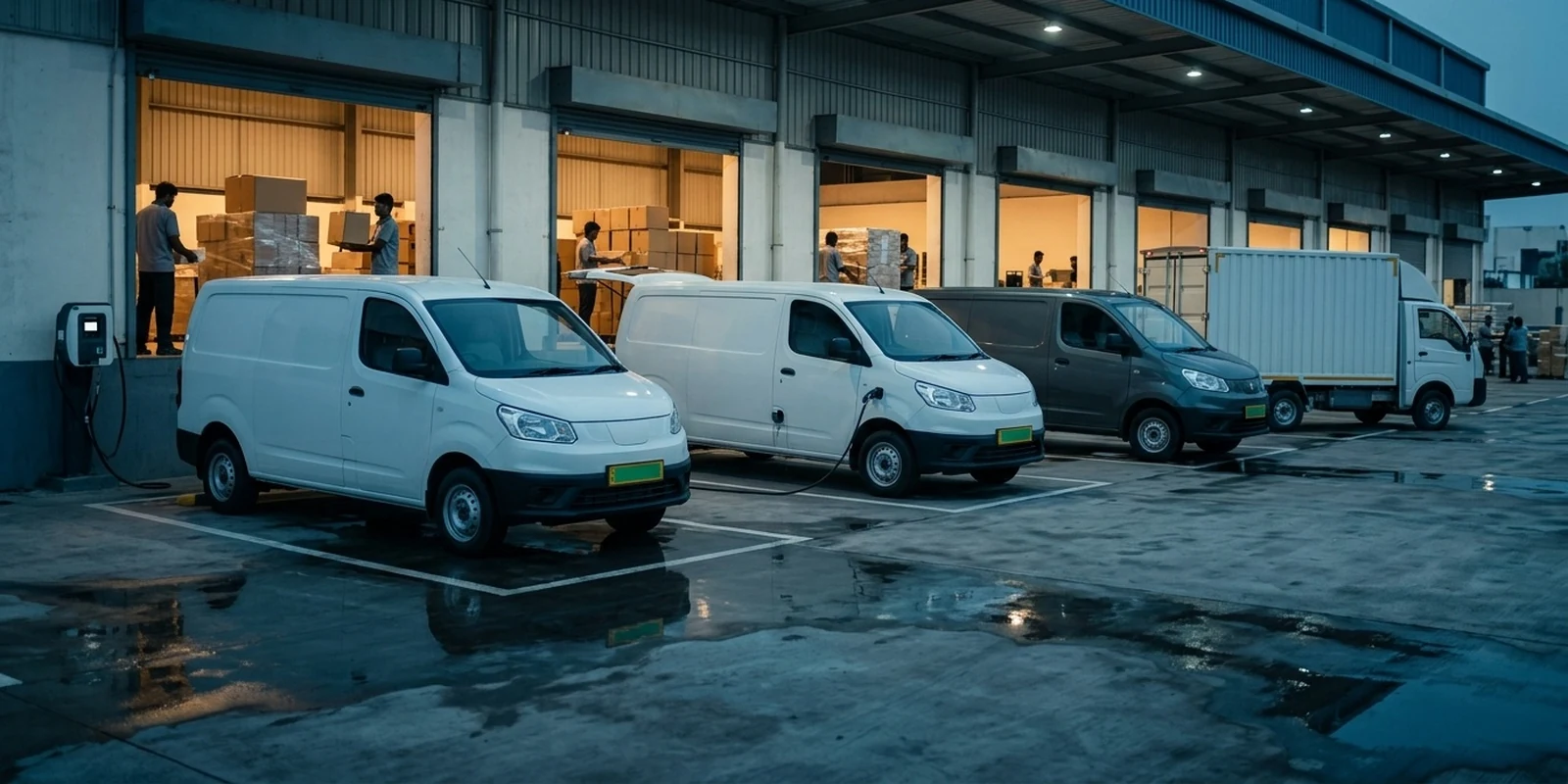
Green Logistics: Winning Shipper Contracts With An Electric Fleet
💡 Green Logistics: Key Highlights
- Supply-chain emissions run about 26× a company’s own operations (CDP) — hence the questionnaire on your desk.
- SEBI’s BRSR Core reaches value-chain partners worth 2%+ of a listed company’s purchases or sales.
- Procurement scores intensity per tonne-km or consignment under ISO 14083 / GLEC — not how many EVs you own.
- At India’s grid factor of 0.710 tCO₂/MWh (CEA, FY 2024-25) an electric van runs about 57% below diesel — not zero.
- The premium is thinning into a qualifier; the prize is multi-year committed volume, what makes the capex financeable.
Green logistics has moved out of the CSR deck and into the commercial terms of freight contracts. This is for the reader who feels that shift as revenue — the commercial lead at a 3PL, a dedicated-fleet contractor or a last-mile operator bidding for shipper business in India. Not the officer who writes the sustainability report, but the person who answers question 14 of an RFP and prices it.
The mechanism is not environmental, and seeing that is the advantage. Your customer’s disclosure obligations now reach into your depot: their freight emissions are their Scope 3, and you hold the only data that substantiates the number. That makes an electric fleet a scored line item — if you can produce evidence procurement and its auditor will accept.
Why Carbon Entered Logistics RFPs
A shipper’s own offices and plants are a rounding error next to its supply chain — CDP puts corporate supply-chain emissions at around 26 times operational emissions. Transport is one of the few categories procurement can move alone: a company cannot redesign a supplier’s steel plant, but it can change who carries its pallets.
In India that pressure has a regulatory spine. SEBI’s BRSR Core extends reasonable assurance to the top 1,000 listed entities by FY 2026-27, and its value-chain disclosures cover partners contributing at least 2% of purchases or sales by value, with limited assurance on a comply-or-explain basis from FY 2025-26. Most 3PLs meet it as a contract clause, not a notice — a data-provision obligation in the master service agreement and an emissions section in the tender. The scale explains the urgency: India’s freight sector emits over 200 million tonnes of CO₂ a year.
What A Shipper’s Procurement Team Actually Asks For
The most common bid-losing mistake is answering a question about intensity with a statistic about assets. “We operate 40 electric vehicles” is a fleet fact. A shipper needs a figure it can multiply by its own volumes, compare across three bidders and defend to an auditor — grams of CO₂e per tonne-kilometre, or per consignment on a lane. It also cares less about whose number is lowest than whether all three were built the same way — the ground our guide to generating sustainability reports from fleet data covers.
| What the RFP asks | Answer that loses | Answer that scores |
|---|---|---|
| Emissions per shipment on our lanes | Annual fleet-level tonnes | gCO₂e per tonne-km and per consignment, by lane |
| Which methodology? | “Internal calculation” | ISO 14083:2023 via the GLEC Framework, with boundary and allocation declared |
| Primary or default data? | Industry averages × vehicle counts | Metered energy and distance from your own vehicles; defaults only for gaps |
The Green Logistics Data Trap
A 3PL wins a shortlist place on an all-electric urban lane, then cannot answer the follow-up: how many kWh did those vehicles consume on our consignments last quarter? Registration certificates prove ownership — nothing about energy, distance or allocation, the three inputs behind any credible intensity figure.
Where the numbers have to come from
Two streams carry the entire claim. Distance and payload come from the vehicle, which is why EV fleet telematics specifications matter far more once emissions data is contractual than when tracking was only about ETAs. Energy comes from the charging side: session-level kWh, timestamped and attributed to a vehicle — depot, public or driver’s home. Reconciling the two into a per-lane figure is ordinary CO₂ tracking and fleet reporting work — but only if both were captured. Last quarter’s sessions cannot be reconstructed later.
Electric is lower, not zero
Overclaiming is the other way to fail diligence. Grid electricity carries a factor: the CEA’s weighted average for FY 2024-25 is 0.710 tCO₂/MWh. A small e-LCV covering 90 km a day at roughly 0.18 kWh/km draws 16.2 kWh — about 11.5 kg CO₂e per vehicle-day, or 96 g across 120 drops. Its diesel equivalent at 9 km/litre burns 10 litres, near 26.8 kg, or 223 g per consignment. A 57% reduction, not a zero. Evidence 57% and you are credible; say “zero-emission deliveries” and one assurance question later you are a risk. It improves without buying a vehicle, too — shift charging to a depot solar PPA or a cleaner off-peak window and the same kilometres carry less carbon, a lever the EV fleet ESG strategy conversation skips.
Turning Green Logistics Into Contract Advantage
Once the evidence exists, the question is what it is worth. Three structures are appearing in Indian tenders, and they pay very differently.
Green lane vs scored qualifier
On a green lane, the shipper ring-fences lanes or a city for a dedicated electric fleet because they sit inside a public commitment with a date attached. That is where a genuine premium exists — the shipper is buying a dated outcome, not a transport service. On mainstream urban parcel lanes it is a scored qualifier instead: enough points to separate two bidders whose rates sit within a rupee of each other, and increasingly a floor. A bidder who cannot supply the data is screened out before price is opened.
The real prize is tenure, not rate
Chasing a rate premium misreads where the money is. An electric fleet’s economics live in the utilisation of an asset you have already bought, so the decisive variable is contract length — the point our breakdown of EV fleet TCO in India keeps landing on. A three-to-five year committed-volume contract turns an unfinanceable capex request into a bankable one: the lender underwrites a receivable, not a hope. Trade a thinner rate for tenure and a minimum-volume guarantee — that is the deal shape that funds electrification.
Which Lanes To Electrify First
Sequencing is a commercial decision disguised as an engineering one. The lanes that work first are short and dense, with daily distance comfortably inside usable range at 80% state of charge; depot-returning, so charging is scheduled rather than opportunistic; and predictable enough that one overnight window covers the duty cycle. Urban last-mile and fixed-route distribution fit; long-haul trunk routes and irregular spot work do not — not yet.
The sanctioned-load question comes before the bid
The costliest mistake here is bidding an all-electric contract before the depot power exists. A load-sanction enhancement and transformer upgrade routinely takes months, on a DISCOM timeline you do not control. Establish sanctioned load and a realistic energisation date before the response goes out, then size charging to it. Charging around a constrained supply is a solvable software problem — a fleet operating system like YoMobility holds EV vehicle tracking, charging and reporting together. A go-live date that lands before the power does is not solvable at all.
Green Logistics RFP-Readiness Checklist
Declare a methodology. ISO 14083 / GLEC conformance, boundary and allocation basis, stated in the bid itself.
Capture energy per session. kWh, timestamped and attributed to a vehicle — depot, public and home charging alike.
Capture distance and payload per trip. Tonne-km is the denominator; without payload there isn’t one.
Use the published grid factor. Current CEA figure, version cited, never rounded to zero.
Confirm depot power first. Sanctioned load and a written energisation date before committing a go-live.
Green logistics rewards the operator who treats emissions data as a deliverable with a specification, the way a shipper treats on-time delivery. The fleet is the easy part; the record of what it did is what gets paid for.
Frequently Asked Questions
Two deliverables, not a philosophy: a lower emissions intensity on the shipper’s lanes, and auditable records proving it. Achieve the first without the second and you get no commercial credit.
Sometimes, and decreasingly. A premium is realistic on dedicated green-lane contracts where the shipper has a dated public commitment. On mainstream urban parcel lanes it is a scored qualifier, not a price uplift — negotiate tenure and committed volume instead.
No. The tailpipe is zero, but electricity carries the grid factor — 0.710 tCO₂/MWh on the CEA’s FY 2024-25 average, putting a typical urban electric van about 57% below diesel. Claiming zero invites an assurance challenge you will lose.
Not directly — it reaches you through your customer. The value-chain scope covers partners accounting for at least 2% of a listed entity’s purchases or sales, so a significant transport vendor becomes a data source for someone else’s disclosure. It arrives as a contract clause.
Sources: SEBI — BRSR Core: Assurance and ESG Disclosures for Value Chain | CDP — Supply Chain Emissions 26× Operational Emissions | GHG Protocol — Corporate Value Chain (Scope 3) Standard | CEA — CO₂ Baseline Database for the Indian Power Sector | RMI — Transforming Trucking in India
Manage Your Fleet’s Emissions Evidence Today
Talk to YoMobility about capturing the trip and charging-session data your next shipper RFP will ask you to prove.
YoMobility EV-FMS
EV fleet management softwareRun every vehicle, driver, charge and payment from one platform. Charge on multiple networks, and get one invoice for all of it.
Resources
Keep reading
Driver Monitoring System For EV Fleets: What The Camera Sees And What It Should Change
💡 Driver Monitoring System: Summary A driver monitoring system is usually bought as a camera and judged on detection: does […]
EV Battery Replacement Cost For Fleets: What Drives The Quote — And When Replacing Is The Wrong Call
💡 EV Battery Replacement Cost: Key Highlights The EV battery replacement cost is the largest single repair bill a fleet […]
Electric Scooter For Delivery Fleets: Specs That Survive A Full Rider Shift
💡 Electric Scooter For Delivery Fleets: Summary An electric scooter for delivery and an electric scooter for commuting are usually […]
See YoMobility on your fleet
Tell us how many vehicles you run and where they charge. We'll show you how they'd run on one platform, with one invoice.
Or contact us