Fit Your Depot’s Charging Inside The Load You Already Have
Send us your sanctioned load, charger mix and departure pattern, and we will show you how allocation is prioritised by departure time — and where your current setup would strand a vehicle.
By Shaurya Rathore8 min read
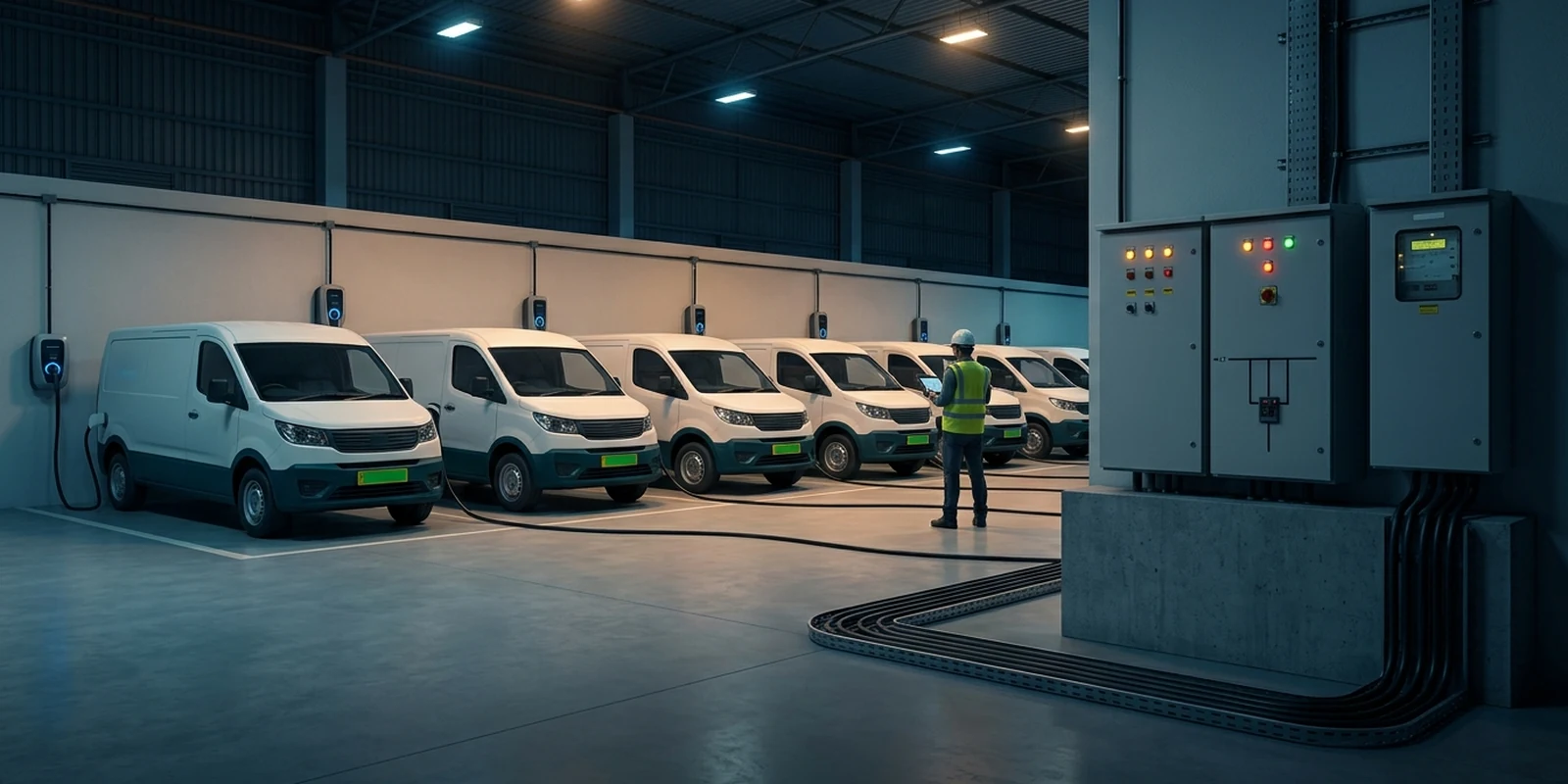
Electric vehicle smart charging is the layer that decides how much power each vehicle in your depot gets, second by second, against a limit your DISCOM set long before you bought the fleet. It is for depot supervisors and ops leads whose last-mile or corporate fleet now has more chargers than sanctioned load. This is not about when vehicles charge — EV fleet charging schedules covers that. It is about who gets the kilowatts.
Three numbers govern a depot. Connected load is the sum of nameplate ratings behind the meter. Sanctioned load — contract demand on an HT connection — is what the DISCOM approved and sized the transformer for. Maximum demand is what you actually draw at peak, and it is what your bill is built on.
Take a 40-van depot in Pune: 20 DC guns rated 60 kW on a 300 kVA connection — 1,200 kW of connected load, four times the contract. It is not short of energy: forty vans taking a 40 kWh top-up need 1,600 kWh, or 5.3 hours at a flat 300 kW inside a ten-hour window. It has twice the energy it needs and can still miss a departure, because the constraint is instantaneous allocation. Raising sanctioned load means capex, a higher monthly fixed charge and DISCOM lead times in months; sizing is in our EV depot layout and power guide.
Static load management fixes a ceiling per charger so the total can never exceed the site limit: 300 kW ÷ 20 guns = 15 kW each. Cheap, no metering, safe by construction. The cost shows at 22:00, when only six vans are back — each still gets 15 kW, the depot draws 90 kW of its 300 kW ceiling, and 210 kW you pay a fixed charge on sits idle.
Dynamic load management puts a controller on a meter at the point of supply and reallocates live headroom every few seconds. Those same six vans get 50 kW each — forty-eight minutes instead of two hours forty. It also sees the whole meter: a depot’s non-charging base load of lighting, compressor, water pump and office HVAC runs 30–60 kW, invisible to static caps.
Dynamic is never worse than static, though: at full occupancy it converges on the same equal share, so the entire gain sits in the hours the depot is not full — most of the night. This belongs in the charging management layer, not the chargers; the staged-ramp variant for bus depots is in electric bus fleet operations.
One-directional smart charging — V1G — has exactly three primitives.
Modulate changes the current setpoint mid-session — AC chargers signal it over the IEC 61851 control pilot, DC chargers negotiate directly. There is a hard floor: an AC charger cannot signal below 6 A, roughly 1.4 kW single-phase or 4.1 kW three-phase, below which it must stop the session, not slow it. Pause and resume suspends delivery with the connector latched and the transaction open. Prioritise hands out headroom by rank, not equally.
The mechanism is the OCPP charging profile — a schedule of power limits, with a station-level profile acting as a hard ceiling across every gun. It is a standard, not a vendor feature: OCPP 2.0.1 Edition 3 became IEC 63584, so name the version and profile support in the tender. Profiles are issued station-side, typically by a charging management system like YoCharge, and wired in per our system integration guide. All three primitives are one-directional; pushing energy back out is vehicle-to-grid.
This decision separates a depot that hits its departures from one that does not, and most controllers ship with equal share or arrival order. Both are fair. Both are wrong.
Back to the Pune depot. Van 17 returns at 02:30 on 15% state of charge and departs at 05:00: 40 kWh in two and a half hours, or 16 kW sustained. Nineteen other vans are plugged in, so an equal share of the 300 kW ceiling gives every gun 15 kW. Van 17 takes 37.5 kWh and leaves short, or late. Nothing failed — no breaker tripped, no charger faulted, the depot stayed inside its contract — and it still broke a route.
Deadline-aware allocation fixes it on the same 300 kW. Pause three vans departing at 11:00, freeing 45 kW; move Van 17 to its gun’s full 60 kW and it takes 40 kWh in forty minutes, done by 03:10. The paused three resume with 7.8 hours to absorb 40 kWh each — a 5.1 kW average. Same connection, no missed departure.
That needs data, not hardware: three fields per vehicle — next departure time, required state of charge at departure, duty priority. Without them the controller sees only current SOC, which cannot tell urgent from merely low. Which is why depot power control belongs with a fleet operating system like YoMobility, not the charger vendor’s box: departure times live in the duty roster, and no charger has seen the roster.
Indian commercial and industrial bills price peak demand, not only units: HT consumers are billed on recorded maximum demand, commonly with a ratchet floor, so one fifteen-minute spike sets a charge you carry for months. Smart charging’s value here is that it lets you hold a ceiling you chose — holding that depot at 300 kVA rather than doubling to 600 kVA avoids 300 kVA of contract demand, illustratively ₹90,000 a month at ₹300/kVA/month.
Check the category on your own bill, though: several states created concessional EV-charging tariffs with reduced or waived demand charges, but those were written for public stations, and a captive depot on an industrial connection may not qualify. Which hours to buy in is separate — see dynamic tariffs for EV fleets. Solar and a depot battery flatten the daytime peak but do nothing for the 01:00 one; sizing is in our EV depot design strategy.
Smart charging fails quietly. Five causes account for most stranded vehicles:
None announce themselves, and an SOC threshold alarm is useless here — at 02:00 most of the depot is low. Project instead: every few minutes, project each vehicle’s SOC at its departure time from its current allocation, compare it with what the duty requires, and raise an exception alert ninety minutes out on anything that will not make it — enough time to move it or swap the duty. Then trend the near-misses in fleet reporting: a depot whose alerts creep earlier every night has outgrown its connection.
Control over how much power each session draws — modulating, pausing and re-prioritising vehicles against a live site limit — rather than each vehicle taking whatever its charger gives.
Fixed caps suffice only if every gun is occupied for the whole window, which almost no depot achieves. Dynamic control never allocates less than a static cap, reclaims the headroom the rest of the time, and sees the 30–60 kW of lighting, compressors and HVAC that static caps cannot.
Yes, if it allocates equally rather than by deadline. A van plugging in at 02:30 for an 05:00 departure needs about 16 kW sustained; an equal share across twenty guns on a 300 kW site gives 15 kW. The fix is departure times in the charging layer, not more power.
A standard: charging profiles are defined in the protocol itself, and OCPP 2.0.1 Edition 3 was accepted by the IEC as IEC 63584. Implementations vary, so name the version and profile support in the tender, not just “OCPP compliant”.
Sources: IEA — Global EV Outlook 2026, Electric Vehicle Charging | Open Charge Alliance — Open Charge Point Protocol | NITI Aayog — Handbook of EV Charging Infrastructure Implementation | MSEDCL — Tariff schedules
Send us your sanctioned load, charger mix and departure pattern, and we will show you how allocation is prioritised by departure time — and where your current setup would strand a vehicle.
YoMobility EV-FMS
EV fleet management softwareRun every vehicle, driver, charge and payment from one platform. Charge on multiple networks, and get one invoice for all of it.
Resources
💡 Electric Scooter For Delivery Fleets: Summary An electric scooter for delivery and an electric scooter for commuting are usually […]
💡 PM E-DRIVE Scheme: Key Highlights If you are timing an electric vehicle purchase for a commercial fleet, the PM […]
💡 CNG vs EV For Fleets: Key Highlights This is for one reader: the fleet owner replacing a diesel light […]
Tell us how many vehicles you run and where they charge. We'll show you how they'd run on one platform, with one invoice.
Or contact us