
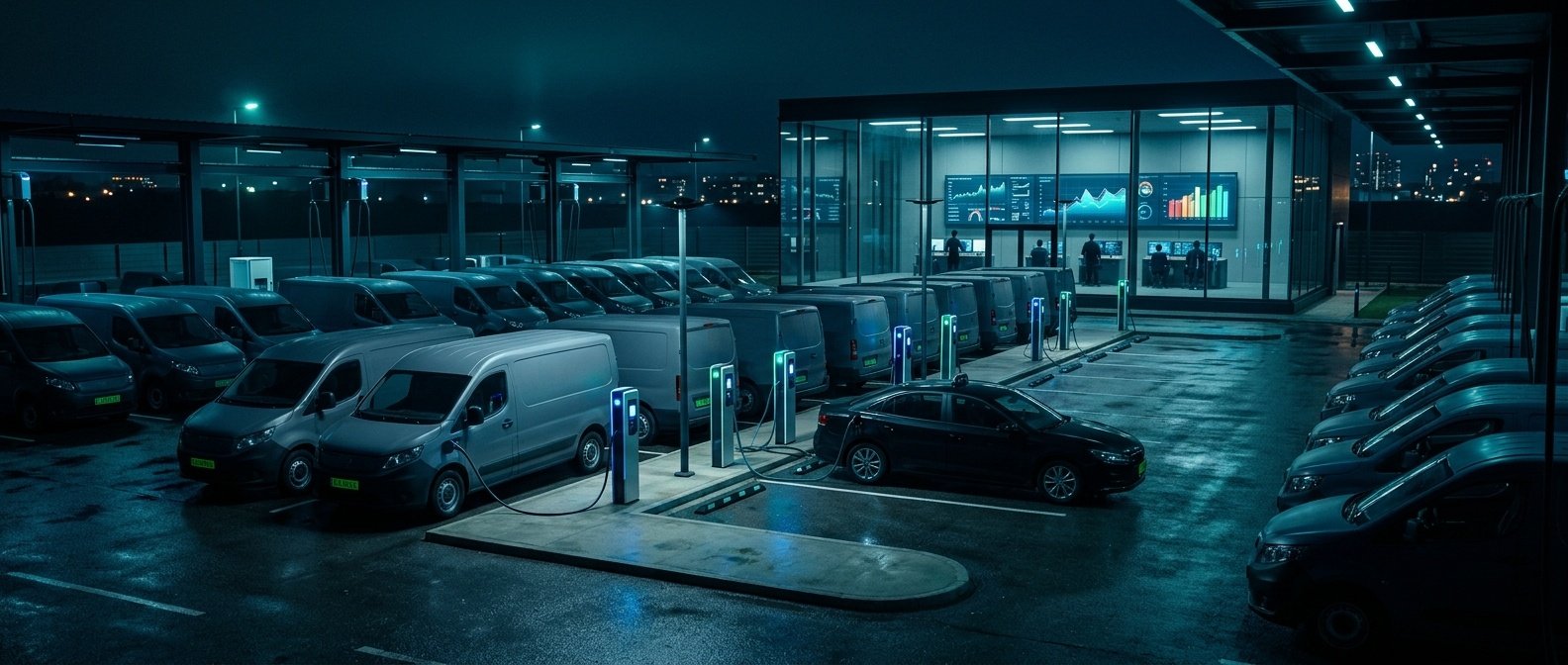
Dynamic Tariffs: Turning Pricing Into a Margin Lever
💡 EV Fleet Dynamic Tariffs: Key Highlights
- Time-of-use (ToD) pricing is now statutory for Indian commercial & industrial connections above 10 kW — peak-hour rates run at least 1.2x the normal tariff, off-peak/solar hours run 10–20% lower.
- Demand charges are billed on a depot’s single highest 15-minute power draw — plug in every vehicle at once and that one spike can dominate the monthly bill.
- Staggered, tariff-aware charging can cut a fleet’s electricity bill by 30–50%, per RMI’s fleet-charging research.
- Location-based pricing varies sharply by DISCOM — Bengaluru’s BESCOM cut its EV charging tariff from ₹8 to ₹4.85/unit specifically to pull demand toward it.
- An AI operating system that understands tariff structure can route, charge and bill around it automatically — turning a pricing headache into a controllable margin lever.
Most fleet leaders treat electricity pricing as a fixed cost — something finance reconciles after the month closes. That assumption is now expensive. EV fleet dynamic tariffs — the combination of time-of-use pricing, demand charges and location-based rates that Indian DISCOMs are actively rolling out — can swing a depot’s charging bill by 30% or more depending purely on when and where vehicles plug in. For last-mile and urban taxi fleets running dozens to hundreds of vehicles, that swing shows up directly in cost per kilometre and, ultimately, in margin. Fleets that treat tariff structure as a variable to actively manage — not a bill to passively absorb — are building a real cost advantage over competitors still charging on autopilot.
What Dynamic Tariffs Actually Mean for a Fleet
Three distinct pricing mechanisms sit inside the term “dynamic tariffs,” and it matters that fleet leaders separate them — each one rewards a different operational fix, and conflating them leads to the wrong investment.
Time-of-Use (ToD) Pricing
Under the Ministry of Power’s Electricity (Rights of Consumers) Amendment Rules, commercial and industrial connections drawing more than 10 kW moved to Time-of-Day tariffs starting April 2024, with peak-hour rates set no lower than 1.2x the normal tariff and solar/off-peak-hour rates running 10–20% below it (PIB). Rollout to every non-agricultural category is tied to the pace of smart-meter installation, so exact timing still differs state to state — but the direction is set: the era of a single flat per-unit rate is ending. For a depot charging fleet overnight, the practical effect is simple: the same kWh can cost meaningfully more or less depending purely on the clock.
Demand Charges
Demand charges are billed on a connection’s single highest power draw in a 15-minute-to-1-hour window, not on total energy consumed. A depot where every vehicle plugs in the moment drivers clock off creates exactly the kind of spike this charge punishes. RMI’s fleet-charging research finds that shifting charging into the lowest-cost, least-congested windows — rather than everyone charging on arrival — can cut a fleet’s electricity bill by 30–50%, and that a single bad day forcing peak-hour charging (a late run, a flat tyre, a rescheduled pickup) can add meaningfully to that month’s bill (RMI). This is the tariff lever operations, not finance, controls day to day.
Location-Based Pricing
The same charging session can cost differently depending purely on which DISCOM’s territory it happens in. Bengaluru’s BESCOM cut its EV charging tariff from ₹8 to ₹4.85 per unit specifically to pull demand toward off-peak, grid-friendly charging (Deccan Herald). Fleets that run across state or DISCOM boundaries — a common pattern for inter-city logistics and multi-city taxi operators — are effectively running under several different tariff regimes at once, whether they’ve mapped that out or not.
EV Fleet Dynamic Tariffs: Cost Risk or Margin Lever?
Here’s how to think about it: the IEA’s Global EV Outlook is blunt that unmanaged EV charging load will increasingly strain distribution grids, and that time-of-use tariffs and smart-charging coordination are the primary tools regulators are counting on to prevent that (IEA). That means dynamic tariffs aren’t a temporary irritation on the way to a simpler flat rate — they’re the permanent shape of EV-era electricity pricing. Treated passively, EV fleet dynamic tariffs are a cost risk: unpredictable bills, margin erosion on your least-flexible routes, and exposure every time a DISCOM revises its schedule. Treated actively, the same tariff structure is a lever — a fleet that can shift, stagger and site its charging in response to price signals is pulling real cost out of the same electricity the fleet next door is paying full peak rate for.
| Tariff Lever | What Drives the Cost | Fleet-Side Lever to Pull |
|---|---|---|
| Time-of-use pricing | Grid demand by hour — peak surcharge, off-peak/solar discount | Shift charging windows |
| Demand charges | Highest 15-minute power draw at the depot | Stagger vehicle plug-in times |
| Location-based pricing | DISCOM/state-specific EV tariff category | Choose charging sites and partners strategically |
How the Math Changes for Last-Mile vs. Taxi Fleets
The right response to dynamic tariffs depends on your operating pattern, not a generic playbook. Last-mile, urban taxi and corporate fleets each hit these tariffs differently.
Last-Mile Delivery Fleets
Consider 50 delivery vans running out of a single Delhi depot, each pulling a 30 kWh top-up overnight. At a commercial base rate of roughly ₹8/kWh, charging during the 6–10pm peak window (+20% under ToD rules) costs about ₹288 per vehicle; the same session shifted past 11pm into the off-peak window (a conservative 15% discount) costs about ₹204 — a saving of roughly ₹84 per vehicle per night. Across 50 vans, that’s over ₹15 lakh a year recovered purely by changing when chargers turn on, with zero change to routes or fleet size.
Urban Taxi Fleets
Taxi fleets face the demand-charge problem more acutely than they face ToD pricing, because shift changes concentrate charging into narrow windows. Picture 100 taxis in Bengaluru, with 40 of them returning to a shared depot within the same 90-minute window after the evening shift. Plugging all 40 in at once creates a single, expensive demand spike that sets that month’s demand-charge tier; staggering the same 40 vehicles across three or four consecutive slots keeps the depot’s peak draw — and the fixed monthly charge tied to it — a fraction of that. This is exactly the mechanism behind RMI’s 30–50% bill-reduction finding, applied to an Indian taxi depot instead of a US truck yard.
Corporate employee-transport fleets sit between the two: fewer vehicles than a last-mile operation, but shift-driven charging patterns similar to taxis, plus a sustainability reporting angle that makes documented, tariff-optimised charging worth citing in board-level ESG updates.
Where an AI Operating System Fits: Routing, Charging and Payments
None of the math above is exotic — it’s arithmetic any finance team could run on a spreadsheet once a quarter. The problem is that tariffs, vehicle schedules and driver behaviour all change daily, and a spreadsheet updated quarterly can’t keep up with a tariff structure that changes by the hour. This is precisely the gap an AI-powered operating system like YoMobility’s fleet management platform is built to close — by embedding tariff logic directly into the three systems that actually decide when and where a kWh gets consumed.
Routing With Tariff Awareness
When route planning already accounts for state of charge and charger locations, adding tariff windows as a third constraint is a natural extension. In practice, teams usually find that a route ending 20 minutes later but landing the vehicle back at the depot after the peak window closes is the cheaper route overall — even though it looks “slower” on a naive time-only view.
Charging Orchestration
Once vehicles are back at the depot, remote charging session management is what actually staggers plug-in times against the live tariff schedule instead of relying on drivers to self-coordinate. The system holds vehicles that don’t need an immediate full charge, prioritises the ones that do, and spreads the depot’s total draw across the cheapest available window — the same mechanism behind the 30–50% figure cited above, just automated instead of manually scheduled.
Payments and Reconciliation
Tariffs only translate into margin if they’re actually billed correctly. Consolidated charging invoices that apply the right time-of-use rate to every session — depot, public network, or driver home charging — remove the manual reconciliation work that otherwise buries the savings in a finance team’s backlog. The same tariff data that drives routing and charging decisions also feeds driver reimbursement, which matters increasingly as more fleets adopt home-charging reimbursement models and need those payouts to reflect the driver’s actual local tariff rather than a flat estimate. This is the broader case we’ve made before for why payments belong natively inside the fleet operating system rather than bolted on as a separate finance tool.
What Fleet Leaders Should Ask Before the Next Tariff Reset
DISCOMs revise tariff schedules periodically, and each revision either widens or narrows the gap between a fleet that manages tariffs actively and one that doesn’t. Before the next reset, it’s worth putting these questions to your ops and finance leads:
- Do we know, right now, what our depot’s peak 15-minute demand draw was last month — and what it’s costing us?
- How many of our charging sessions happen inside the peak ToD window purely by default, not by necessity?
- If we operate across more than one DISCOM territory, do we actually know each one’s current EV tariff category?
- Are driver home-charging reimbursements keyed to real local tariffs, or a flat rate that’s quietly over- or under-paying drivers?
- If our depot’s tariff schedule changed next month, would routing and charging adapt automatically — or would someone have to notice and manually reconfigure it?
Fleets that can answer all five with confidence are the ones for whom dynamic tariffs are already a margin lever. For everyone else, the gap is closing slower than the DISCOMs are moving.
Frequently Asked Questions
What are dynamic tariffs in EV fleet charging?
Dynamic tariffs are electricity pricing structures that change based on when, how much, and where power is drawn — primarily time-of-use (ToD) pricing, demand charges based on peak power draw, and location-based rates that vary by DISCOM or state. For fleets, all three affect the real cost of charging the same vehicle the same amount.
How do time-of-use tariffs affect fleet charging costs in India?
Under Ministry of Power rules, commercial and industrial connections above 10 kW pay peak-hour rates at least 1.2x the normal tariff and off-peak/solar-hour rates 10–20% lower. Charging overnight instead of during the evening peak can meaningfully cut the electricity-cost line of a fleet’s P&L without any change to vehicles or routes.
What are demand charges and why do they matter for fleet depots?
Demand charges are billed on a connection’s single highest power draw in a short window (typically 15 minutes to an hour), not on total energy used. A depot where many vehicles plug in simultaneously can trigger a large demand charge even if total energy consumption is unchanged — staggering plug-in times is the direct fix.
How does location-based pricing affect where fleets should charge?
EV charging tariffs are set DISCOM by DISCOM and can differ significantly between cities and states — Bengaluru’s BESCOM, for example, cut its EV tariff from ₹8 to ₹4.85 per unit to encourage adoption. Fleets operating across multiple territories effectively run under several tariff regimes at once and should map each one rather than assume a single rate.
Can an AI fleet operating system automatically adapt to changing tariffs?
Yes — a platform that already tracks vehicle state of charge, charger availability and routes can add live tariff data as another input, automatically shifting charging windows, staggering plug-in times, and applying the correct rate at billing and reimbursement time, without manual reconfiguration each time a DISCOM revises its schedule.
Sources: Press Information Bureau — Time of Day Electricity Tariff | Business Standard — Time of Day Power Tariff | IEA — Global EV Outlook 2024 | RMI — Smarter Charging for Electric Truck Fleets | Deccan Herald — BESCOM EV Tariff Cut
Manage Your Fleet’s Dynamic Tariffs Today
Talk to YoMobility to model your tariff strategy across routing, charging and payments — and see how much of your electricity bill is sitting in avoidable peak-hour and demand-charge costs.