Vehicle To Grid Technology For Fleets: What V2G Requires Before It Pays
By Shaurya Rathore8 min read
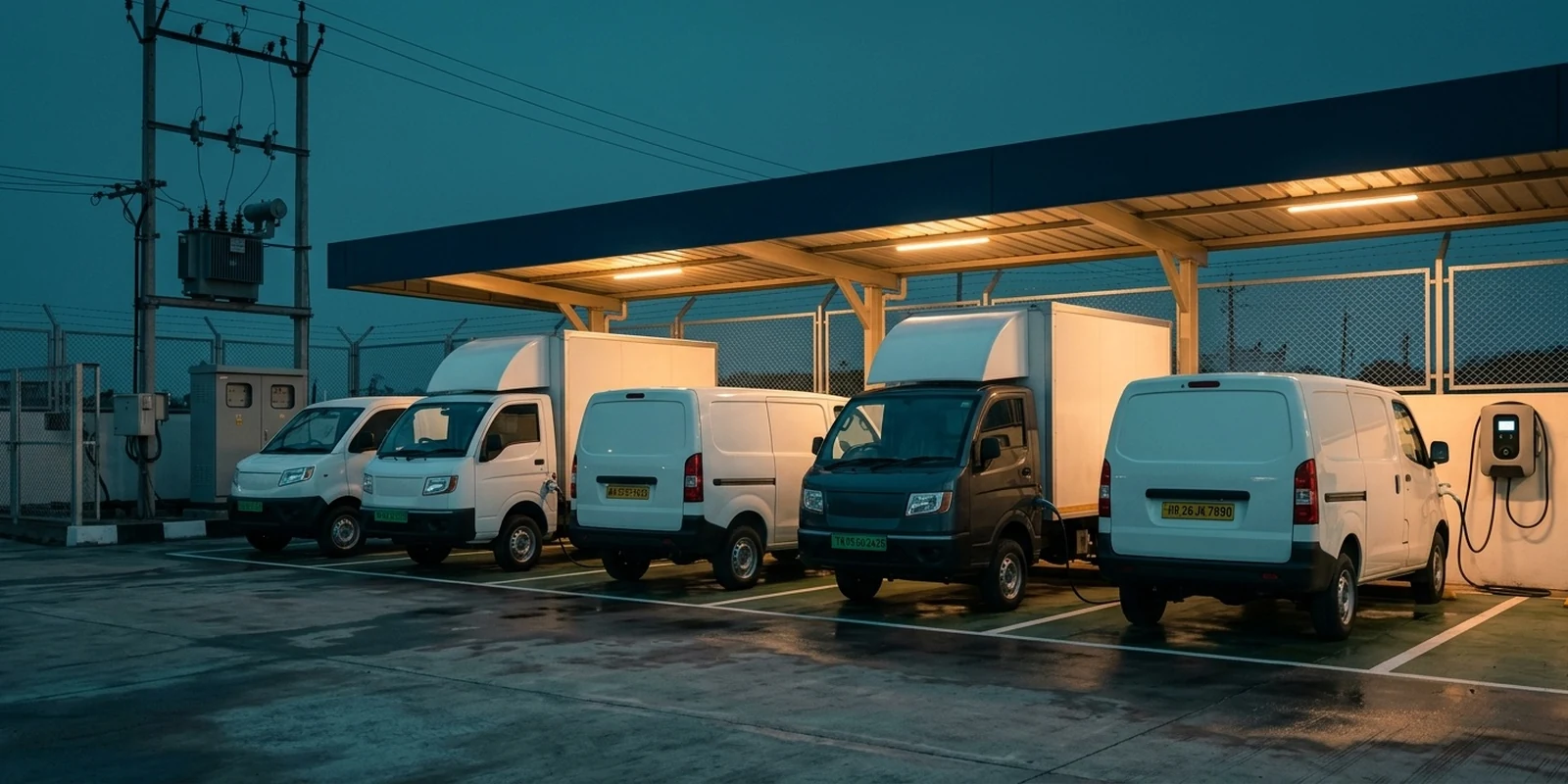
Vehicle To Grid Technology For Fleets
💡 Vehicle To Grid Technology: Key Highlights
- 22 EV models worldwide have V2G capability — under 1.5% of all models, and no Indian commercial vehicle among them.
- A bidirectional interface costs 3–5× a smart charger, and existing depot chargers cannot be firmware-upgraded into one.
- Typical warranties guarantee 70% capacity at 8–10 years or 160,000 km; export cycles spend that budget unless the OEM permits it in writing.
- India has no notified route for a fleet to sell exported energy — the CEA’s reverse-charging report is still recommendations.
- What pays today is managed charging, which can cut peak depot demand by up to 60%.
Vehicle to grid technology reaches fleet operators as found money: your vans stand still for fourteen hours a night, so sell part of that parked battery back to the grid. The physics is sound and the fleet case is the strongest in the industry, far better than the private car it is usually sold on. The commercial case in India in 2026 is not, and the gap is specific enough to plan around. Written for fleet CXOs and depot energy leads with 50-plus vehicles and owned depot parking.
Vehicle To Grid Technology vs Smart Charging: Know Which One You Are Buying
Two different machines get sold under one word. Managed charging, or V1G, modulates how fast each vehicle draws — throttling, pausing, re-prioritising against a live site limit. Power flows one way, on hardware most depots already own. V2G reverses it: energy leaves the pack and enters the grid, which needs an inverter path a one-directional charger does not have.
The IEA puts shifting part of a depot’s charging load to off-peak or daytime windows at up to a 60% cut in peak depot demand — a V1G number, on chargers you can buy this quarter. A depot without that control layer has skipped a step. Our guides cover when vehicles charge and what that electricity costs; the charging management layer implements both.
Why a depot fleet is the best V2G asset in the country
The industry’s stock V2G illustration is a private car — the wrong asset, since cars sit parked 80–90% of their lives but nobody knows when one leaves. A depot fleet has a roster: known departure times, one grid connection, one meter, chargers you control, telematics already reporting state of charge. The CEA names depot charging India’s highest-potential V2G setting for exactly that reason, and aggregated across sites it is the resource behind Yellow Haze’s virtual power plant capabilities.
The same assessment caveats it: depot flexibility may last only a few hours, and a bus or truck can use its whole battery in a day against 40–50% for a car. A hard-run fleet has less to sell, not more.
What Vehicle To Grid Technology Physically Requires
The vehicle has to be built for it
The IEA counts 22 production models with manufacturer-stated V2G capability — under 1.5% of all EV models, almost all passenger cars in Europe, Japan, Korea and the US. No Indian commercial vehicle is on the list. CCS2 supports bidirectional flow in principle, but Tata Power told the CEA’s committee that CCS2 V2G support was still under development.
The charger cannot be upgraded into it
Bidirectional operation needs different power electronics, not different firmware, so depot units already installed will never become V2G chargers via software. The CEA puts the bidirectional interface at three to five times the cost of unidirectional smart charging. Bidirectional AC units sell for under USD 1,500 and DC units from about USD 5,000 — two- to ten-year paybacks in markets that pay for the service, which India does not.
| Layer | What V2G requires | Where an Indian fleet stands in 2026 |
|---|---|---|
| Vehicle | Bidirectional pack, BMS and inverter path | 22 models globally, no Indian commercial model |
| Charger | Bidirectional power electronics — hardware, not a setting | 3–5× a smart charger; no upgrade path from existing units |
| Communication | ISO 15118-20, absent from the CCS standard until 2022 | Multi-vendor conformity tests still in development |
| Metering | Net metering separating exported from driving energy | No settled protocol; left to operator and utility |
| Market access | A route to sell into ancillary services or flexibility | None notified; CEA’s floor is 1–2 MW, roughly 500 vehicles |
Four of the five layers sit outside the fleet operator’s control.
Every commercial V2G offer on earth today is a bundle — one model, one charger, one utility’s tariff, one country — and the conformity tests that would break that up are still being written.
The Battery Warranty Trade-Off, Costed Honestly
Battery warranties are throughput budgets written as time and distance. Typical cover guarantees 70% capacity after 8–10 years or 160,000 km, and every exported kilowatt-hour spends that budget exactly as a delivery run does. Until an OEM permits grid export in writing, a fleet running V2G trades warranty cover for grid revenue — judged on the manufacturer’s own BMS figure.
Manufacturers manage that exposure openly: vehicle-to-home permitted, grid export withheld, approved chargers required, throughput capped. India has not settled it either — Tata Power’s submission to the CEA asked that peak-load use “should not affect the warranty support from EV OEM”, a request rather than a rule.
The physical risk is smaller than the contractual one: the IEA finds well-managed V2G can reduce capacity loss against unmanaged charging because average state of charge falls, and the CEA agrees degradation stays limited within a 60–80% band. Run the arithmetic anyway. At the top of the range the IEA observes in Europe — a little over USD 1,000 per vehicle a year — a 100-vehicle fleet grosses under ₹90 lakh. One pack replaced outside warranty takes a serious share of that, and no Indian tariff pays the ₹90 lakh anyway.
India’s Regulatory Gap: There Is No Revenue Route Yet
The Ministry of Power asked the CEA to frame guidelines for reverse charging from EV batteries in March 2023; the committee reported that November, recommending provisions be added to the CEA’s grid-connectivity regulations. That is still where it sits; a recommendation is not a tariff you can invoice against.
Three things are missing. Metering: the CEA calls net metering for bidirectional flow complex and leaves it to operator and utility. Participation: it records policy and regulation as “in complete abeyance” for backward injection from multiple distributed resources. Market access: a viability floor of 1–2 MW, roughly 500 aggregated vehicles, routes nearly every fleet through an aggregator and a DISCOM and CPO relationship with no V2G product in it.
What India has is pilots. ISGF ran South Asia’s first AC V2G demonstration in May 2026 — four retrofitted Tata Nexon EVs across BSES Rajdhani, BSES Yamuna, Tata Power-DDL and ANERT Kerala. Useful engineering; four cars. The IEA’s country-by-country V2G readiness assessment covers 15 markets; India is not one, and the EU already requires bidirectional capability on new chargers from 2027.
What To Do At Procurement Now
None of this argues for ignoring V2G — it argues for buying optionality cheaply and paying no premium for a revenue stream with no regulatory route. Four moves hold up today.
- Spec bidirectional-capable hardware only where the price delta is small. Ask vendors for the upgrade path in writing, assume there isn’t one, and read OEM silence as a no.
- Put the warranty question in the RFP, not the sales call. Does the OEM permit grid export, under what throughput cap, with which chargers, and does it alter the 70% / 8-year terms?
- Build the managed-charging layer now. V1G pays immediately, protects the depot’s sanctioned load, and is the same control and roster integration V2G would need later. Grid capacity sits with depot design.
- Preserve the data from day one. Any V2G or flexibility contract is priced off dwell windows, departure reliability, state-of-charge history and metered sessions — evidence you cannot reconstruct later. That is a telematics and fleet analytics discipline, and a fleet operating system like YoMobility is where it collects.
The honest verdict for 2026: vehicle to grid technology is not a revenue line for an Indian fleet. It is a hardware and data decision you make now, which decides whether you can participate when it becomes one.
Frequently Asked Questions
Only as pilots. ISGF ran South Asia’s first AC V2G demonstration in May 2026 with four retrofitted Tata Nexon EVs at three Delhi discoms. No notified tariff lets a fleet sell exported energy.
No. Bidirectional operation needs different power electronics, not different firmware. The CEA puts the interface at three to five times the cost of a unidirectional smart charger — a replacement decision, not an upgrade.
It depends on the OEM’s written terms. Typical cover guarantees 70% capacity at 8–10 years or 160,000 km, and manufacturers limit risk by allowing only vehicle-to-home use, requiring approved chargers or capping throughput.
V1G modulates how fast a vehicle draws power, always one way; V2G exports energy from the pack to the grid. V1G runs on standard chargers and can cut peak depot demand by up to 60%; V2G needs bidirectional hardware on both sides.
Sources: CEA — Electric Vehicles Utilization for Vehicle-to-Grid (V2G) Services | IEA — Global EV Outlook 2026 | CharIN — ISO 15118 | Business Standard — ISGF V2G Demonstration
Manage Your Fleet’s Grid Readiness Today
Talk to YoMobility about the managed-charging layer that pays today, and the charging history a future V2G contract will be priced against.
YoMobility EV-FMS
EV fleet management softwareRun every vehicle, driver, charge and payment from one platform. Charge on multiple networks, and get one invoice for all of it.
Resources
Keep reading
Driver Monitoring System For EV Fleets: What The Camera Sees And What It Should Change
💡 Driver Monitoring System: Summary A driver monitoring system is usually bought as a camera and judged on detection: does […]
EV Battery Replacement Cost For Fleets: What Drives The Quote — And When Replacing Is The Wrong Call
💡 EV Battery Replacement Cost: Key Highlights The EV battery replacement cost is the largest single repair bill a fleet […]
Electric Scooter For Delivery Fleets: Specs That Survive A Full Rider Shift
💡 Electric Scooter For Delivery Fleets: Summary An electric scooter for delivery and an electric scooter for commuting are usually […]
See YoMobility on your fleet
Tell us how many vehicles you run and where they charge. We'll show you how they'd run on one platform, with one invoice.
Or contact us