Truck Transport Rate Per Km: How Electric Trucks Change The Way Transporters Price Freight
By YoMobility Editorial Team12 min read
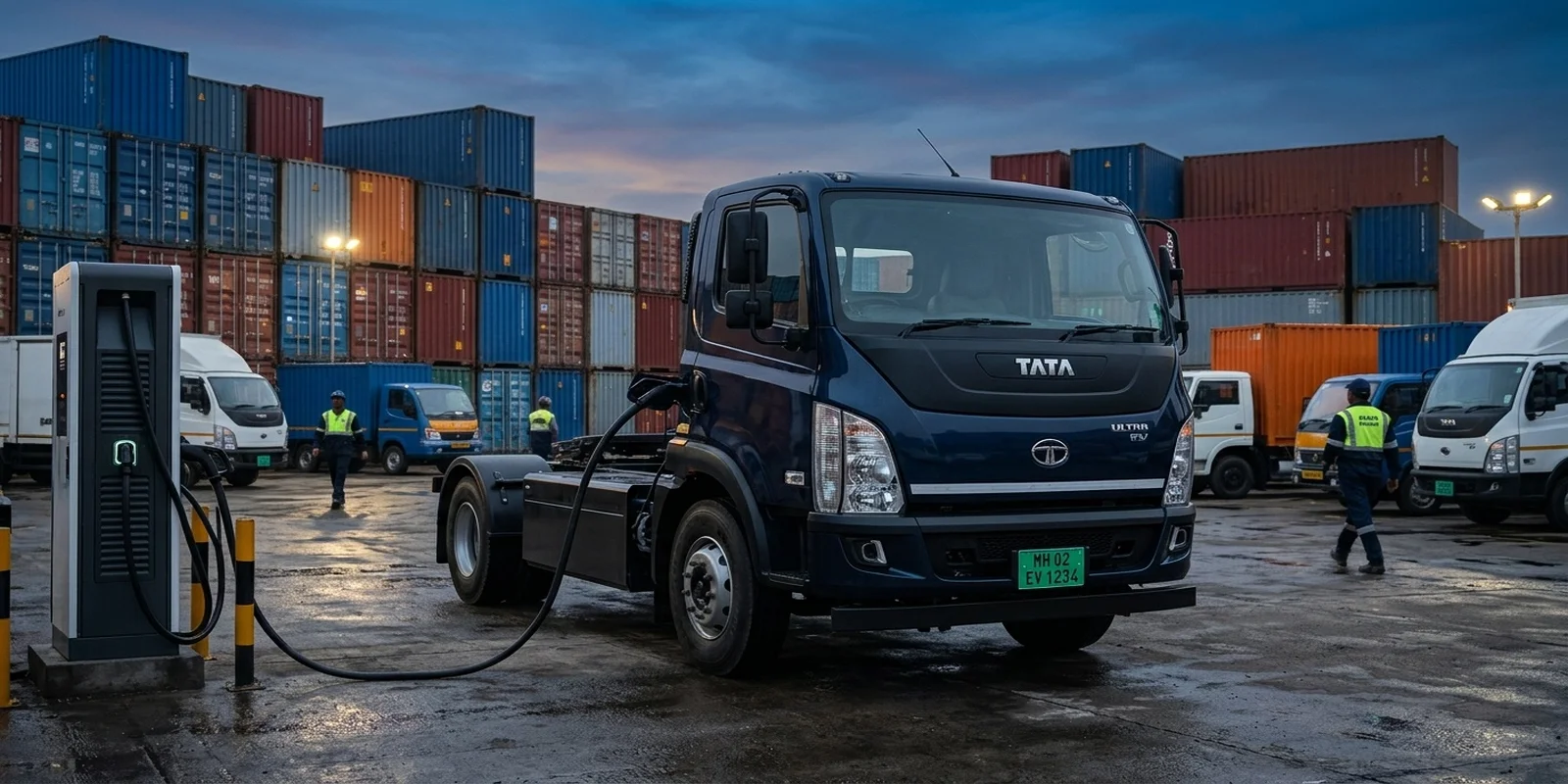
How Electric Trucks Change Freight Pricing
💡 Truck Transport Rate Per Km: Key Highlights
- A per-km truck rate is not one number — it is a build-up of fixed costs, variable costs, empty-run allowance and margin, divided by chargeable kilometres.
- Diesel escalation clauses index variable costs to the PPAC-published retail diesel price (Rs 95.20/litre in Delhi as of 26 November 2026). That index does not apply to an electric truck.
- EV depot charging tariffs range from Rs 4 to Rs 7 per kWh across Indian states, set by State Electricity Regulatory Commissions under Ministry of Power guidelines.
- Electric trucks need a new clause — an electricity-tariff-indexed escalation tied to the depot’s tariff order or the CPO’s invoiced rate, not to diesel.
- Contract structures that work for e-trucks include minimum-guaranteed km per month, dedicated lanes, and return-load commitments — adapted from the bus sector’s gross-cost-contract model.
If you are a transporter quoting freight to a shipper, or a logistics buyer evaluating a quote, the truck transport rate per km is the number both sides negotiate around. For decades, that number has been built on a simple formula: take your costs, divide by chargeable kilometres, add margin. The largest variable inside the formula is diesel — and an entire clause in every Indian freight contract exists to adjust the rate when diesel moves. An electric truck breaks that formula. Its energy cost per kilometre is a fraction of diesel, but its capital cost is higher, and its charging time sits inside the duty day in a way refuelling never did. Apply a diesel rate card to an e-truck and you will either underprice the asset or overprice the service. This post walks through how a truck transport rate per km is actually built, why the diesel escalation clause does not transfer to EVs, what contract structures fit electric trucks, and what a shipper should ask for in an EV freight quote.
How A Per-Km Truck Transport Rate Is Actually Built
A truck transport rate per km is not a single figure pulled from a rate card. It is a cost build-up that the transporter assembles for each lane, tonnage class and contract type. The structure is the same whether you run one truck or five hundred:
Fixed Costs (Spread Over Chargeable Km)
Fixed costs include the EMI or lease rental on the vehicle, insurance, permits and fitness, driver salary and benefits, and parking or depot rent. These do not change with distance — they change with utilisation. A truck financed at Rs 20 lakh over five years carries roughly Rs 40,000 per month in EMI alone. If that truck runs 8,000 km per month, the fixed-cost share is Rs 5 per km. If utilisation drops to 5,000 km — because of empty return runs, maintenance downtime or seasonal demand — that same EMI spreads to Rs 8 per km.
Variable Costs (Change With Every Trip)
Variable costs are what move with kilometres: fuel or energy, tolls, tyre wear, running maintenance and driver allowances (DA, food, lodging). For a diesel truck, fuel is overwhelmingly the largest variable line — typically 40 to 50 per cent of the total rate.
The Build Table — Illustrative Scenario
The table below shows how a per-km rate is assembled. These are illustrative inputs, not market rates — actual costs vary by lane, truck class, payload and region. The structure is what matters.
| Cost Line | Diesel Truck (Illustrative) | Electric Truck (Illustrative) | Notes |
|---|---|---|---|
| Vehicle cost (EMI/lease per month) | Rs 40,000 | Rs 70,000 | E-truck capital ~1.7x higher today |
| Insurance + permits + fitness | Rs 8,000 | Rs 7,000 | Green-plate vehicles exempt from road tax in some states |
| Driver salary + benefits | Rs 25,000 | Rs 25,000 | Same driver pool |
| Depot/parking | Rs 5,000 | Rs 5,000 | E-truck depot may include charger amortisation |
| Total fixed per month | Rs 78,000 | Rs 1,07,000 | |
| Assumed utilisation (km/month) | 8,000 | 7,000 | E-truck loses ~1,000 km to charging time in this scenario |
| Fixed cost per km | Rs 9.75 | Rs 15.29 | |
| Variable costs per km | |||
| Fuel / energy | Rs 7.94 | Rs 2.50 | Diesel: 3.5 km/l at Rs 95.20/l (Delhi, PPAC, 26 Nov 2026); EV: 1.0 kWh/km at Rs 5/kWh depot tariff (illustrative mid-range, MoP EV charging guidelines) |
| Tolls | Rs 2.00 | Rs 2.00 | Same lane, same toll |
| Tyres + running maintenance | Rs 1.50 | Rs 0.80 | Fewer moving parts, regenerative braking |
| Driver allowance (DA/food) | Rs 1.50 | Rs 1.50 | |
| Total variable per km | Rs 12.94 | Rs 6.80 | |
| Cost per km (before margin) | Rs 22.69 | Rs 22.09 | |
| Margin (10%) | Rs 2.27 | Rs 2.21 | |
| Quoted rate per km | Rs 24.96 | Rs 24.30 | |
All inputs are labelled illustrative. Diesel mileage, electricity tariff and utilisation vary by vehicle class, state and route. The purpose is to show the structure, not to publish a market rate.
Two things stand out. First, the e-truck’s total rate is in the same range as diesel — but the composition is inverted. Fixed costs dominate instead of fuel. Second, the rate is extremely sensitive to utilisation: if the e-truck runs 8,000 km (matching the diesel truck), its fixed cost per km drops to Rs 13.38, pulling the total rate below diesel. This is the structural difference that every contract must price correctly.
The Diesel Escalation Clause — And Why It Breaks For Electric Trucks
Every multi-month Indian freight contract includes a diesel escalation clause. The logic is straightforward: the base rate is quoted at a reference diesel price (say, Rs 95.20 per litre in Delhi as of 26 November 2026, per PPAC). If diesel rises by Rs 2, the rate adjusts upward by a formula — typically the percentage change in diesel multiplied by a fuel-weight factor (often 0.40 to 0.50, reflecting fuel’s share of cost). If diesel falls, the rate adjusts downward. Both sides accept this because diesel prices are published daily, verifiable, and outside either party’s control.
Apply this clause to an electric truck and three things go wrong:
- The index is irrelevant. An e-truck’s energy cost per km tracks the electricity tariff at the depot or the CPO’s invoiced rate — not the diesel pump price. Diesel could rise Rs 10 and the e-truck’s cost would not move.
- The fuel-weight factor is wrong. Energy is roughly 10 to 15 per cent of the e-truck’s total cost, not 40 to 50 per cent. A clause that adjusts 45 per cent of the rate for a 5 per cent price movement massively over-corrects.
- Charging time is a hidden variable. A diesel truck refuels in 15 minutes. An e-truck at a depot DC charger may take 60 to 90 minutes. That time is either idle time (a cost the transporter absorbs) or it shortens the duty day (reducing km per month, raising fixed cost per km). No diesel escalation clause accounts for this.
Replace It: An Electricity-Tariff-Indexed Clause
The replacement is an escalation clause indexed to the depot’s electricity tariff. The reference price is the per-kWh rate from the depot’s latest State Electricity Regulatory Commission (SERC) tariff order — or, if the truck charges at a third-party CPO, the CPO’s invoiced rate per kWh for the billing period. Under Ministry of Power guidelines, EV charging tariffs are set at the Average Cost of Supply (ACoS) by the DISCOM, with a 0.8x multiplier during solar hours (9 AM to 4 PM) and 1.2x during non-solar hours. State-level tariffs currently range from approximately Rs 4 per kWh in Delhi to Rs 7 per kWh in Maharashtra for depot-level supply.
The clause should specify: (a) the reference tariff and its source document (SERC order number and date); (b) the energy-weight factor (typically 0.10 to 0.15 for an e-truck, reflecting energy’s true share of cost); (c) who bears the charging-time cost — if the shipper requires guaranteed delivery windows that force mid-route fast charging at higher CPO rates, the clause should state whether that premium is passed through or absorbed. A well-drafted clause makes the quote auditable using fleet reporting data — energy consumed per trip, tariff applied, and total cost per km are all recorded in the platform.
Contract Structures That Fit Electric Trucks
The diesel freight market runs on spot loads and short-term contracts because the truck is cheap, utilisation risk is low (you can always find a return load on a busy lane), and fuel cost tracks a public index. An electric truck’s economics reward commitment. Three contract structures transfer well from the bus sector’s gross-cost-contract model:
Minimum-Guaranteed Kilometres Per Month
The shipper commits to a minimum volume — say 6,000 km per month. The transporter prices fixed costs against that floor. If actual utilisation exceeds the minimum, the marginal km costs only the variable component (energy, tolls, tyres), which is where the e-truck’s advantage is steepest. This protects the transporter’s capital recovery and gives the shipper a lower blended rate on higher volumes. It is the structure used in most Indian city bus contracts under the gross-cost model.
Dedicated Lanes With Return-Load Commitments
Electric trucks work best on fixed, predictable routes where the transporter can plan charging around the duty cycle. A dedicated-lane contract — say, Delhi warehouse to Jaipur distribution centre and back — eliminates the empty-return problem. The transporter knows the daily km, can schedule depot charging overnight, and can quote a tighter rate because there is no utilisation uncertainty. If the shipper guarantees a return load (or pays for the empty leg explicitly), the truck transport rate per km drops further because the fixed-cost denominator doubles.
Energy-Pass-Through With Fixed Service Fee
In this model, the shipper pays the actual energy cost (passed through at the invoiced tariff per kWh, verifiable from charging records) plus a fixed service fee per km that covers the truck, driver, maintenance and margin. The transporter has no energy-price risk. The shipper has full visibility into the energy line — and can compare it against the diesel equivalent. This structure works well where the shipper owns or controls the depot charger, since the tariff is directly in their name. For shippers managing charging costs across a fleet, payment management tools consolidate invoices across CPOs and depot chargers into a single reconciled view.
What A Shipper Should Ask For In An EV Freight Quote
If you are a logistics buyer receiving a truck transport rate per km quote for an electric truck, here is what to look for beyond the headline number:
- The rate build-up, not just the rate. Ask the transporter to show the fixed and variable split. If the quote does not separate energy cost from the service fee, you cannot audit it and you cannot compare it to a diesel alternative on a like-for-like basis.
- The utilisation assumption. A per-km rate is only valid at a stated utilisation. Ask what km-per-month figure the quote assumes and what happens to the rate if actual km fall below that — this is where the minimum-guarantee clause matters.
- The escalation index and its source. The clause should name a specific, public tariff document (SERC order, CPO published tariff) and a defined review frequency (quarterly or on tariff revision, whichever is earlier).
- Energy data per trip. An e-truck can report exact kWh consumed per trip from the vehicle’s telematics or the charger’s session log. Require this as a deliverable — it is the equivalent of a fuel receipt, but more precise.
- CO₂ per trip as a deliverable. If you are reporting Scope 3 emissions under BRSR or CSRD, the transporter should provide verified grams of CO₂ per tonne-km. An electric truck on grid power does carry an emission factor (the grid’s average); a truck on depot solar carries near-zero. Ask which applies. For the broader shipper-side ESG case, see our guide on green logistics for 3PL and shipper contracts.
- Charging-time treatment. Is charging time included in the trip time? If the transporter charges mid-route at a public CPO, is the higher per-kWh rate passed through or absorbed? Clarify before signing.
For a detailed breakdown of how EV fleet operating costs compare to diesel across vehicle classes, see our EV fleet TCO analysis for India. The TCO post covers the cost side; this post covers the price the transporter quotes and the contract that holds it together.
Building A Truck Transport Rate Per Km That Works For Both Sides
The shift from diesel to electric does not change the fact that freight is priced per kilometre. What it changes is the composition of that rate and the index that adjusts it over time. For the transporter, the priority is protecting capital recovery through utilisation guarantees and passing energy cost through transparently. For the shipper, the priority is auditability — an EV quote should come with data (kWh per trip, tariff source, CO₂ per trip) that a diesel quote never could.
The transporters who will price EV freight competitively are those who build their truck transport rate per km from the actual cost structure of an electric truck — not those who take a diesel rate card and subtract a discount. And the shippers who will get the best rates are those who offer the utilisation commitment that makes an e-truck’s capital economics work. A fleet platform like YoMobility’s EV fleet management software gives both sides the operational data — energy per trip, charging cost per session, route-level analytics — to build, verify and adjust that rate with confidence.
Frequently Asked Questions
What is the truck transport rate per km for an electric truck in India?There is no single published market rate. The truck transport rate per km for an electric truck depends on the vehicle’s capital cost, the electricity tariff at the depot or CPO, monthly utilisation and the contract structure. A transporter builds the rate from a fixed-plus-variable cost model; it is not read off a rate card. The illustrative scenario in this post shows how the components assemble.
How does the diesel escalation clause change for an EV freight contract?It is replaced with an electricity-tariff-indexed clause. Instead of tracking the PPAC diesel price, the clause references the depot’s SERC tariff order or the CPO’s invoiced rate per kWh. The energy-weight factor drops from 0.40–0.50 (diesel) to 0.10–0.15 (EV), because energy is a much smaller share of the electric truck’s total cost.
Are electric truck freight rates cheaper than diesel truck rates?Not automatically. The e-truck’s energy cost per km is significantly lower, but its capital cost is higher. At high utilisation (consistent monthly km on dedicated lanes), the total per-km rate can match or beat diesel. At low or unpredictable utilisation, the higher EMI spreads over fewer km and the rate rises. Contract structure — especially minimum-guaranteed km — is what determines whether the EV rate undercuts diesel.
What data should a shipper ask for in an electric truck freight quote?Ask for the rate build-up (fixed vs variable split), the utilisation assumption, the escalation index and its source document, energy consumed per trip in kWh, and CO₂ per tonne-km. These are deliverables an electric truck can provide from telematics and charging records — and they make the quote auditable in a way diesel quotes rarely are.
How does charging time affect the truck transport rate per km?Charging time reduces the truck’s available running hours per day, which lowers monthly utilisation (km per month). Since fixed costs are spread over fewer km, the fixed-cost-per-km component rises. Overnight depot charging minimises this impact. Mid-route fast charging at a CPO adds higher per-kWh costs. The contract should state whether charging time is inside or outside the trip window and who bears the cost of any mid-route fast charging.
Sources: PPAC — Diesel RSP, 26 Nov 2026 | Ministry of Power — Revised EV Charging Guidelines & Standards | PIB — Assessment of Logistics Cost in India
Researched and drafted with AI assistance; facts checked against the sources linked above and reviewed by the YoMobility team.
Price Your EV Fleet’s Freight With Real Data
Build, verify and adjust your truck transport rate per km using energy-per-trip data, charging cost breakdowns and route-level analytics from YoMobility.
Get Expert Consultation
YoMobility EV-FMS
EV fleet management softwareRun every vehicle, driver, charge and payment from one platform. Charge on multiple networks, and get one invoice for all of it.
Resources
Keep reading
Logistics Cost In India: What The National Logistics Policy Targets And Where Fleet Electrification Moves The Number
💡 Logistics Cost In India: Key Highlights Every year, the question surfaces in boardrooms and policy debates: what does logistics […]
LNG Truck Vs Electric Truck: Which Bet Makes Sense For Heavy-Freight Fleets
💡 LNG Truck Vs Electric Truck: Key Highlights An LNG truck and a battery-electric truck both promise to cut a […]
ISO 14001 For Logistics And Transport Companies: What The Standard Asks Of Your Fleet
💡 ISO 14001 For Transport Fleets: Key Highlights This guide is for EHS, quality and sustainability leads at 3PLs, transporters […]
See YoMobility on your fleet
Tell us how many vehicles you run and where they charge. We'll show you how they'd run on one platform, with one invoice.
Or contact us