Road Freight Decarbonisation In India: What The NDC-TIA II Pact Means For Electric Truck Fleets
By YoMobility Team8 min read
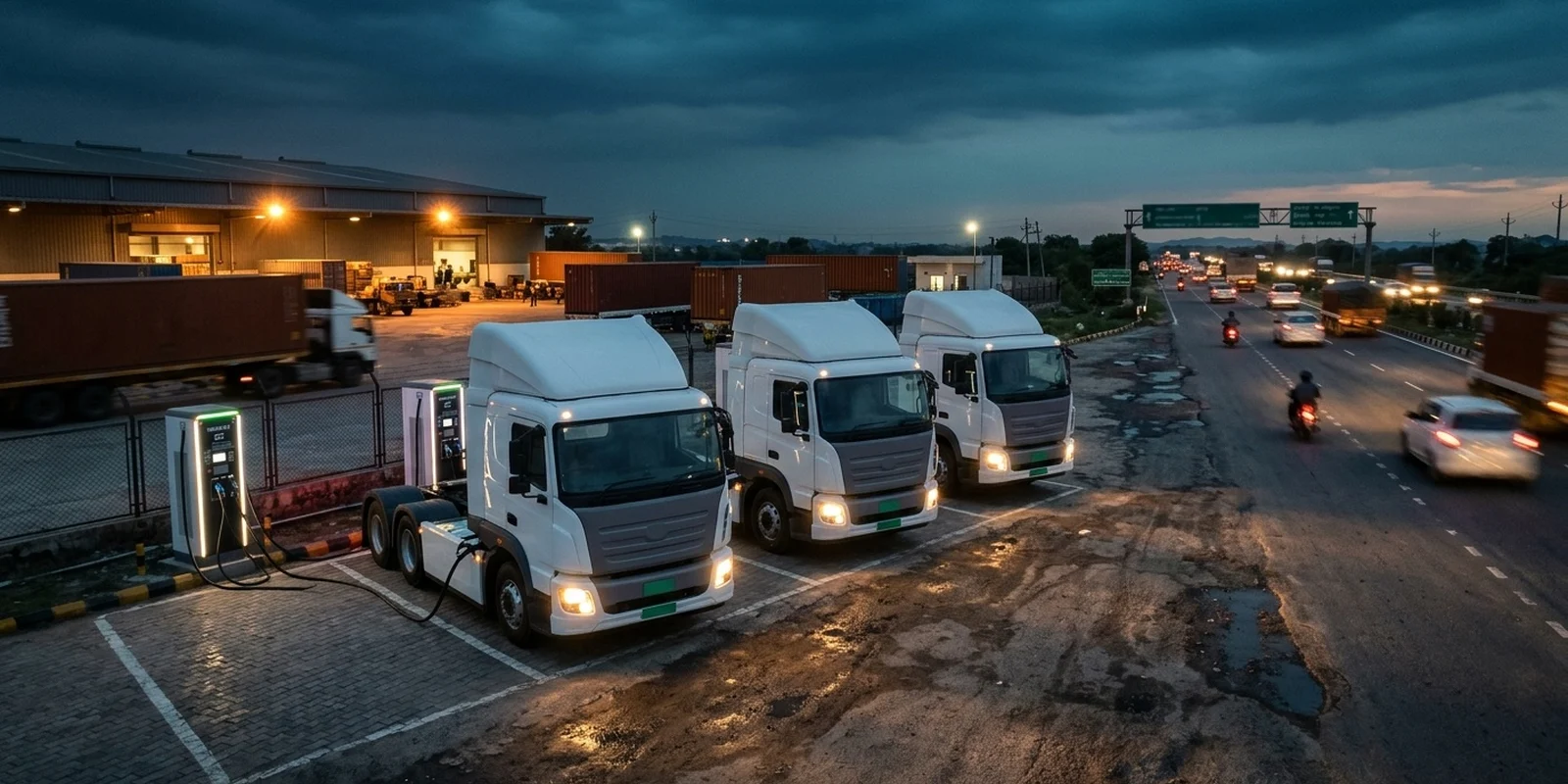
Road Freight Decarbonisation: What NDC-TIA II Signals For E-Truck Fleets
💡 Road Freight Decarbonisation: Key Highlights
- 3 November 2026: NITI Aayog and GIZ signed an implementation agreement under NDC-TIA II to accelerate road freight decarbonisation in India.
- No targets, budget or timeline were announced for India. The release names three gaps: charging infrastructure, financing and regulation.
- €4.9 million, three countries: the IKI-funded programme covers China, India and Vietnam from November 2024 to September 2028.
- 3% of vehicles, 44% of CO₂: ICCT’s figure for medium- and heavy-duty trucks’ share of road transport’s well-to-wheel emissions.
- 201 to 826: e-freight vehicle deployments from FY25 to FY26, per NITI Aayog, with 3,000+ electric MHD trucks now running.
Road freight decarbonisation in India gained a new institutional backer on 3 November 2026, when NITI Aayog and Germany’s GIZ signed an implementation agreement under the Nationally Determined Contribution–Transport Initiative for Asia Phase II (NDC-TIA II). This briefing is for freight fleet operators, transporters and 3PLs running or evaluating medium- and heavy-duty electric trucks.
The release names three things India’s truck electrification still lacks (charging infrastructure, innovative financing and an enabling regulatory framework) and announces no budget, targets or timelines. The useful question is what those three gaps mean for a fleet that wants to move freight on batteries in the next two to three years.
What NITI Aayog And GIZ Actually Signed
According to the PIB release of 4 November 2026, the agreement formalises collaboration between NITI Aayog and GIZ on accelerating the decarbonisation of India’s road freight sector. World Resources Institute (WRI) India, ICCT India and Agora Energiewende are among the implementing partners, and the programme is funded by the German government’s International Climate Initiative (IKI).
The IKI project page fills in the frame the release leaves out. NDC-TIA Phase 2 is a regional programme for China, India and Vietnam. It runs from November 2024 to September 2028, lists IKI funding of €4.9 million, and names GIZ as implementer and NITI Aayog as India’s political partner. Its stated aim is coordinated policy measures to electrify freight transport and commercial vehicles, delivered through facilitation, technical advice and dialogue. Nothing on the page points to purchase subsidies for trucks or chargers.
The “NDC” in the name refers to India’s climate pledge under the Paris Agreement. The updated NDC approved in August 2022 commits India to cutting the emissions intensity of its GDP by 45% by 2030 from 2005 levels.
With no e-truck target, corridor list or financing facility attached, read the agreement as a policy-design signal, not a demand signal.
Why Road Freight Decarbonisation Starts With Trucks
The arithmetic is lopsided. ICCT’s August 2024 India study finds that medium- and heavy-duty trucks make up 3% of the on-road vehicle fleet but produce 44% of road transport’s well-to-wheel CO₂ emissions. NITI Aayog Member Rajiv Gauba made the same point in September 2026: heavy trucks are 3–4% of vehicles yet produce over a third of transport-sector emissions, and 70% of India’s freight moves by road.
Adoption is real but still small. NITI Aayog reported that e-freight vehicle deployments rose more than fourfold, from 201 in FY25 to 826 in FY26, and that over 3,000 electric medium- and heavy-duty trucks are now in operation. Gauba noted that only around 800 heavy-duty electric trucks were sold in 2025. We covered those numbers, and NITI Aayog’s PACT demand-aggregation platform, in our report on the electric heavy duty truck market in India.
The two do different jobs: PACT pools freight demand along named corridors so manufacturers, financiers and charge point operators can see it, while NDC-TIA II works on the policy groundwork underneath.
Charging, Finance And Regulation: The Operator’s Version
The release names three barriers. Here is what each one looks like from a dispatch desk.
Charging: depot first, corridor later
Return-to-base duty cycles (port shuttles, plant-to-warehouse runs, city distribution) can run on depot charging today. Line-haul needs high-power highway charging, and no single fleet will fund chargers its competitors also get to use.
ICCT’s modelling shows battery-electric trucks reaching a lower total cost of ownership than diesel across daily distances of 200–700 km by model year 2030. It adds that a robust charging network is what maximises those savings. Until corridors exist, the practical move is to electrify the lanes you can charge at base and log every session, so you know your real energy cost per kilometre before corridor tenders arrive. Running depot and public sessions from one charging management view turns that data into a cost line rather than a pile of receipts.
Finance: the price of uncertainty
ICCT estimates the upfront cost of a battery-electric truck at 4–6 times that of a comparable diesel truck for model year 2023, when specified for full real-world duty. The pilot-spec units already deployed in India cost 2–3 times as much. Lenders price that gap, plus an unknown: Indian e-trucks have almost no resale history.
MoRTH Secretary V. Umashankar said in September that battery health monitoring and new operating models for high-utilisation vehicles can improve transparency, strengthen resale value and reduce financing risk. In practice, a fleet that can show a financier verified utilisation and battery data makes a better case for its next tranche, whether it buys outright or goes through EV fleet leasing.
Regulation: the lever that moves diesel’s cost too
Regulation works on both sides of the comparison. ICCT finds that stringent fuel-consumption standards would raise the upfront cost of 12-, 16- and 28-tonne diesel trucks by 62–89% by 2030. That lifts e-trucks’ projected TCO savings in 2030 from 7–12% to 20–26%.
On incentives, PM E-DRIVE’s e-truck component, set out in the Ministry of Heavy Industries’ e-truck notification of 10 July 2025, offers ₹5,000 per kWh of battery capacity, capped at ₹9.6 lakh per truck, from a ₹500 crore outlay. It requires a scrapping certificate for an old vehicle. MHI later extended the scheme to 31 March 2028, citing the nascent e-truck market. One figure for spec sheets, from our own calculation: at ₹5,000 per kWh the ₹9.6 lakh cap is reached at 192 kWh, so a bigger battery earns no extra incentive beyond that point, and a lower price or weight-band limit may apply sooner. Our PM E-DRIVE fleet incentives guide has the full eligibility rules.
What Road Freight Decarbonisation Means For Your Fleet Now
NDC-TIA II will not change your cost per kilometre this quarter. Over its run to September 2028, it may shape the instruments that do: corridor charging planning, financing products and the kind of regulation ICCT’s research models. Teams that move early usually do three things.
- Pick the right first routes. Start with return-to-base lanes where depot charging covers the full shift, and leave line-haul until corridor charging is proven. Our guide to the best electric trucks for fleet operators in India compares the models on sale.
- Build the record lenders will ask for. Track energy per km, charging cost per trip, uptime and battery state of health for every truck, using EV vehicle tracking rather than spreadsheets.
- Report the emissions you avoid. Shipper sustainability teams want carrier-level numbers, and fleet-level CO₂ tracking turns each electric trip into one.
This is the operating layer YoMobility’s EV-FMS is built for: charging across multiple networks from one fleet wallet, one consolidated GST invoice, live vehicle data and BRSR-ready CO₂ reports. With the fleet’s consent, a leasing or finance partner can also see data for the vehicles it has financed.
Watch for NITI Aayog and the implementing partners to publish work under the agreement. That is where any targets, corridor priorities or finance proposals will first appear, and we will cover them when they do.
Frequently Asked Questions
Manage Your Fleet’s E-Truck Charging Today
Multi-network charging, one consolidated GST invoice and BRSR-ready CO₂ reporting for electric truck fleets, on one platform.
Book a Free DemoSource: NITI Aayog and GIZ India sign NDC-TIA II Implementation Agreement — PIB / NITI Aayog, 4 November 2026 (Release ID 2332576) | NDC Transport Initiative for Asia, Phase 2 — International Climate Initiative (IKI), accessed 11 November 2026 | TCO parity between battery-electric and diesel trucks in India — ICCT, 14 August 2024 | e-FAST India launches PACT — PIB / NITI Aayog, 7 September 2026 (Release ID 2307592) | Rajiv Gauba at the 5th e-FAST India Summit — PIB / NITI Aayog, 7 September 2026 (Release ID 2307575) | PM E-DRIVE tenure extension — PIB / Ministry of Heavy Industries (Release ID 2154408) | PM E-DRIVE scheme notifications (e-trucks, 10 July 2025) — Ministry of Heavy Industries | India’s updated NDC — PIB, August 2022 (Release ID 1847812).
YoMobility EV-FMS
EV fleet management softwareRun every vehicle, driver, charge and payment from one platform. Charge on multiple networks, and get one invoice for all of it.
Resources
Keep reading
CAFE Norms 2027-2032 Are Final: What EV Super-Credits Mean For Fleet Buyers
💡 CAFE Norms 2027-2032: Key Highlights India’s CAFE norms 2027-2032 are now final. On 30 September 2026 the Ministry of […]
State EV Policy Scores Just Jumped: What The India Electric Mobility Index 2025 Means For Fleets
💡 India Electric Mobility Index 2025: Key Highlights India’s state EV scorecard moved a long way in twelve months. The […]
Electric Heavy Duty Truck In India: Deployments Grew 4x As NITI Aayog Launches PACT
💡 Electric Heavy Duty Truck In India: Key Highlights India deployed 826 electric freight vehicles in FY26, up from 201 […]
See YoMobility on your fleet
Tell us how many vehicles you run and where they charge. We'll show you how they'd run on one platform, with one invoice.
Or contact us