
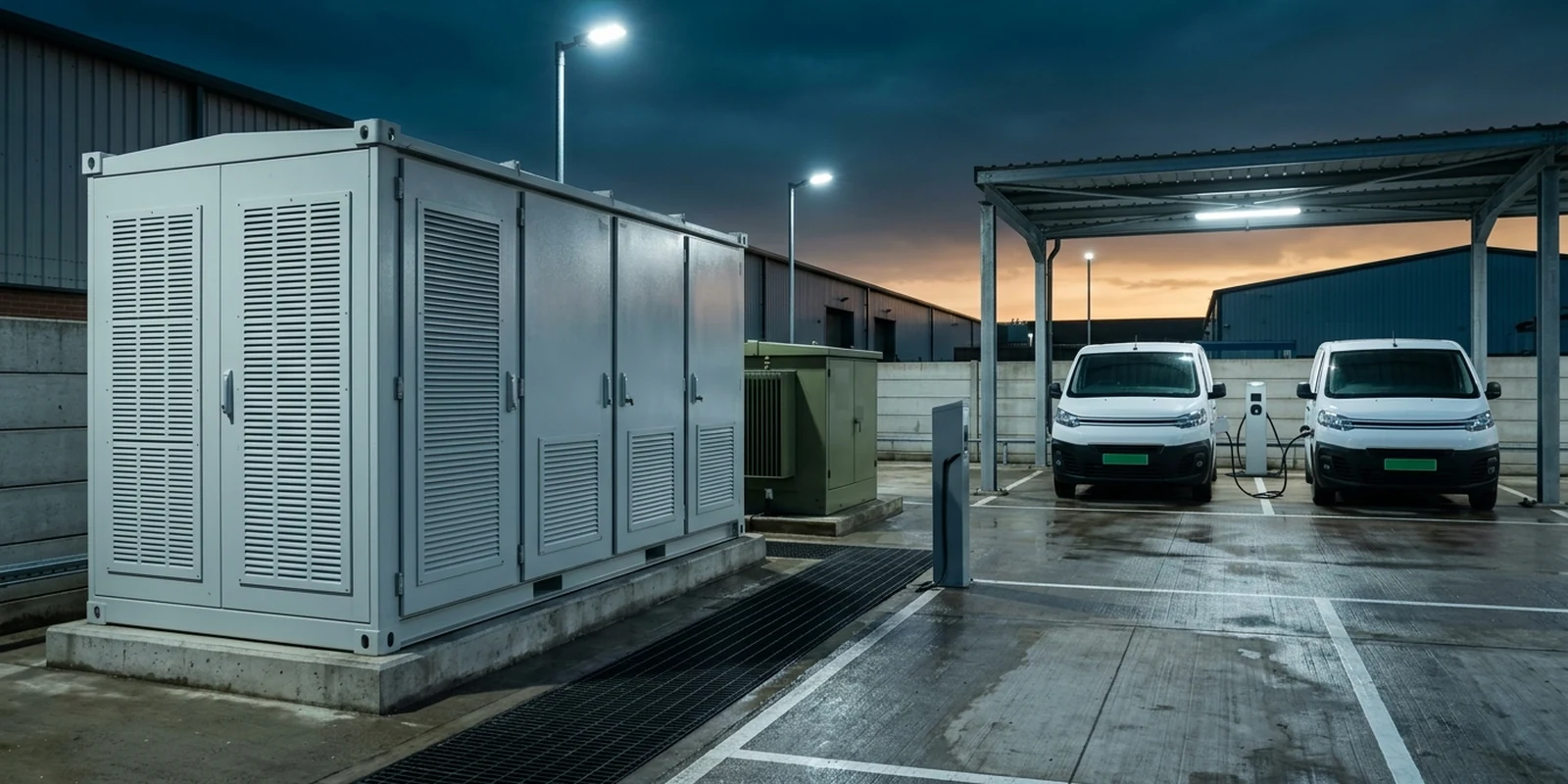
Battery Storage At The Depot
💡 Depot Battery Energy Storage System: Key Highlights
- A depot BESS competes with a transformer and a 33 kV bay — not with a sustainability target. Price it as avoided connection capex.
- Peak shaving is capped by your state’s billing-demand floor. In Chhattisgarh that floor is 85% of contract demand — worth ₹24,000 a month on a 400 kVA connection, and not a rupee more.
- Maximum demand is a 15-minute sliding window, so size the pack against the overlap (~225 kWh), not the depot’s whole evening (2,000 kWh).
- CEA models a grid-scale BESS at 88% round-trip efficiency, 2.5% annual fade and a 15-year life — the three numbers that actually move payback.
- The headroom you avoid buying is the real return. An extra 500 kVA of contract demand costs ₹24 lakh a year at ₹400/kVA/month, whether you draw it or not.
- A BESS loses where the demand charge is already nil, the overnight window is long, spare sanctioned load exists, or the depot lease is short.
If your depot cannot charge everything it needs to because the DISCOM sanctioned 400 kVA and your vans want 900, somebody has already offered you a battery energy storage system as the answer. It usually arrives wrapped in sustainability language, which is the least useful way to think about it. A depot BESS is not a green accessory. It is a capital asset you buy instead of a bigger grid connection — cells, steel and a concrete plinth bought in place of a transformer, a cable run, a 33 kV bay and however many months your DISCOM takes to energise them.
This post is for fleet operators whose depot charging is capped by sanctioned load, or whose bills are being punished by demand charges on contract demand. The question is never whether you should have storage. It is narrower and harder: is the battery cheaper than the connection upgrade it replaces, and does it stay cheaper once the pack has quietly lost a fifth of its capacity?
What A Depot Battery Energy Storage System Actually Buys
A depot battery does exactly two commercially useful things. Keep them apart, because they behave differently and only one of them usually justifies the cheque. Where the battery physically sits, how it ties into the site and how it interacts with rooftop solar are depot-planning questions — our EV depot design strategy guide covers those, including the solar-plus-storage case. This post stays on the money.
Headroom: More Chargers Behind The Same Sanctioned Load
Take 50 electric delivery vans at a Raipur depot on an 11 kV connection with 400 kVA of contract demand. You want eight more 60 kW DC guns, which is another 480 kW of instantaneous draw. Under the Chhattisgarh commission’s FY 2026-27 tariff order an 11 kV connection is capped at 500 kVA of contract demand, so you are not asking for a bigger number — you are asking for a different voltage. That means a 33 kV bay, a new transformer, a fresh feasibility study and the DISCOM’s queue. It is also permanent: the demand charge is levied on contract demand as a monthly minimum whether you draw it or not, so moving from 400 to 900 kVA at ₹400 per kVA per month adds ₹2,00,000 every month — ₹24 lakh a year, ₹3.6 crore across the fifteen years CEA assumes a battery lasts — before a single extra unit of energy. A battery that supplies the extra 480 kW for the ninety minutes it is genuinely needed buys the same headroom without touching the contract.
Peak Shaving: Real, But Capped Lower Than You Think
The second thing a BESS buys is a smaller bill on the connection you already have, and this is where business cases quietly overstate themselves. In Chhattisgarh, billing demand is the higher of the maximum demand actually recorded and 85% of contract demand. On 400 kVA that floor is 340 kVA. Shave the peak perfectly and the demand charge falls from ₹1,60,000 to ₹1,36,000 a month — ₹24,000, and not one rupee more, however good your battery is. Nearly every state order carries a floor like this. Find yours before you model anything, because it is the ceiling on half your savings.
How To Size A Battery Energy Storage System For A Depot
Size The Overlap, Not The Depot
Operators routinely size a depot pack against the whole evening’s energy and arrive at a number that kills the project on the spot. Fifty vans taking a 40 kWh top-up is 2,000 kWh, and nobody is buying that. But that is not what the battery is for. Maximum demand in Chhattisgarh — as in most states — is the highest sliding-window average kVA over any consecutive fifteen minutes in the billing month. One bad quarter-hour sets the charge for thirty days. So the battery only has to cover the part of the load curve that pokes above your target, for as long as it pokes. If the evening overlap runs 150 kW above target for ninety minutes, that is 225 kWh of discharge — a ninth of the naive number.
Then Add Efficiency, Depth Of Discharge And A Decade Of Fade
Three multipliers turn 225 kWh into a purchase order. CEA models grid-scale BESS at 88% round-trip efficiency, so delivering 225 kWh means buying about 256 kWh. You cannot cycle the whole pack either; at 80% usable depth of discharge you need roughly 280 kWh of nameplate capacity. And CEA assumes 2.5% annual capacity fade, taken from actual Indian tender results, which leaves a pack at about 78% of day-one capacity after ten years. Size for year one and you are short by year four. Size for year ten and you are buying about 360 kWh today to solve a 225 kWh problem.
50-van Raipur depot, 400 kVA contract demand, evening overlap 150 kW above target for 90 minutes.
| Energy the battery must deliver above your target (150 kW × 90 min) | 225 kWh |
| ÷ 88% round-trip efficiency — energy you buy per cycle | 256 kWh |
| ÷ 80% usable depth of discharge — nameplate needed in year one | 280 kWh |
| ÷ 78% capacity remaining after 10 years at 2.5% annual fade | ~360 kWh |
The Payback Picture, With Your Own Tariff In It
Put the two halves together, because separately they give opposite answers.
CEA’s Long-Term National Resource Adequacy Plan prices a four-hour grid-scale BESS at ₹5 crore per MW today, falling to ₹3.6 crore per MW by 2035-36 — about ₹12,500 per kWh installed, with 1% of capex a year in O&M over a fifteen-year life. Treat that as a floor, not a quote: a 360 kWh depot pack gets none of that scale, and CEA is explicit that real cost turns on depth of discharge, round-trip efficiency, degradation, cycle count, land and civil works. Cells are getting cheaper quickly — BloombergNEF’s 2025 survey put stationary-storage packs at $70/kWh, down 45% in a year and now the cheapest segment of the market — but a pack is not a commissioned system.
At ₹12,500 per kWh, 360 kWh is roughly ₹45 lakh. Against that, the peak-shaving leg earns ₹24,000 a month at absolute best, less the round-trip losses you pay for: 31 kWh a day at ₹7.85 per kVAh is about ₹7,200 a month. Net ₹16,800, or a little over ₹2 lakh a year before O&M. That is a payback approaching thirty years on a fifteen-year asset.
So peak shaving alone does not pay. The headroom pays — the ₹24 lakh a year of contract demand you never took on, plus the upgrade capex and the months of waiting you avoided. Get your DISCOM’s written estimate for the connection you would otherwise build, set it beside the ₹45 lakh, and the decision usually makes itself. Doing that honestly needs your own fifteen-minute demand data, which is what fleet analytics is for.
When A Battery Energy Storage System Loses
Your State May Have Already Zeroed The Demand Charge
Chhattisgarh’s schedule carries a separate EV-charging-station category with a demand charge of Nil and energy at ₹6.42 per kVAh. If your depot qualifies for the equivalent category in your state, the entire peak-shaving leg of the case is worth zero and you are arguing the battery on headroom alone. That is the first question to put to your DISCOM, not the last.
A Long Night, Spare Load, Or A Short Lease
The battery also loses when you simply have enough time. Fifty vans needing 2,000 kWh across a ten-hour window need 200 kW on average; if your 400 kVA connection is genuinely idle overnight you do not have a power problem, you have a sequencing problem, and software solves it for a fraction of the money. The same applies when the cheap window is already where you charge — Chhattisgarh prices 23:00 to 09:00 at the normal rate and only 17:00 to 23:00 at a 120% premium, so a depot that charges overnight has no time-of-day spread left to arbitrage. Working that spread is tariff strategy and belongs to our post on EV fleet dynamic tariffs; setting it up is covered in the tariff configuration guide. Finally, check the lease. CEA amortises a BESS over fifteen years. If the depot sits on a five-year lease the container can move, but the plinth, the trench and the grid-tie cannot.
No Control, No Saving
A battery is a buffer, not a plan. It lowers the peak only if something decides, in real time, which vans charge at what power and when the pack discharges — and that decision has to be right inside a fifteen-minute window, every day, for the life of the asset. A depot that cannot pause or throttle a session cannot bank the saving; the battery will follow the same uncontrolled peak and merely flatten a smaller version of it.
That control layer is its own subject with its own trade-offs — static versus dynamic allocation, departure-time priority, what happens when a van is left stranded — and our guide to electric vehicle smart charging at the depot covers it properly. What matters here is the dependency: the battery’s business case sits downstream of the control system, not beside it. If you are still allocating depot power by hand, fix that first. It costs almost nothing, and it may remove the need for the battery altogether. Where a battery does earn its place, charging management and a fleet operating system like YoMobility are what turn a stack of cells into a smaller bill. For the wider portfolio view — solar, storage and demand response together — see our piece on charging a bus fleet from distributed energy resources.
Frequently Asked Questions
Two things, and only one of them usually pays. It gives you headroom — more chargers running behind the same sanctioned load — and it shaves the monthly demand peak. The headroom is what normally justifies the spend, because it substitutes for a connection upgrade you would otherwise have to buy and then pay a monthly fixed charge on forever.
Far smaller than most operators assume. Size it against the part of the load curve that exceeds your target, not the depot’s total evening energy. A 150 kW overlap lasting ninety minutes is 225 kWh of discharge; after round-trip efficiency, usable depth of discharge and ten years of capacity fade, that is a pack of roughly 360 kWh — against a naive estimate of 2,000 kWh for the same depot.
No. State tariff orders set a billing-demand floor: in Chhattisgarh it is the higher of recorded maximum demand and 85% of contract demand. On a 400 kVA connection you can never be billed for less than 340 kVA, so perfect peak shaving saves ₹24,000 a month and stops there. To go lower you have to reduce contract demand itself, which is a different decision.
CEA amortises grid-scale BESS over fifteen years and assumes 2.5% capacity loss a year, based on recent Indian tenders. That compounds: a pack holds about 78% of its day-one capacity after a decade. Any sizing that only works on day one will stop working within about three or four years.
Often, but you have to compare the right numbers. Put the installed cost of the pack against two things together: the one-off capex of the transformer, cable and switchgear your DISCOM quotes, and the permanent monthly demand charge on the larger contract demand. At ₹400 per kVA per month, an extra 500 kVA costs ₹24 lakh a year whether you use it or not — and that recurring figure is usually what decides it.
Sources: CEA — Long-Term National Resource Adequacy Plan (2026-27 to 2035-36) | CSERC Tariff Order FY 2026-27 | MNRE — Energy Storage Systems overview | BloombergNEF — 2025 Battery Price Survey
Work Out Whether A Battery Beats A Bigger Connection
Tell us your sanctioned load, your charger count and when your evening peak actually lands, and we will show you the 15-minute demand picture your bill is built on — so you can price a pack against the connection upgrade instead of guessing.