
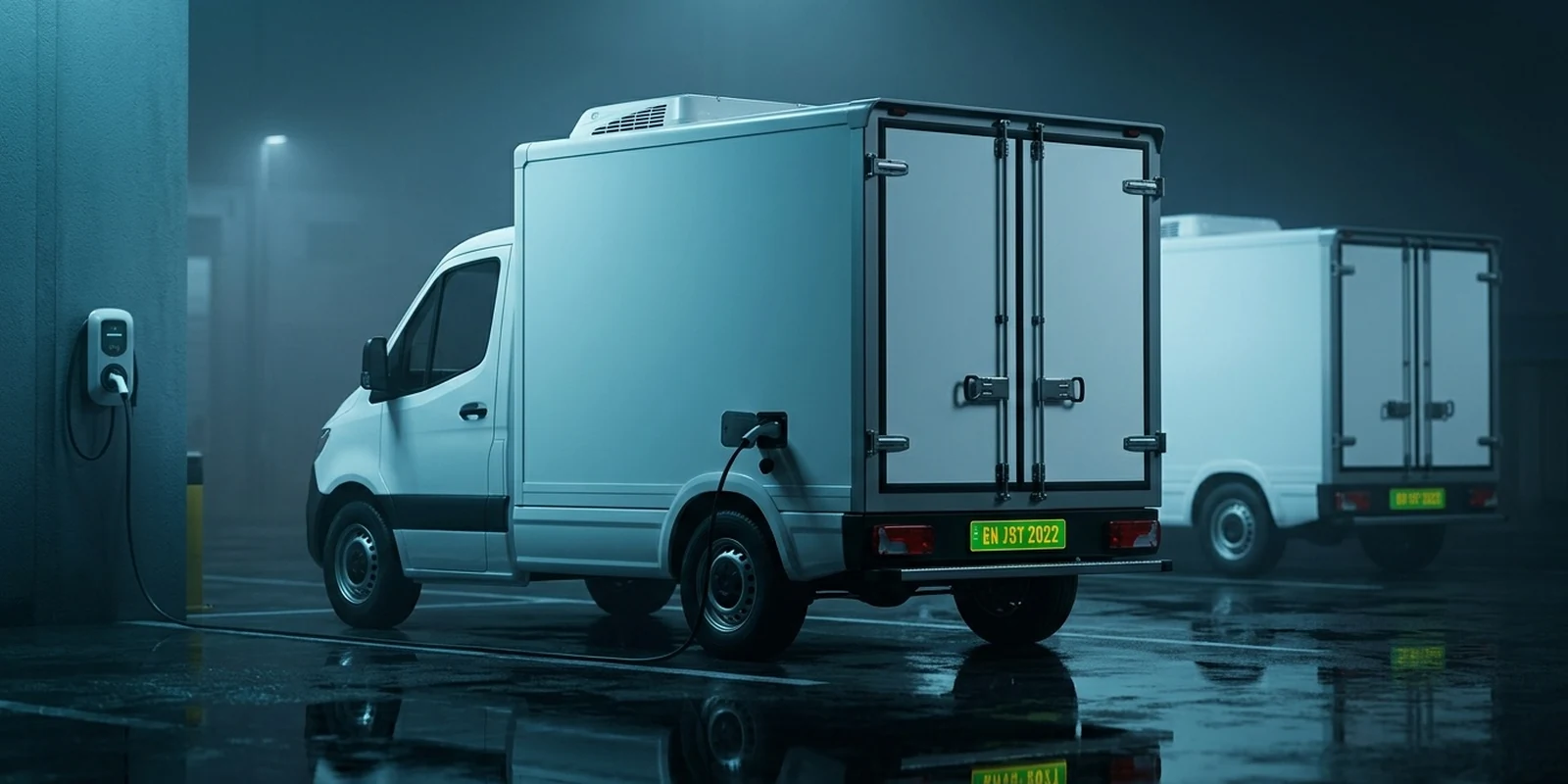
Electric Vans For Cold Chain Logistics
💡 Cold Chain Logistics On Electric Vans: Key Highlights
- The reefer and the drivetrain share one pack — refrigeration is a second vehicle on the same battery, not an accessory.
- Reefer energy scales with time and heat, not distance: ambient, door-open frequency and drop count beat kilometres.
- Payload is squeezed twice — by the battery, then by the insulated body — inside one certified gross vehicle weight.
- Pre-cool on shore power and put that load on the depot’s charging schedule, not on the driver.
- NCCD assessed India’s need at 61,826 reefer vehicles against roughly 9,000 in service — a gap of 52,826.
If you run cold chain logistics in India — a 3PL moving dairy and frozen quick-service stock, or a pharma distributor with a temperature-controlled last mile — the numbers you inherited from your diesel fleet will mislead you on electric reefer vans. This is for the operator who buys and runs the vehicles, not the shipper hiring a cold-chain service.
One design change causes all of it. NCCD’s definition of a reefer describes refrigeration “powered through integrated diesel driven motors, independent of the main” engine. On an electric van, the reefer and the drivetrain share one pack. Our guide to electric last-mile logistics covers the ambient case; what follows is what refrigeration changes.
Why Cold Chain Logistics Changes The Range Arithmetic
Traction energy scales with distance. Refrigeration energy scales with time and heat. That difference breaks the range assumptions carried over from diesel, so model the two as separate line items on one pack.
Take 50 chilled-distribution vans in Delhi. A 3.5-tonne van with a 40 kWh usable pack running 110 km at roughly 180 Wh/km uses about 20 kWh in traction. A small reefer unit averaging 1.8 kW across a nine-hour shift draws another 16 kWh — it runs at the kerb and in traffic, not only when the wheels turn. That is 36 kWh of 40 usable; on ambient goods the same van finishes at half pack.
| Where a 40 kWh pack goes on a 9-hour chilled shift | Energy | Share |
|---|---|---|
| Traction — 110 km at ~180 Wh/km | ~20 kWh | 50% |
| Refrigeration — 1.8 kW average over 9 hours | ~16 kWh | 40% |
| Margin for traffic, detours and reserve | ~4 kWh | 10% |
Illustrative model, not a vehicle specification — the method is the point. Size the reefer as its own load, then measure your own duty cycle.
Ambient temperature
Heat ingress is roughly proportional to the gap between outside air and setpoint. A 43°C Delhi afternoon against a +4°C setpoint is a 39-degree gradient; the same route in January at 20°C is 16. Same van, same drops, twice the reefer energy.
Door-open frequency
Every stop dumps warm air into the box, and pull-down back to setpoint is the most power-hungry state in the cycle. FSSAI’s handbook is blunt: doors stay closed except when the space is filled, emptied or cleaned.
Payload: The Pack And The Insulated Body Compete For The Same Tonne
Gross vehicle weight does not rise because the van is electric. The certified GVW on the registration certificate is fixed, so every kilogram the battery adds comes out of payload — and the insulated body takes a second slice from the same allowance.
Budget for both before you sign. A body built from 50–75 mm polyurethane panels plus a roof-mounted unit adds a few hundred kilograms over a dry box of the same external size — a coachbuilder figure that belongs on the quotation, in writing.
Fleets spec cold-chain vans on volume — “we need eight cubic metres” — and find the weight problem after delivery. Insulation cuts both ways: 60 mm of panel on six faces removes internal volume from the same envelope, so the van cubes out smaller and weighs out sooner than the brochure suggests.
Insist in writing on payload at certified GVW with the reefer body fitted, and on axle-wise loading — a roof-mounted condenser shifts weight forward before a single crate goes in.
Plan Routes By Drops And Door-Open Minutes, Not Kilometres
Once refrigeration is a second load on the pack, routing stops being a distance problem. Sequence and dwell decide whether the van comes home.
Build the route around cold minutes
Total each stop’s expected door-open time. Two 110 km routes with 12 and 38 drops are not the same job for an electric reefer van, though a distance-based planner prices them identically. Sequence the longest-dwell, most temperature-sensitive drops early, while the box is coldest.
Treat the mid-shift top-up as dearer than it looks
The load stays cold while the van charges, so the reefer draws throughout the session. A 30-minute DC top-up at 30 kW puts roughly 15 kWh in, less the kilowatt-hour the reefer takes back meanwhile. Park in shade: a van standing in direct sun gains heat faster than one moving.
Watch temperature and state of charge together
Two alarms that usually sit in separate systems belong together, because a falling pack and a rising box temperature are one incident. Live EV vehicle tracking alongside fleet alerts on one dashboard lets a controller re-sequence remaining drops rather than explain a rejected consignment afterwards.
Pre-Cool On Shore Power, Not On The Pack
The cheapest kilowatt-hour in cold chain logistics is the one the van takes from the depot’s grid connection before it leaves the yard.
Pulling an empty body from ambient to setpoint is the largest single cooling event of the day. Do it on shore power while the van is plugged in and it departs with a full pack and a cold box; do it on the pack after loading and you have spent route range on work the depot could have done far more cheaply. Insist on standby mains capability — a unit that cannot run on shore power forces every pre-cool onto the battery.
Then put that load on the schedule. Pre-cooling peaks in the hour before dispatch, exactly when chargers finish their overnight cycle: 50 vans at 2 kW each is 100 kW landing on a connection sized for charging alone. A depot charging schedule that stages both against the sanctioned limit avoids the demand-charge surprise, and a fleet operating system like YoMobility sequences them against one ceiling.
What Belongs In The Spec Sheet And The Contract
Three clauses decide who pays when the arithmetic above goes wrong.
Reefer duty cycle under warranty
Battery warranties are written in kilometres and years. A reefer van consumes pack cycles standing still, so ask the OEM to state in writing whether auxiliary load counts toward the warranty and how it is measured. A van spending 40% of its energy on cooling ages its pack faster than a kilometre-based schedule implies.
Temperature-excursion logging you can produce on demand
FSSAI puts delivery vehicle air temperature at 0°C to +5°C for chilled foods and −18°C for frozen, and food delivered at the wrong temperature must be rejected. Specify a logger with a fixed recording interval and exportable records, so a door-open spike and its recovery are both visible — an unlogged excursion is indistinguishable from a broken cold chain.
Liability when charging delays the load
If a charger is down and the consignment warms past the threshold, someone wears the loss. Name the excursion threshold, the evidence standard and the liable party in the 3PL contract before the first van is delivered, not during the claim.
Cold chain logistics on electric vans is a different energy problem wearing the same body. The capital support exists — MoFPI has approved 395 cold chain projects since 2008 on grants of 35–50%, capped at ₹10 crore. The fleets that model the reefer as a second vehicle before buying are the ones not surprised after.
Frequently Asked Questions
Sources: NCCD — All India Cold-chain Infrastructure Capacity | FSSAI — Safe Storage, Distribution & Transportation of Food | PIB / MoFPI — Integrated Cold Chain and Value Addition Infrastructure
Cold-chain fleet assessment
Send us your routes — drop counts, door-open times, setpoints, depot connection — and we will model the energy split, the real payload and the schedule your pre-cool load needs.
A 30-minute session to size refrigeration against your pack, payload and depot power.
Book a Free DemoOr write to sales@yomobility.com