EV Fleet Telematics: What Changes When You Track Batteries Instead Of Fuel
By YoMobility Team10 min read
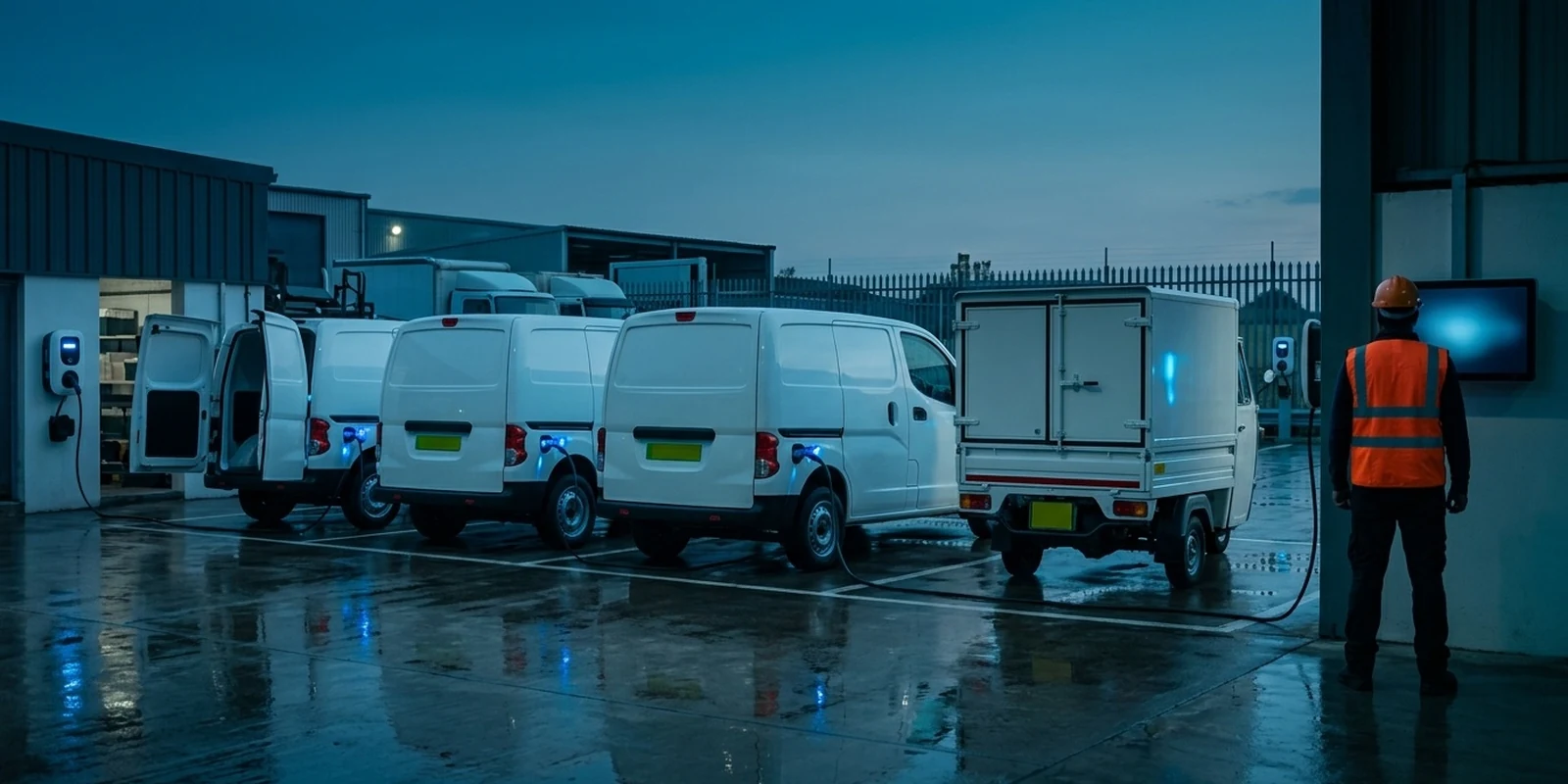
EV Fleet Telematics
💡 EV Fleet Telematics: Summary
- AIS-140 says where a vehicle is, not what its battery is doing — position to 5 m CEP, speed, heading, an emergency button, and no battery or energy parameter at all.
- State of charge is an estimate, not a gauge reading. Published errors run from under 1% on modern estimators to 8–15% on the current-integration methods still shipping in low-cost packs.
- State of health can only be captured forward. Tata Motors’ standard EV cover is 8 years or 160,000 km and engages below 70% — a claim is argued on logged history.
- Charging-event data has no diesel equivalent — metered kWh, charger identity, tariff at the moment of charge. OCPP 2.0.1, an IEC standard since 2024, carries them.
- Get the OEM field list in writing before signing. What the feed withholds — usually cell-level health — no dashboard can ever show.
A diesel fleet’s telematics answers two questions: where is the vehicle, and how much fuel is left. EV fleet telematics has to answer questions diesel never asked — and most operators find that out in month three, when the feed they bought turns out to carry position, speed and a state-of-charge percentage, and nothing else worth having.
This is for ops leads, depot supervisors and the technical lead procuring the hardware and data feed for a last-mile, taxi or corporate fleet in India. It is deliberately not about dashboards or metrics — our command centre operations guide covers dashboard design and escalation, and the KPIs Indian EV fleets should review covers which numbers matter. This is the layer underneath both.
What EV Fleet Telematics Has To Answer That Fuel Never Did
A diesel fleet has one energy vendor and one energy record: the fuel card. Electrification fragments that record across four systems and makes the vehicle one of them. Only one of the four data families has a diesel ancestor. Position and speed carry over unchanged. State of charge replaces the fuel gauge and behaves nothing like it. Battery state of health has no equivalent at all, and neither does charging-event data — which charger delivered how many kilowatt-hours to which vehicle, at what tariff, at what time. Miss any of them at procurement and the gap is permanent for that vehicle’s service life.
The test is blunt: ask a vendor to show cost per kilometre for one named vehicle, last month, split by depot, public network and driver’s home. Few can, because it needs vehicle data and charging-session data joined on the same identity. This is also no longer an early-adopter problem — the IEA records India’s annual EV sales at 2.3 million units, with electric car sales up over 75%.
State Of Charge Is Not A Fuel Gauge
A fuel gauge measures a physical quantity: liquid in a tank. State of charge measures nothing. The battery management system computes it from current integration and voltage modelling, and it drifts with temperature, load, cell age and time since the last full charge. How far you can trust it depends on the estimator inside the pack you bought — published research puts basic current-integration methods at 8–15% mean absolute error, Kalman-filter approaches below 3% RMSE, and modern learned estimators at roughly 0.4–2.5%.
Range remaining compounds it. The kilometres on the cluster are state of charge times usable capacity, divided by a predicted consumption rate that moves with ambient temperature, cabin cooling, payload and gradient. A loaded van on a 2 p.m. Delhi shift with the air-conditioning running does not consume what the same van consumes empty at 6 a.m. Same 60% on screen, different range — which is why “send anything above 40%” strands vehicles on hot loaded afternoons and wastes range on cool empty mornings.
Dispatch on energy headroom instead
Compare energy required with energy available. For 50 electric vans in Delhi, a 90 km afternoon round at an observed 240 Wh/km needs about 21.6 kWh, so a 30 kWh usable pack at 60% holds roughly 18 kWh and does not go — while the same vehicle at the same 60% clears a 70 km morning round at 195 Wh/km. That arithmetic assumes you stored usable capacity per vehicle and per-shift consumption history: procurement decisions, not dashboard features. Set on headroom rather than percentage, fleet alert and monitoring rules fire on real risk instead of a number that means something different every afternoon.
Battery State Of Health: The Number You Can Only Capture Forward
State of health is the share of original capacity a pack still holds. It sets residual value, decides which vehicle gets the long route, and determines whether a warranty claim is arguable — and alone among fleet metrics it cannot be reconstructed later. A single reading is close to meaningless; the useful artefact is a curve, per vehicle, across months, against kilometres, DC fast-charge share and ambient temperature. You either started that curve on day one or you do not have it.
Warranty claims are won on data, not on the pack
Indian OEM terms are more specific than fleets expect. Tata Motors’ standard EV battery and motor cover runs 8 years or 160,000 km, engaging where state of health falls below 70% of nominal energy; gradual loss above that line is expected behaviour and sits outside cover. The lifetime warranty announced for Curvv.ev and Nexon.ev 45 applies to first private owners and excludes commercial use, so a fleet is on standard terms regardless. The OEM then assesses the claim on its own BMS-reported figure — an operator logging that value monthly since delivery can show when the curve broke trend; one starting in year four has an opinion. Record separately whether a number is BMS-reported or from a controlled capacity test, because the two disagree. Our guide to what changes in EV fleet maintenance covers the servicing side of the same asset.
Charging-Event Data: The Feed With No Diesel Equivalent
Refuelling produced one record from one vendor. Charging produces a stream of events from up to four — depot chargers you own, public networks you roam onto, drivers’ home meters, occasional third-party depots. Until those events are attributed to a vehicle, cost per kilometre and driver reimbursement are not merely inaccurate, they are uncomputable. Five fields make a session usable:
| Field | What it decides | Where it comes from |
|---|---|---|
| Start and stop timestamps | Which time-of-day tariff band the session fell in | Charger via OCPP, or the CPO’s session record |
| Metered energy delivered | The cost basis — what you actually pay for | Charger meter, never a state-of-charge delta |
| Charger or EVSE identity | Depot vs public vs home split, per-site cost | OCPP or OCPI record |
| Vehicle or driver identity | Whether cost per km is per vehicle or fleet-average | RFID or app authorisation bound to the vehicle |
| Tariff in force at that moment | Real exposure to peak-hour pricing | DISCOM contract, or CPO price at session |
Miss the fourth row and every other row averages away.
The protocol side is settled enough to specify confidently: OCPP 2.0.1 replaced the older start, stop and meter-value messages with a unified TransactionEvent, supports clock-aligned meter values, and became IEC 63584 in 2024 — so a session can be reconstructed months later for a billing dispute. The failure mode is identity, not protocol. Chargers that start on a button press rather than per-vehicle authorisation give you depot kilowatt-hours, not vehicle kilowatt-hours, and a fleet-average cost per kilometre forever. Our EV fleet system integration guide covers the OCPI and AIS-140 plumbing, and driver home-charging reimbursement handles the source with no protocol at all.
Energy Per Kilometre Replaces Mileage
Fuel economy was a monthly fleet average from a bill. Watt-hours per kilometre can be computed per trip, driver and route, because the meter is on the charger and the odometer is on the vehicle bus. Two rules keep it honest. Measure grid-side: roughly a tenth of the energy drawn is lost in the charger, cabling and thermal management before reaching the cells, and the grid-side figure is the one on the bill. And never compare Wh/km across duty cycles — regenerative braking recovers far more in stop-start last-mile work than on a steady highway run, so a van that looks efficient may just be braking more. The ICCT puts e-buses around 70% more energy-efficient than diesel, but averages like that say nothing about which of your vehicles is drifting; track by route archetype and the outliers surface. Our EV fleet TCO breakdown for India carries the per-kilometre figure through to total cost of ownership.
Choosing A Data Source In India: OEM API, Dongle Or AIS-140
Three routes exist, and Indian fleets routinely assume the compliance device already bolted to the vehicle will do the job. It will not.
| Source | What you get | What you do not get |
|---|---|---|
| OEM telematics API | Location, speed, odometer, state of charge, usually charging state — supported and warranty-safe | Cell-level health in most cases; a common schema across brands; often, historical export |
| Aftermarket OBD/CAN dongle | Whatever the vehicle bus exposes, in one format across a mixed fleet | Anything the OEM does not publish on the bus — and it may affect warranty terms |
| AIS-140 VLTD (already fitted) | GPS and NavIC position to 5 m CEP, speed, heading, ignition state, emergency button | Every battery, energy and charging parameter — a compliance device, not a data source |
AIS-140 is mandatory and useful. It is simply answering a different question.
The OEM data-gap trap
Ask for the complete field list before signing, not the brochure. OEM APIs commonly expose state of charge while withholding pack state of health, cell voltages, cell temperatures and cumulative DC fast-charge energy — and no reporting layer can invent a field that never arrives. That is a permanent ceiling on your reporting, set at signature. Mixed-OEM fleets compound it: three brands means three field lists, three definitions of state of charge and three update rates, which makes reconciliation a vehicle management problem long before it is a dashboard problem. Teams normalise the feeds inside a fleet operating system like YoMobility rather than accept one OEM’s portal as the system of record — the same argument for keeping the data layer vendor-agnostic from the first vehicle.
An EV Fleet Telematics Procurement Checklist
Put these to the OEM or telematics vendor in writing, before signature.
- The complete parameter list — every field, with units and update frequency.
- Is pack state of health included? BMS-reported or test-derived, and at pack, module or cell level?
- Is cumulative charge throughput available — total kWh in, and the DC fast-charge share of it?
- What is the usable pack capacity, not the nominal rating, and is it reported as it changes?
- Is history retrievable through the API? Retained how long, and can we bulk-export it if we leave?
- Who owns the data, and may we share it with a third-party platform — in the contract, not on the call?
- API rate limits and per-vehicle cost at three times our current fleet size.
- If the depot chargers are ours: OCPP 1.6J or 2.0.1, and per-vehicle or per-plug authentication?
Answer them at procurement rather than at go-live for one reason. Location data can be backfilled from a new device next quarter; a battery degradation curve cannot. Whatever an EV fleet telematics contract leaves unspecified today becomes a blank column in every report you run for the next eight years.
Frequently Asked Questions
No. AIS-140 is a vehicle location tracking standard — GPS and NavIC position to 5 m CEP, speed, heading and an emergency button. It defines no battery, state-of-charge or energy parameter. Keep it for compliance and source battery and charging data separately.
State of charge is how full the pack is right now, as a share of the capacity it currently has. State of health is how much of the original capacity remains. A pack at 100% state of charge and 78% state of health is completely full and holds 78% of what it held when new.
Sometimes. It depends on whether the vehicle publishes the value on its CAN bus and whether you hold the manufacturer’s message definitions to decode it. On several Indian commercial EVs it is not exposed, and third-party hardware can affect warranty terms — get both answers in writing first.
Charging losses and a different metering point. The charger meters energy taken from the grid; state of charge reflects energy that reached the cells. Roughly a tenth is lost in the charger, cabling and thermal management, and the gap widens on DC fast charging and in high ambient temperatures.
For the life of the asset. Battery decisions are trend decisions, so per-vehicle state of charge, consumption and charging-session records should be kept until the vehicle is sold, and full historical export should be a contract term rather than a favour.
Sources: ARAI — Automotive Industry Standards | IEA — Global EV Outlook 2026 | ICCT — PM-eBus Sewa Emissions Assessment | Open Charge Alliance — OCPP 2.0.1 | Tata Motors — HV Battery Warranty
Manage Your Fleet’s Battery Data Today
Talk to YoMobility about the telematics and charging-session data your fleet should capture from day one — and how several OEM feeds become one set of numbers.
YoMobility EV-FMS
EV fleet management softwareRun every vehicle, driver, charge and payment from one platform. Charge on multiple networks, and get one invoice for all of it.
Resources
Keep reading
Driver Monitoring System For EV Fleets: What The Camera Sees And What It Should Change
💡 Driver Monitoring System: Summary A driver monitoring system is usually bought as a camera and judged on detection: does […]
EV Battery Replacement Cost For Fleets: What Drives The Quote — And When Replacing Is The Wrong Call
💡 EV Battery Replacement Cost: Key Highlights The EV battery replacement cost is the largest single repair bill a fleet […]

Electric Scooter For Delivery Fleets: Specs That Survive A Full Rider Shift
💡 Electric Scooter For Delivery Fleets: Summary An electric scooter for delivery and an electric scooter for commuting are usually […]
See YoMobility on your fleet
Tell us how many vehicles you run and where they charge. We'll show you how they'd run on one platform, with one invoice.
Or contact us