
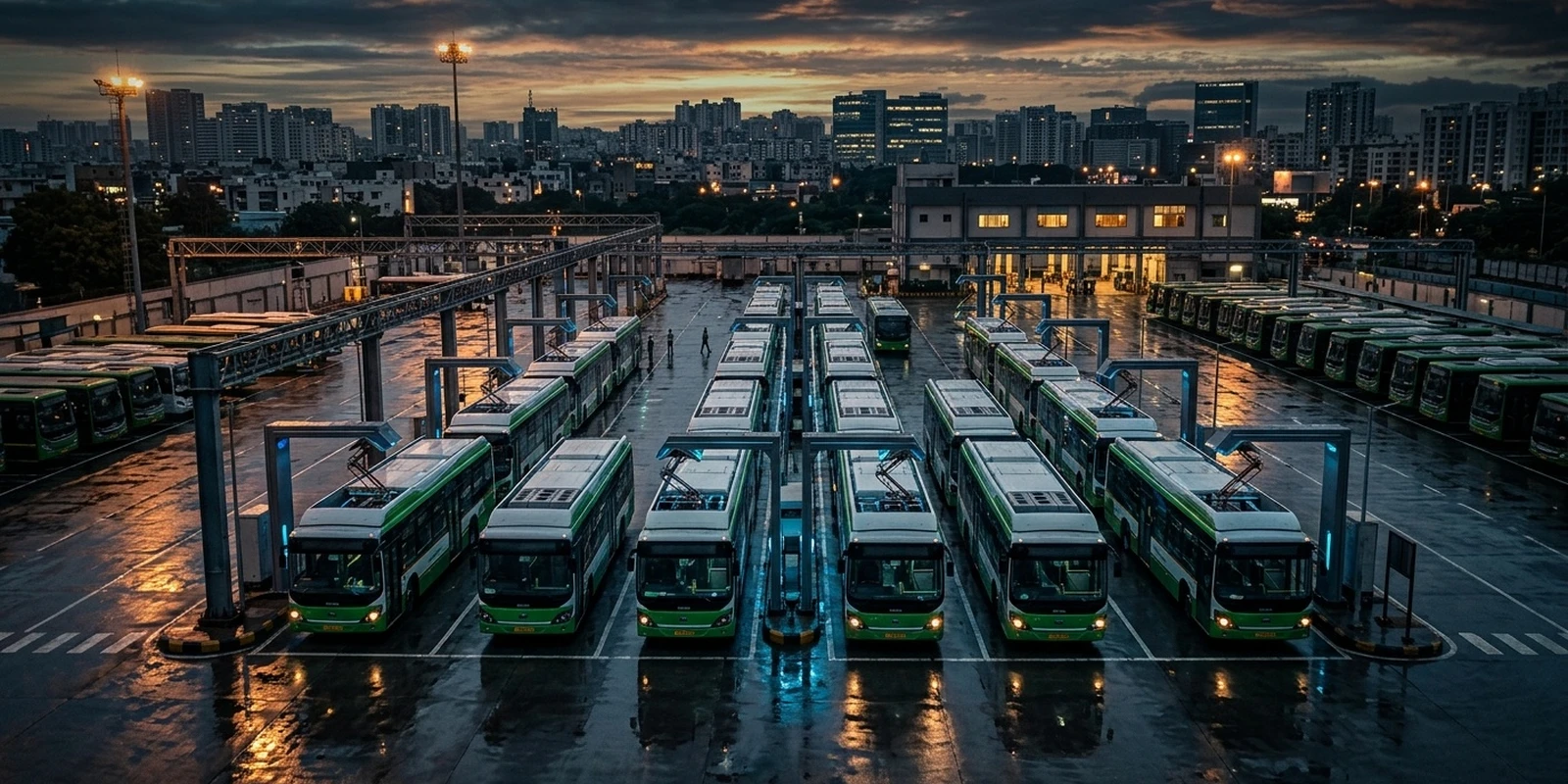
Only 523 Of 27,555 Sanctioned E-Buses Are Running
💡 PM eBus Sewa Deployment Gap: Key Highlights
- 27,555 e-buses are sanctioned across India’s e-bus schemes against a national target of 38,000 — but only 523 are actually running as on 10.07.2026, under 2% of the sanctioned fleet.
- The coverage splits three ways: 10,000 buses under MoHUA’s PM-eBus Sewa Scheme, 14,000 under MHI’s PM E-DRIVE Scheme, and 3,555 under state/STU initiatives.
- Odisha illustrates the lag concretely: 400 e-buses allocated under PM-eBus Sewa, zero deployed as on 03.08.2026.
- The PSM (Payment Security Mechanism) layer exists specifically to de-risk operator and OEM payments from cash-strapped Public Transport Authorities — a ₹3,435.33 crore backstop notified in October 2024.
- Recurring bottlenecks: tender-to-delivery timelines that routinely exceed a year, charging-depot infrastructure that hasn’t kept pace, and State Transport Undertakings carrying an estimated ₹38,000 crore in collective debt.
- The gap isn’t a scheme failure — it’s a large, already-funded deployment wave still working its way from sanction to the road, which is exactly the phase where fleet-management tooling earns its keep.
India’s e-bus rollout has a numbers problem that has nothing to do with funding. Government data disclosed in the Lok Sabha shows the country’s e-bus schemes have sanctioned 27,555 buses — nearly three-quarters of the national 38,000-bus target — yet only 523 of them are physically on the road. That’s the PM eBus Sewa deployment gap in one statistic: a scheme that isn’t short of buses on paper, but is very short of buses in service. For fleet operators, State Transport Undertakings (STUs), and the OEMs building these vehicles, understanding why that gap exists — and how long it’s likely to persist — matters more than the headline sanction number itself.
The Gap, By The Numbers
The figures come from a written reply by the Ministry of Heavy Industries in the Lok Sabha, posted 4 August 2026. As on 10 July 2026, India’s combined e-bus schemes — the PM-eBus Sewa Scheme (Ministry of Housing & Urban Affairs), the PM E-DRIVE Scheme (Ministry of Heavy Industries), and various State Government/STU initiatives — together cover 27,555 e-buses against a targeted 38,000. Of that sanctioned pool, only 523 e-buses have actually been deployed under the PM-eBus Sewa–Payment Security Mechanism (PSM) Scheme. That’s a deployment rate of under 2% against what’s already been approved and funded.
Breaking down the 27,555 figure matters, because “sanctioned” covers three different funding tracks that move at different speeds: 10,000 buses under MoHUA’s PM-eBus Sewa Scheme, 14,000 under MHI’s PM E-DRIVE Scheme (which replaced FAME-II after that scheme concluded on 31 March 2024, with a ₹10,900 crore outlay notified 24 September 2024), and 3,555 through State Government and STU-led procurement. Each track has its own tendering process, its own OEM contracts, and — as the Odisha case below shows — its own pace of translating a sanction letter into a bus at a depot.
What The PM eBus Sewa PSM Scheme Actually Does
The “PSM” in PM eBus Sewa–PSM stands for Payment Security Mechanism, and the name is a clue to why this scheme exists at all. E-buses are typically run under gross-cost contracts, where a private operator or OEM buys, deploys, and maintains the buses while a Public Transport Authority (PTA) — usually a state or city transport corporation — pays a fixed per-kilometre fee. That model only works if the PTA actually pays on time, and India’s STUs are not known for that: the sector carries an estimated ₹38,000 crore in collective debt across roughly 56 STUs. A single missed payment cycle can make an e-bus contract unviable for an operator that’s already carrying the higher upfront cost of electric vehicles.
The PSM Scheme, approved by the Ministry of Heavy Industries with a ₹3,435.33 crore outlay notified in October 2024, sits underneath the PM-eBus Sewa Scheme specifically to remove that payment risk. If a PTA defaults, the mechanism steps in to protect the selected bidder, operator, or OEM — reducing the single biggest reason private operators have historically avoided aggressive bidding on Indian e-bus tenders. In other words, the PSM layer was designed to fix a financing problem, not a manufacturing or infrastructure one. That distinction is useful context for the deployment numbers above: the scheme has done its job of getting buses sanctioned at scale. What it can’t do on its own is compress the time it takes a sanctioned order to become a running bus.
Why Sanctioned Buses Aren’t Reaching The Road
The clearest illustration: Odisha
400 e-buses have been allocated to Odisha under MoHUA’s PM-eBus Sewa Scheme. As on 3 August 2026, deployment against that allocation stood at zero — a full month after the national deployment count was reported at 523, and with no buses yet on Odisha’s roads under this allocation.
Odisha isn’t an outlier so much as a clean example of a pattern repeating across states. Four causes show up consistently in how India’s e-bus tenders move from award to deployment:
Tender-to-delivery timelines routinely exceed a year
Industry reporting on the sector has flagged that deployment typically follows tender award by more than 12 months, and delays in finalising tenders push that timeline out further still — disrupting OEM production planning in the process (Business Standard). A bus “sanctioned” this quarter may not be contractually due for delivery until well into next year.
Charging-depot infrastructure hasn’t kept pace with sanctioned volumes
An e-bus is only as useful as the depot charging infrastructure behind it. A meaningful share of the cities where tenders have closed reportedly still lack fully operational charging depots, which means buses can be built and delivered before there’s anywhere for them to charge overnight — a sequencing problem, not a demand problem.
STU balance sheets are stretched thin
A standard 12-metre e-bus costs roughly ₹1.2–1.5 crore before subsidy — about 2 to 2.5 times a comparable diesel bus. For STUs already carrying tens of thousands of crores in debt, that upfront gap makes even PSM-backed contracts harder to close quickly, and slows the state-level approvals that sit between a national sanction and a local rollout.
Operator participation has been uneven
Some large aggregated e-bus tenders have drawn fewer private bidders than expected, with operators citing contract-risk and viability concerns even under the PSM framework. Fewer credible bidders on a tender means slower award-to-deployment cycles for the buses that do get sanctioned.
None of this means the PM eBus Sewa deployment gap reflects a scheme in trouble. It’s worth reading alongside a genuinely strong adjacent data point: the PLI-Auto scheme, which covers EV manufacturing capacity more broadly, has already drawn ₹44,326 crore in investment — more than its own ₹25,938 crore outlay — and disbursed ₹2,386.36 crore in incentives against 67,820 jobs created as of 31 March 2026 (see our earlier coverage of the PLI-Auto investment numbers). Manufacturing capacity is scaling. The e-bus numbers say the harder problem is everything that happens after a bus rolls off the line: tendering, depot readiness, and STU cash flow.
What It Means For Fleet Operators And STUs
Read the deployment numbers as a timing signal, not a demand signal. 27,555 buses funded against a 38,000-bus target means a large wave of e-buses is still coming — it’s just arriving on a longer curve than the sanction headlines suggest. For STUs, private operators, and OEMs preparing for that wave, the operators who convert a sanction into a running bus fastest will be the ones who treat depot-readiness and fleet operations as seriously as they treat the tender itself.
In practice, that means three things get harder to run on spreadsheets as fleets scale past a pilot batch: vehicle and charge-state visibility across a depot with buses arriving in tranches rather than all at once; real-time alerts when a charger, route, or SOC threshold needs attention before it turns into a missed service; and payment and invoice reconciliation that stays clean even when a PSM claim, a state subsidy, and an OEM warranty are all moving through the same operation at once. This is exactly the operational layer an EV fleet management platform like YoMobility is built for — giving STUs and PSM-scheme operators one place to track vehicles, depots, and payments as sanctioned buses convert into running ones, instead of chasing that visibility across separate spreadsheets and vendor portals.
The honest takeaway from this data isn’t that India’s e-bus push is behind schedule in some alarming way — it’s that the country has moved past the “will these buses get funded” question and is now squarely in the harder “how fast can we actually run them” phase. That’s a fleet-operations problem, and it’s solvable with the right tooling in place before the next tranche of sanctioned buses starts arriving at the depot gate.
Frequently Asked Questions
What is the PM eBus Sewa Payment Security Mechanism (PSM) Scheme?
It’s a Ministry of Heavy Industries scheme, notified in October 2024 with a ₹3,435.33 crore outlay, that protects e-bus operators and OEMs from payment defaults by Public Transport Authorities. It sits under the broader PM-eBus Sewa Scheme, which targets deployment of 38,000 e-buses nationally.
How many e-buses are sanctioned in India, and how many are actually running?
As on 10 July 2026, 27,555 e-buses are covered under India’s combined e-bus schemes against a 38,000-bus national target. Only 523 of them had actually been deployed under the PM-eBus Sewa–PSM Scheme as of the same date — under 2% of the sanctioned total.
Why has Odisha deployed zero of its 400 allocated e-buses?
The government’s own reply doesn’t give a state-specific reason for Odisha, but the pattern nationally points to a mix of tender-to-delivery timelines that often exceed a year, charging-depot infrastructure that isn’t yet operational in every tender city, and STU financial constraints that slow local approvals even after national sanction.
Does the deployment gap mean the PM eBus Sewa scheme has failed?
No. The scheme has succeeded at what it was designed to do — get e-bus contracts sanctioned at scale by removing PTA payment risk for operators and OEMs. The gap sits in the deployment stage: tendering, manufacturing ramp-up, and depot readiness, which run on a separate, longer timeline than sanction approvals.
What should fleet operators and STUs do to close the sanction-to-deployment gap?
Prioritise depot and charging readiness ahead of bus delivery rather than after it, and put fleet-management tooling in place early — for vehicle/charge-state visibility, alerting, and payment reconciliation across PSM claims, subsidies, and OEM contracts — so that operational capacity doesn’t become the next bottleneck once buses do arrive.
Source: Ministry of Heavy Industries, Lok Sabha written reply — Press Information Bureau, Government of India, 4 Aug 2026 (PRID 2294481) | Ministry of Heavy Industries — PM e-Bus Sewa PSM Scheme.
Manage Your Fleet’s e-Bus Rollout Today
From sanction to depot to route — track every e-bus, charger, and payment in one place as your fleet scales past the pilot phase.
Book a Free Demo