
💡 EV Fleet CPO Utility Partnerships: Key Highlights
- Connection mandate vs. reality: Ministry of Power guidelines direct DISCOMs to sanction charging connections within 7–30 days, but fleets requesting new HT/33kV capacity in several states report real timelines of 3–18 months without a structured agreement.
- The tariff ceiling isn’t the tariff you should pay: the single-part EV charging tariff cap (Average Cost of Supply, through 31 March 2028) protects against overcharging — it doesn’t make charging cheap. Time-of-day and group-captive structuring do.
- Group-captive status waives cross-subsidy surcharge under Section 42(2) of the Electricity Act, 2003 — one of the largest legal levers on a depot’s landed tariff.
- UBC is building national roaming on OCPI and Beckn, but until every network a fleet uses is covered, roaming terms belong in the CPO contract, not just the app.
- Most CPO contracts sell charging, not data — session-level API access should be a named clause, not an informal ask.
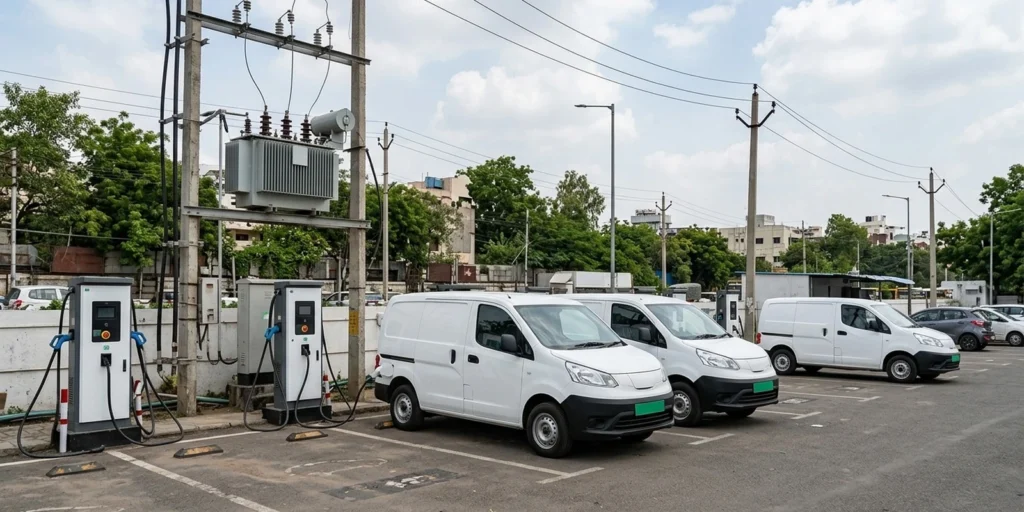
Building EV fleet CPO utility partnerships is what separates a 10-vehicle pilot from a 200-vehicle operation that never runs out of power at the wrong time. For last-mile delivery fleets and urban taxi operators in Bengaluru, Delhi or Mumbai, the charging point operator (CPO) you swipe a card at and the DISCOM whose wires actually deliver the electricity are, today, mostly strangers to your business — you’re a walk-up customer paying a posted rate, competing for capacity with retail EV owners, and hoping the app works when you need it. That works fine for 10 vehicles. It doesn’t survive 100.
This is for CXOs and fleet heads deciding how seriously to formalize those relationships — what to negotiate for reserved capacity, tariffs, roaming and data — before scale forces the decision on worse terms.
Why Ad-Hoc CPO Relationships Break Down At Scale
At a small scale, informal works fine. A 10-taxi operator in Bengaluru or a 15-van last-mile fleet in Delhi can run entirely on public charging apps and depot top-ups without ever speaking to a CPO’s account team. The moment a fleet crosses roughly 50–100 vehicles — the point where last-mile and taxi operators typically start planning a dedicated depot — four cracks show up at once.
The Capacity Ceiling
Public and workplace CPO infrastructure is typically sized for staggered retail walk-up demand, not 40 vehicles plugging in within the same two-hour window at shift change. Without a reserved-capacity agreement, a fleet is competing for the same limited kW as every other user, and the CPO has no obligation to prioritize it.
The Tariff Volatility Problem
Public charging tariffs are posted rates, not fleet rates — they don’t move with volume, and they carry the full commercial-tariff burden that a negotiated depot arrangement can avoid.
The Roaming Gap
A driver on a route outside the depot’s coverage is at the mercy of whichever CPO network happens to be nearby — and India’s charging market is still split across dozens of independent networks with historically limited cross-acceptance between them.
The Data Blackout
A fleet’s own dashboard shows what its own chargers report — nothing about a partner CPO’s session history, or whether a slowdown at a public charger was a CPO fault or a DISCOM-side capacity constraint. Neither party is contractually obliged to share that.
Reserved Capacity: Turning A CPO Into An Infrastructure Partner
The Ministry of Power’s Revised Consolidated Guidelines for EV charging infrastructure direct DISCOMs to sanction a charging connection within 7 days in metro cities, 15 days in other municipal areas, and 30 days in rural areas. In practice, fleet operators applying for new HT or 33kV connections in several states have reported real timelines of 3 to 18 months for a new transformer or substation upgrade — the mandate covers the paperwork, not the physical grid capacity behind it.
Depots are already recognized as a distinct “captive charging” facility class under the same guidelines, and State Nodal Agencies are tasked with coordinating DISCOM connections for e-bus depot, workplace and community charging specifically. That’s the opening a fleet should use: instead of applying for capacity vehicle-by-vehicle as the fleet grows, a structured agreement locks in a load-reservation schedule tied to the fleet’s own growth plan — so the DISCOM sanctions ahead of demand instead of reacting to it.
What To Put In The Agreement
- A minimum guaranteed kW block, reviewed quarterly against fleet growth — not renegotiated from zero every time.
- A priority-restoration clause for depot power during outages, critical for fleets running overnight charging with no daytime buffer.
- Advance-notice windows (60–90 days) for capacity-upgrade requests, so scaling from 50 to 150 vehicles doesn’t stall on a fresh multi-month sanction cycle.
Negotiated Tariffs: Group Captive, Time-Of-Day, And The Real Savings Math
The regulatory floor is a ceiling, not a deal. Ministry of Power guidelines cap the tariff for Public Charging Stations at a single-part rate that cannot exceed the DISCOM’s “Average Cost of Supply” — and that protection now runs only through 31 March 2028. It stops fleets from being overcharged; it doesn’t make charging cheap.
Two levers actually move the number. The first is time-of-day (ToU) structuring: Delhi’s DISCOMs already run a dedicated EV charging tariff around ₹4.5/kWh, well under standard commercial rates, and are examining differential time-of-day pricing through the Delhi Electricity Regulatory Commission specifically to push more charging into off-peak, lower-tariff hours — shifting depot charging into a late-night window can plausibly cut the per-unit rate by a fifth to a third versus evening-peak charging on an unstructured connection.
The second is captive or group-captive structuring. Under Section 42(2) of the Electricity Act, 2003, captive and group-captive consumers are exempt from the cross-subsidy surcharge — and the additional surcharge — that standard open-access consumers otherwise pay. A fleet depot large enough to qualify as captive, alone or grouped with other consumers, can land a materially lower per-unit rate than an unstructured commercial connection, particularly in states where the cross-subsidy surcharge runs high. None of this happens by reading the nearest CPO’s storefront rate card — it happens because a fleet’s finance team negotiated it as a depot-level agreement.
The Financing Angle
A negotiated, multi-year tariff schedule does something beyond cost reduction: it gives a lender or investor evaluating a fleet-electrification capex plan a fixed input-cost assumption instead of a variable one — exactly the kind of predictability that turns a fleet-electrification business case from directionally good into bankable.
Roaming: Why Interoperability Belongs In The Contract, Not Just The App
A last-mile or taxi fleet rarely charges in one place. Vehicles top up at the depot, at a partner CPO’s public network mid-route, and occasionally at a third network entirely — and India’s charging market has long been split across more than 30 independent CPO networks with limited cross-acceptance between them, forcing drivers to carry multiple apps and RFID cards.
The Ministry of Power and Bureau of Energy Efficiency’s Unified Bharat eCharge (UBC) framework — built on the OCPI roaming protocol and the Beckn network layer — is the national fix for this, designed to let any EV user charge on any participating network through one app or account instead of bilateral CPO-to-CPO agreements. We’ve covered how UBC actually works for fleet operators in a separate explainer on Unified Bharat eCharge; the point here is narrower: until UBC coverage is universal across every CPO a fleet actually uses, roaming terms — which networks a fleet’s drivers can use, at what rate, on what settlement cadence — belong as an explicit clause in the CPO contract, not an assumption based on which app happens to work that day.
Data Sharing: The Clause Most Fleets Forget To Negotiate
Standard CPO service agreements are built to sell charging, not data. Most say nothing about whether a fleet gets API access to session-level data — energy delivered, session duration, fault codes, time-of-day breakdown — or whether that data stays locked inside the CPO’s own app. For a fleet trying to track energy cost per km, charger utilization, or missed trips caused by charging delays, that gap means rebuilding by hand what the CPO’s backend already knows.
It matters more once a utility relationship enters the picture too: telling apart a CPO-side charger fault from a DISCOM-side voltage or capacity constraint needs session data from one side and grid data from the other, and neither is obliged to hand it over by default. A structured partnership should include a data-export or API-access clause as a named contract line item — the same way payment terms or uptime SLAs are — not an informal ask to an account manager.
The Neutral OS Layer: Making EV Fleet CPO Utility Partnerships Work At Scale
Once reserved capacity, negotiated tariffs, roaming terms and data-sharing clauses are actually in place across multiple CPOs and, in some cases, a direct DISCOM relationship, a fleet is managing several simultaneous commercial relationships that don’t naturally talk to each other. Somebody still has to sit above all of it — tracking whether reserved capacity is actually being used, whether the negotiated tariff is showing up correctly on every invoice, and whether roaming sessions on a partner network are behaving the way the contract says they should.
That’s the specific gap a fleet operating system like YoMobility is built to close: unifying vehicle data, multiple charging networks, energy and tariff data, and payments across every partner in one place, so the fleet negotiating its next CPO or DISCOM agreement works from real utilization numbers instead of a CPO’s sales deck. It doesn’t replace any of the underlying commercial relationships — it’s the layer that makes running several of them at once operationally sane, and gives a fleet’s own negotiating position more weight the next time a tariff or capacity agreement comes up for renewal.
Two things sit deliberately outside this piece’s scope. Reconciling what’s actually owed across those CPOs once the sessions happen — automated invoicing, driver reimbursement, dynamic tariff application — is a related but separate operating discipline, covered in our EV fleet payments strategy piece. And the CPO side of this relationship — who to bring into the partnership and how — lives on our CPO partnership page. For turning a reserved-capacity plan into a day-to-day operating schedule across chargers and vehicles, that’s what our charging management module is built for.
Frequently Asked Questions
It’s a load-reservation agreement with a DISCOM or CPO that guarantees a fleet a minimum kW block at a depot or charging site, instead of competing for available capacity first-come. It’s negotiated ahead of need and typically reviewed quarterly against the fleet’s growth plan.
Under Section 42(2) of the Electricity Act, 2003, captive and group-captive consumers are exempt from the cross-subsidy surcharge (and additional surcharge) that standard open-access consumers pay — which can meaningfully lower the landed per-unit tariff for a depot large enough to structure as captive or group-captive, especially in states with a high cross-subsidy surcharge.
Unified Bharat eCharge (UBC) is the Ministry of Power and Bureau of Energy Efficiency’s national interoperability framework, built on the OCPI protocol and the Beckn network layer, meant to let any EV user charge across participating networks with one app or account instead of bilateral agreements between every CPO pair. Until it covers every network a fleet actually uses, roaming terms are still worth negotiating directly into CPO contracts.
For anything beyond a handful of vehicles on public charging, both matter. The CPO contract covers charging service, tariffs and roaming; a direct or CPO-mediated relationship with the DISCOM is what secures reserved capacity and connection-timeline commitments for a depot as it scales.
Session-level data — energy delivered, session duration, fault or downtime codes, time-of-day breakdown — via API access, not just an in-app summary. This is what feeds fleet KPI tracking, ESG/CSRD-style reporting, and diagnosing whether a slowdown is a CPO or a DISCOM-side issue.
Ministry of Power guidelines direct DISCOMs to connect a charging station within 7 days in metros, 15 in other municipal areas and 30 in rural areas — but fleet operators requesting new high-capacity transformer or substation capacity in several states have reported real timelines of 3 to 18 months, which is exactly why locking in reserved capacity ahead of scaling matters.
Sources: Ministry of Power — Revised Consolidated Guidelines & Standards for EV Charging Infrastructure | Delhi Government — EV Policy Update Portal | Delhi Electricity Regulatory Commission — Open Access Charges
Manage Your Fleet’s Charging Partnerships Today
See how YoMobility unifies vehicles, multiple CPO networks, energy data and payments — so your next tariff or capacity negotiation is backed by real utilization data, not guesswork.