
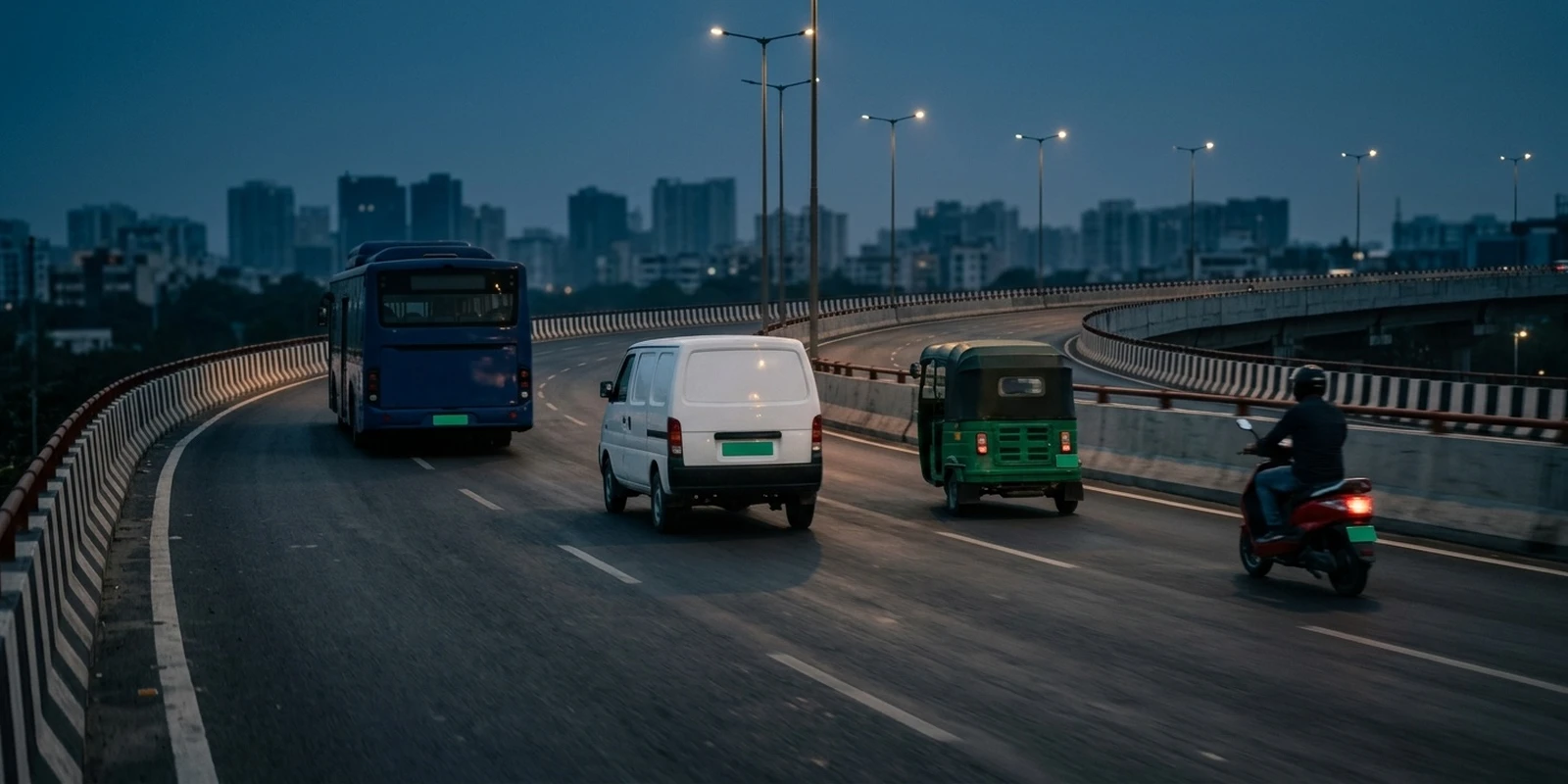
India EV Ecosystem Report 2026: 46x Sales Growth Since 2016
📊 India EV Ecosystem Report 2026: Key Highlights
- EV sales grew 46x since 2016 — ~50,000 units (2016) to 2.3 million units (2025) — outpacing global EV growth of ~20x.
- EV share of vehicle sales rose from 0.08% (FY15-16) to 8.26% (FY25-26); registrations grew at 62%+ CAGR over the decade.
- NITI Aayog’s new India Electric Mobility Index (IEMI) ranks every state — Delhi, Maharashtra and Chandigarh are the current Frontrunners.
- 52,718 public charging stations as of July 2026 (16,561 fast-charging); 1.32 million targeted by 2030.
- The ecosystem raised $1.4B+ in FY2025; the EV market is projected to hit $191.04B by 2034.
- PM E-DRIVE, PLI-Auto and PLI-ACC now fund vehicles, batteries and charging infrastructure simultaneously.
India’s EV sales have grown 46x since 2016 — more than double the ~20x rate the global EV market posted over the same stretch. That’s the headline number in Roads Reimagined: The Rise of India’s Electric Vehicles Ecosystem, a Backgrounder the Press Information Bureau released on 5 August 2026 covering sales, exports, a new state-competitiveness index, and a market forecast running to 2034. This India EV ecosystem report 2026 is less a scorecard than a roadmap of where public money and policy are pointing next — directly relevant to any fleet operator or OEM planning a multi-year vehicle-acquisition strategy.
EV Sales And State-Wise Growth: 46x Since 2016
India sold roughly 50,000 EVs in 2016. By 2025, that had climbed to 2.3 million units — a 46x increase that outpaced the global EV market’s ~20x growth over a comparable window (918,000 to 18.78 million units, 2016–2024). EV penetration rose from 0.08% of total vehicle sales in FY15-16 to 8.26% in FY25-26, with registrations growing at a compound annual rate of over 62% across the decade. India’s EV penetration relative to the world went from roughly one-fifth of the global rate in 2020 to over two-fifths by 2024.
Most of this growth isn’t passenger cars — it’s two- and three-wheelers. Electric two-wheelers (12.8 lakh units) and three-wheelers (8 lakh units) sold in 2025 did the heavy lifting, which matters for fleet planning: last-mile delivery and short-hop passenger fleets are electrifying faster than any other segment.
Which states are leading
Uttar Pradesh sold more than 4 lakh EVs in 2025 — 18% of national sales — followed by Maharashtra and Karnataka. Multi-state fleets should expect the deepest charging and servicing ecosystems in these three states first.
| State | 2025 EV Sales | Share Of National Sales |
|---|---|---|
| Uttar Pradesh | 4 lakh+ units | 18% |
| Maharashtra | 2.66 lakh units | 12% |
| Karnataka | 2 lakh units | 9% |
Exports And India’s Rise As A Global EV Manufacturing Hub
Exports grew from USD 1.2 million in 2020 to USD 84 million in 2024, led by Nepal, Indonesia and Japan. Still a small base in absolute terms, but the direction matters: India is shifting from an assembly market to a genuine manufacturing and export hub, with domestic production now covering battery packs, motors, drivetrains, power electronics and charging equipment.
The clearest proof point is Suzuki’s “e VITARA,” inaugurated in August 2025 — Suzuki’s first global strategic Battery EV, made in India for export to 100+ countries including Europe and Japan; India is now Suzuki’s global EV manufacturing hub. Tata Motors, Mahindra, TVS and Bajaj Auto are expanding EV capacity through dedicated platforms and gigafactory investment, alongside global entrants like VinFast and Korean and Japanese battery makers evaluating India-based production. Around 400 EV startups now operate in India, spanning charging infrastructure, battery innovation and AI-driven features — a supply-chain density worth pairing with our coverage of the rare-earth magnet supply constraint affecting EV motor production.
Charging Infrastructure At A Glance
Charging is deliberately the shortest section here — not because it doesn’t matter, but because it isn’t new information. As of July 2026, per BHEL, India has 52,718 public charging stations, of which 16,561 are fast-charging equipped, locatable via the government’s e-Amrit tool. The 2030 target is 1.32 million stations nationally — roughly 25x today’s count. For the fuller build-out picture, see YoCharge’s breakdown of India’s public EV charging station numbers rather than duplicating that ground here.
NITI Aayog’s New India Electric Mobility Index (IEMI)
The genuinely new data point in this release is the India Electric Mobility Index (IEMI), launched by NITI Aayog in August 2025 — a first-of-its-kind framework scoring every state and union territory across 16 indicators spanning three pillars: transport electrification, charging infrastructure readiness, and EV research & innovation. States are grouped as Frontrunners, Performers or Aspirants; Delhi, Maharashtra and Chandigarh currently hold Frontrunner status.
For fleet operators and OEMs choosing where to expand, the IEMI works as a state-readiness scorecard no prior data point offered: a low score is now a legible early-warning signal for charging-infrastructure and policy friction, not just an assumption based on sales volume. Expect it to become a standard reference in site-selection decisions over the next few state budget cycles.
Investment And The Policy Stack Powering India’s EV Ecosystem Report 2026
India’s EV ecosystem raised over USD 1.4 billion in FY2025, up ~27% year-on-year; EV manufacturers alone captured about USD 1.2 billion, with Delhi the top city for EV investment. That capital flows into a policy stack far more layered than five years ago:
- State policies: 29 states/UTs had notified EV policies as of December 2025 (4 more in draft) — 15–25% capital subsidies, land allotment, stamp duty waivers, up to 100% SGST reimbursement. Tamil Nadu, Maharashtra, Karnataka, Gujarat, Haryana and Uttar Pradesh lead as manufacturing hubs.
- PM E-DRIVE (₹10,900 Cr) targets 28 lakh+ EVs, 22.12 lakh already sold (Jan 2026); ₹4,391 Cr covers 14,028 e-buses, ₹2,000 Cr for charging stations, ₹780 Cr for testing-agency upgrades. Sanction and deployment are furthest apart on the e-bus line — see our piece on the PM e-Bus Sewa deployment gap.
- PLI-Auto has disbursed ₹2,377.56 Cr cumulatively, ₹2,319.88 Cr of it to EV manufacturers — full detail in our PLI-Auto investment breakdown.
- PLI-ACC Battery Storage (₹18,100 Cr) targets 50 GWh of domestic cell capacity — batteries are 35–40% of an EV’s total cost.
Read together, this isn’t a single-scheme story — public capital is now committed across the entire EV value chain at once: vehicles, batteries, charging and testing infrastructure.
What It Means For Fleet Operators
The forward-looking numbers in this India EV ecosystem report should shape multi-year fleet strategy. India’s EV market, valued at USD 3.71 billion in 2025, is projected to reach USD 191.04 billion by 2034 (54.94% CAGR); the EV battery market alone grows from USD 2.71 billion to USD 15.90 billion over the same period. The government’s target is 30% EV share of all sales by 2030 (EV30@30), backed by 1.32 million planned charging stations. CAFE III (2027–2032) and CAFE IV (2033–2037) norms tighten CO₂ limits to 91.7 g/km and 70 g/km, both with a super-credit mechanism that rewards higher EV sales — compressing the runway for OEMs further.
None of this is abstract for a fleet operator. A market scaling toward $191 billion by 2034, a compressed regulatory timeline, and a state index that increasingly determines where infrastructure and policy support land first all point the same way: the fleets that convert this growth wave into running vehicles fastest will be the ones with visibility into charge state, depot scheduling and payment reconciliation from day one — the operational layer a fleet operating system like YoMobility exists to manage, paired with fleet analytics and CO₂ reporting to keep ESG and acquisition planning on one dashboard.
Download The Full PIB Backgrounder
“Roads Reimagined: The Rise of India’s Electric Vehicles Ecosystem” — the complete 14-page government report behind every number in this article.
Frequently Asked Questions
Roughly 46x — from about 50,000 units sold in 2016 to 2.3 million units sold in 2025, per the PIB’s August 2026 EV ecosystem backgrounder.
A NITI Aayog index (launched August 2025) scoring every state and UT across 16 indicators spanning transport electrification, charging readiness, and EV R&D, classifying each as Frontrunner, Performer or Aspirant.
₹4,391 crore for 14,028 e-buses, with 13,800 earmarked for seven metro cities including Bengaluru, Delhi, Mumbai, Hyderabad, Ahmedabad, Pune and Surat.
USD 191.04 billion by 2034, up from USD 3.71 billion in 2025 — a 54.94% CAGR, per the government’s market-size projections.
India’s next-phase fuel-efficiency norms (2027–2032 and 2033–2037), tightening CO₂ limits to 91.7 g/km and 70 g/km, with a super-credit mechanism rewarding higher EV sales.
Source: PIB Backgrounder — “Roads Reimagined: The Rise of India’s Electric Vehicles Ecosystem” — Press Information Bureau, Government of India, 05 August 2026 (PRID 2294688).