₹9,585 Crore PARIVARTAN Scheme Guidelines Approved: Truck & Bus Replacement Incentives For Delhi-NCR
By Shaurya Rathore10 min read
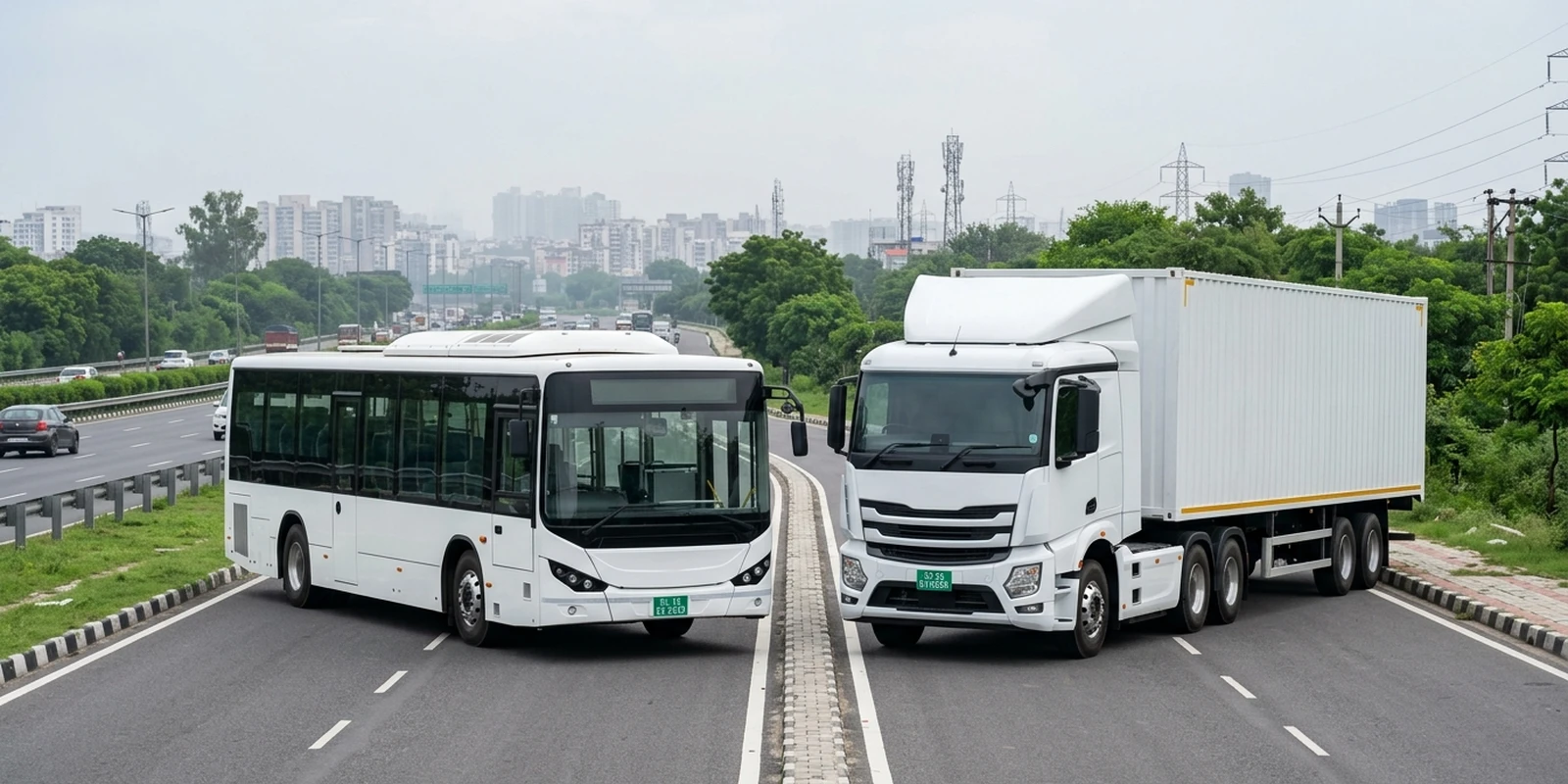
💡 PARIVARTAN Scheme Guidelines: Key Highlights
- ₹9,585 crore total outlay, including ₹5,041 crore in central budgetary support — guidelines approved 16 July 2026, MoRTH implementing via NCRPB.
- Incentive stack: MV tax concession, registration fee waiver, 5% interest subvention, minimum 8% OEM discount, monthly fuel voucher (diesel/CNG) or one-time EV assistance, plus Certificate of Deposit (CoD) trading.
- Rajasthan, Haryana, Uttar Pradesh, and the NCT of Delhi have already notified the 10-year MV tax concession and registration fee waiver.
- 11 OEMs — over 95% of commercial vehicle market share — have signed MoUs to honour the OEM discount.
- Claims run through one digital pipeline — VAHAN, V-Scrap, DigiELV and PFMS — not manual, cross-department paperwork.
India’s PARIVARTAN scheme guidelines just moved from headline to checklist. On 16 July 2026, the Ministry of Housing and Urban Affairs (MoHUA) approved the detailed operational guidelines for the PARIVARTAN scheme — Delhi-NCR’s ₹9,585 crore programme to retire ageing, polluting trucks and buses in favour of BS-VI or electric replacements. If you run a commercial fleet anywhere in the National Capital Region, this is the point where PARIVARTAN stops being a policy announcement and starts being a set of decisions: which vehicles qualify, which states have already notified their share of the incentives, and — most practically — how the money and paperwork actually move.
We covered the scheme’s build-out when its original PARIVARTAN scheme coverage first tracked its OEM partners signing on; this piece picks up from there and focuses on what’s operational today — eligibility, the state-by-state rollout, the full incentive stack, and the digital claims pipeline running through VAHAN, V-Scrap, DigiELV and PFMS.
The PARIVARTAN Scheme Guidelines Are Now Operational For Delhi-NCR
The Union Cabinet cleared PARIVARTAN — the Programme for Accelerated Renewal and Incentivization of Vehicle Assets for Reducing Transport Air Pollution and Network Emissions — on 3 June 2026, with a total outlay of ₹9,585 crore, including ₹5,041 crore in direct central budgetary support. What MoHUA approved on 16 July is the layer that actually matters to a fleet owner: the detailed guidelines that spell out who qualifies, what you get, and how you file.
The Ministry of Road Transport and Highways (MoRTH) is the implementing ministry, and the scheme is funded through the National Capital Region Planning Board (NCRPB) — the body that has historically routed central infrastructure spend into NCR-specific programmes. Union Minister Manohar Lal, who chairs the NCRPB, called the guidelines’ approval a landmark step for the region, noting the scheme is designed to meaningfully cut vehicular pollution from ageing trucks and buses and improve the region’s Air Quality Index (Cabinet approval note, June 2026).
For fleet operators, the practical read is simple: the scheme is no longer a future benefit to plan around — it’s live, funded, and running through named digital systems today.
Who Qualifies: Eligible Vehicles And Owners
PARIVARTAN targets exactly the vehicle category most Delhi-NCR fleet operators have been under pressure to retire: older, high-emission trucks and buses that predate BS-VI norms.
Vehicles Targeted For Replacement
The scheme is built around commercial trucks and buses running on BS-IV or earlier emission norms — the same vehicle category that’s been increasingly restricted from NCR roads under Supreme Court-driven end-of-life enforcement over the past two years. If your fleet includes vehicles caught in that bracket, PARIVARTAN is the financial mechanism designed to make replacement affordable rather than simply mandatory.
What You Can Replace Into
Eligible replacements fall into two tracks: BS-VI-compliant diesel or CNG vehicles, or fully electric trucks and buses. Both tracks draw on the same core incentives — tax concession, registration waiver, interest subvention, OEM discount. The running-cost support differs by track, which is where the real choice gets decided (more on that below).
Confirm before you budget: the published guidelines don’t spell out an exact minimum vehicle age or registration-date cutoff — MoRTH’s implementation notification and the VAHAN portal are the source of truth once your state has formally notified. Check your specific fleet’s eligibility there before committing capital around the scheme.
The Full Incentive Stack: What You Actually Get
PARIVARTAN doesn’t offer a single subsidy — it stacks seven distinct forms of support, some automatic, some tied to your state’s notification status, some tied to which replacement fuel you choose.
₹9,585 Cr
Total outlay
₹5,041 Cr
Central funding
11 OEMs
MoUs signed
Min. 8%
OEM discount
5%
Interest subvention
| Incentive | What It Covers | Applies To |
|---|---|---|
| Motor Vehicle Tax concession | Waiver/reduction on MV tax for 10 years | All eligible replacement vehicles (notified states) |
| Registration fee waiver | No registration fee on the new vehicle | All eligible replacement vehicles (notified states) |
| Interest subvention | 5% off the vehicle loan interest rate | Financed purchases |
| OEM discount | Minimum 8% off the ex-showroom price | Vehicles from the 11 MoU-signed OEMs |
| Fuel voucher support | Monthly voucher toward running fuel cost | BS-VI diesel/CNG replacement vehicles |
| One-time EV assistance | Lump-sum payout at purchase | Electric replacement vehicles |
| Certificate of Deposit (CoD) trading | Tradeable credit generated on scrapping the old vehicle | All owners scrapping an eligible old vehicle |
Financing Support Changes The Replacement Math
Take a ₹35 lakh BS-VI truck. An 8% OEM discount takes roughly ₹2.8 lakh off the sticker price before financing even enters the picture — and 11 OEMs, representing over 95% of commercial vehicle market share, have already signed MoUs committing to it. Layer in the 5% interest subvention on a typical 5-year commercial vehicle loan, and the effective borrowing cost for a PARIVARTAN-eligible replacement drops meaningfully below what the same fleet would pay financing a like-for-like vehicle outside the scheme.
Running-Cost Support Differs By Fuel Choice
Owners replacing into BS-VI diesel or CNG get a monthly fuel voucher — a recurring, usage-linked benefit that offsets fuel spend for as long as it runs. Owners replacing into electric vehicles instead get a one-time financial assistance payout at purchase, plus Certificate of Deposit (CoD) trading tied to scrapping the old vehicle. For a fleet operator modelling total cost of ownership, that’s the real decision variable: a recurring per-litre offset versus a lump sum plus a materially lower per-km running cost from day one.
Where It’s Live: State-By-State Notification Status
Central funding is approved network-wide, but the tax concession and registration fee waiver are state-executed — they only apply where your state has formally notified them.
| State / UT | Notification Status | Incentives Confirmed |
|---|---|---|
| Rajasthan | Notified | 10-year MV tax concession + registration fee waiver |
| Haryana | Notified | 10-year MV tax concession + registration fee waiver |
| Uttar Pradesh | Notified | 10-year MV tax concession + registration fee waiver |
| NCT of Delhi | Notified | 10-year MV tax concession + registration fee waiver |
Rajasthan, Haryana, Uttar Pradesh and the NCT of Delhi cover the bulk of NCR’s commercial vehicle registrations, but if your fleet is registered elsewhere in the wider NCR footprint, track your own state’s notification before assuming the full stack applies. The central components — interest subvention, OEM discount, fuel voucher, EV assistance — aren’t affected either way; it’s specifically the tax and registration relief that waits on state action.
Electric Or BS-VI Diesel/CNG: Which Replacement Pencils Out
PARIVARTAN is fuel-agnostic by design — it doesn’t push every operator toward electric. Which track pencils out depends on how the vehicle is actually used.
A 40-truck intra-NCR distribution fleet running fixed depot-to-depot routes under 150 km a day is close to the ideal electric-replacement profile: predictable range, depot charging windows, and a running-cost advantage that compounds daily on top of the one-time EV assistance. A 60-bus intercity operator running longer, less predictable routes across NCR’s periphery may find BS-VI CNG or diesel the more immediately workable choice — the monthly fuel voucher softens running cost while charging infrastructure catches up on those corridors, with electric phased in as routes and depot charging mature.
| Factor | BS-VI Diesel/CNG Replacement | Electric Replacement |
|---|---|---|
| Running-cost incentive | Monthly fuel voucher (recurring) | One-time EV assistance + lower per-km cost |
| Best-fit route profile | Long-haul, unpredictable, thin charging corridors | Fixed, depot-based, high daily utilization |
| Infrastructure dependency | Low — existing fuel network | Higher — depot/public charging access |
| Tax, registration, financing support | Same stack applies | Same stack applies |
How To Actually Claim It: The Digital Claims Pipeline
PARIVARTAN’s guidelines route the entire claim — scrapping, registration, discount, concession, subvention, disbursal — through one integrated digital platform rather than manual paperwork across departments.
Scrap And Register
- Scrap the eligible old vehicle through a registered facility; the Certificate of Deposit (CoD) is logged in V-Scrap.
- Register the replacement vehicle — BS-VI or electric — through VAHAN; DigiELV cross-verifies the end-of-life vehicle record against the new registration.
- The OEM discount is applied at the point of sale by any of the 11 MoU-signed manufacturers.
Concessions, Subvention And Disbursal
- Motor Vehicle Tax concession and registration fee waiver apply automatically at registration, in states that have notified them.
- The 5% interest subvention is adjusted directly with the financing lender at loan disbursal.
- Fuel voucher (diesel/CNG) or one-time EV assistance is credited through the Public Financial Management System (PFMS) straight to the owner’s account.
What Delhi-NCR Fleet Operators Should Do Now
- Audit your fleet for BS-IV-or-older trucks and buses now, before you’re forced into a compliance-driven replacement instead of a planned one.
- Model electric vs BS-VI diesel/CNG per route, not per fleet — the right call for a depot-based distribution route is often the wrong call for a long-haul or unpredictable one.
- Confirm your state’s notification status before budgeting on the full stack — the four notified states get every layer immediately; others get the central layers now and state relief once notified.
- Keep documentation route-ready for V-Scrap, VAHAN, DigiELV and PFMS — the digital pipeline moves fast for operators with vehicle and ownership records in order, and slowly for those without.
This is exactly the kind of transition where the paperwork problem is bigger than the vehicle problem. A fleet operating system like YoMobility tracks which vehicles in your fleet are PARIVARTAN-eligible through vehicle management, flags where each one sits in the scrap-register-claim pipeline, and keeps a single record of tax concessions, OEM discounts, interest subventions and vouchers claimed per vehicle — instead of that living across four disconnected departments’ worth of paperwork. If you’re deciding between BS-VI and electric for a specific route, the same utilization and range data that feeds fleet reporting and analytics is what makes that call numbers-driven instead of guesswork. As electric enters the mix alongside BS-VI diesel and CNG, having one EV fleet management platform like YoMobility orchestrating vehicles, charging and payments across a mixed fleet is what keeps the transition manageable instead of chaotic.
Frequently Asked Questions
The PARIVARTAN scheme guidelines are the detailed operational rules MoHUA approved on 16 July 2026 for replacing old, BS-IV-or-older trucks and buses in Delhi-NCR with BS-VI or electric vehicles. They follow the Union Cabinet’s 3 June 2026 approval of the scheme’s ₹9,585 crore outlay and make the incentive stack claimable rather than just announced.
The scheme targets commercial trucks and buses operating on BS-IV or earlier emission norms in the NCR. Eligible owners can replace them with BS-VI-compliant diesel/CNG vehicles or with electric trucks and buses.
A Motor Vehicle Tax concession, registration fee waiver, 5% interest subvention on vehicle loans, a minimum 8% OEM discount, monthly fuel voucher support for diesel/CNG replacements, one-time financial assistance for electric replacements, and Certificate of Deposit (CoD) trading on the scrapped vehicle.
Rajasthan, Haryana, Uttar Pradesh, and the NCT of Delhi have notified the 10-year Motor Vehicle Tax concession and registration fee waiver. Central incentives apply regardless of state notification; the state-level tax and registration relief depends on each state formally notifying it.
Through an integrated digital pipeline: scrapping and Certificate of Deposit issuance via V-Scrap, replacement vehicle registration via VAHAN (cross-checked through DigiELV), OEM discounts applied at sale, and subsidy/voucher disbursal through the Public Financial Management System (PFMS).
It depends on route profile. High-utilization, predictable depot-to-depot routes tend to favour electric, where the one-time EV assistance and lower running costs compound daily. Longer or less predictable routes, especially where charging infrastructure is still catching up, often work better with BS-VI diesel or CNG for now, with electric phased in as routes and depot charging mature.
Source: Press Information Bureau — Ministry of Housing and Urban Affairs, 16 July 2026 (PRID 2285463).
Manage Your Fleet’s PARIVARTAN Transition Today
Track every eligible vehicle, incentive claim and replacement decision — electric or BS-VI — from one dashboard as your fleet moves through PARIVARTAN.
YoMobility EV-FMS
EV fleet management softwareRun every vehicle, driver, charge and payment from one platform. Charge on multiple networks, and get one invoice for all of it.
Resources
Keep reading
CAFE Norms 2027-2032 Are Final: What EV Super-Credits Mean For Fleet Buyers
💡 CAFE Norms 2027-2032: Key Highlights India’s CAFE norms 2027-2032 are now final. On 30 September 2026 the Ministry of […]
State EV Policy Scores Just Jumped: What The India Electric Mobility Index 2025 Means For Fleets
💡 India Electric Mobility Index 2025: Key Highlights India’s state EV scorecard moved a long way in twelve months. The […]
Electric Heavy Duty Truck In India: Deployments Grew 4x As NITI Aayog Launches PACT
💡 Electric Heavy Duty Truck In India: Key Highlights India deployed 826 electric freight vehicles in FY26, up from 201 […]
See YoMobility on your fleet
Tell us how many vehicles you run and where they charge. We'll show you how they'd run on one platform, with one invoice.
Or contact us