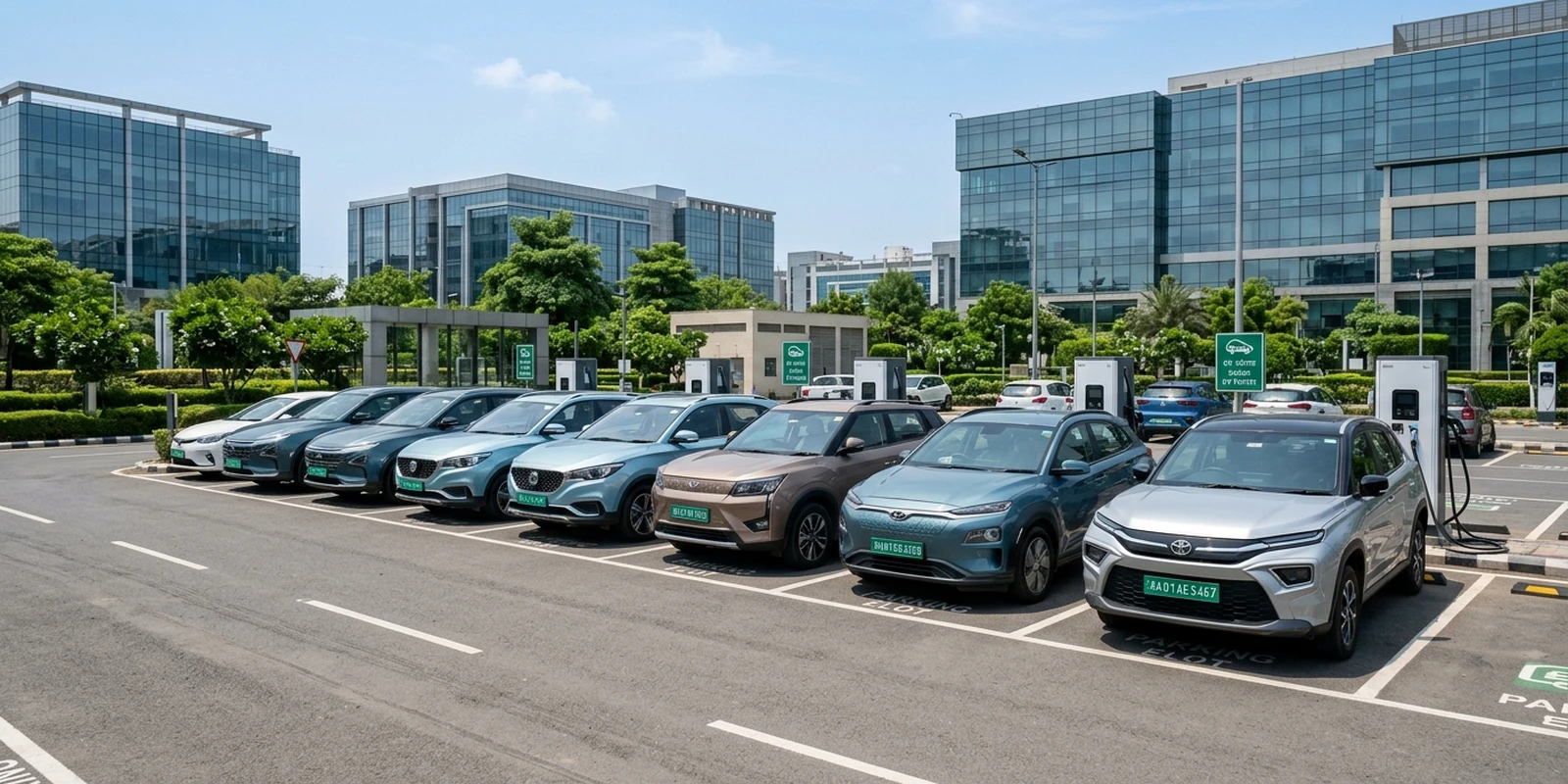
Mixed Corporate EV Fleet Strategy: The Business Case For Employee Transport
SBy Shaurya Rathore10 min read
💡 Mixed Corporate EV Fleet Strategy: Key Highlights
Employee commuting is Scope 3, Category 7 under the GHG Protocol — and it typically runs 10–30% of a company’s total emissions footprint, a line a mixed corporate EV fleet strategy directly shrinks.
SEBI’s BRSR Core framework already requires reasonable third-party assurance for the top 150 listed companies, widening to the top 1,000 by FY 2026–27 — commute-linked energy data has to survive an audit, not just a self-declaration.
Section 135 of the Companies Act lets companies route CSR spend (2% of average net profit) into “environmental sustainability” under Schedule VII — fleet electrification can qualify, subject to your CSR committee’s sign-off.
Over 20 EV100-aligned businesses have pledged 390,000+ India fleet vehicles to go electric by 2030 — corporate mobility is now a boardroom line item, not a facilities afterthought.
One employee-transport EV report found roughly ₹15.7 crore in annual fuel-cost savings at enterprise scale — before any ESG credit is even counted.
Running shuttles, campus transport and business travel as one mixed ICE+EV fleet needs a single operating system for data and payments — not three separate spreadsheets.
If you run corporate mobility — employee shuttles, campus cabs, or the sedans your leadership team takes to client meetings — the calculus around EVs isn’t just a cost question anymore. It’s an ESG, CSR and RFP-scoring question your CFO and compliance team are probably already tracking. A mixed corporate EV fleet strategy — one that electrifies daily employee transport and business travel over a realistic multi-year runway, without forcing an overnight swap of every ICE vehicle on your books — is the version corporate mobility heads and sustainability leaders can actually defend in a board meeting. This is different ground from last-mile delivery or aggregator taxi fleets: your buyer here is a mobility head or sustainability lead reporting upward, not a route planner optimizing drop density. Everything below is built for that reader.
The Corporate Mobility Segment: Employee Transport, Shuttles And Business Travel
“Corporate fleet” is really three different sub-fleets wearing one badge. Daily employee shuttles and cabs run fixed routes on fixed shift windows — IT parks, GCC campuses, manufacturing sites — with the kind of route predictability that makes overnight depot charging almost trivial to plan. Campus and GCC transport operates at real scale: a mid-size GCC in Pune or Bengaluru can easily run 100–150 vehicles across two or three shifts a day. Executive and business-travel fleets are smaller in vehicle count — a 10–20 car pool is typical — but carry outsized brand visibility, since these are the vehicles clients, auditors and site visitors actually see.
Why This Segment Differs From Last-Mile Or Taxi Fleets
Corporate transport has two structural advantages over last-mile or aggregator-taxi electrification: fixed routes mean charging windows are known weeks in advance, not improvised mid-shift, and the reporting stakeholder is internal — your own sustainability and compliance teams — rather than an external aggregator’s app rating. The trade-off is that passenger comfort and vehicle presentation standards are higher, and the ESG story has to hold up to an audit, not just a customer review.
The ESG Case: Why Employee Commute Emissions Land On The CFO’s Desk
Employee commuting is classified as Scope 3, Category 7 under the GHG Protocol, and for many companies it accounts for 10–30% of total reported emissions — a bigger single line than most people expect. In India, that number stopped being academic once the SEBI BRSR Core framework introduced mandatory reasonable third-party assurance on a phased glide path — starting with the top 150 listed companies by market cap and expanding to the top 1,000 by FY 2026–27. Scope 1 and Scope 2 disclosures are already mandatory for BRSR-covered companies; Scope 3 remains a leadership (voluntary) indicator today, but the direction of travel is unmistakable, and commute-linked energy and emissions data increasingly has to survive an external auditor, not just an internal sustainability report.
What Counts As Category 7 In Your Reporting
Category 7 covers commuting by any mode, including remote work — but company-owned or company-leased transport (your shuttles, campus cabs, executive fleet) is controlled emissions data you can measure and reduce directly, unlike an employee’s personal two-wheeler commute, which you can only influence indirectly. That’s precisely why electrifying the fleet you already operate is the highest-leverage first move: it’s the Category 7 slice you can actually own end to end.
CSR Budgets And RFP Scoring: Where Electrification Pays Twice
Section 135 of the Companies Act requires companies above a net worth, turnover or profit threshold to spend at least 2% of average net profit on approved CSR activity each year. Schedule VII of the Act explicitly lists “ensuring environmental sustainability, ecological balance… and conservation of natural resources” as an eligible category — which means a structured fleet-electrification program, run past your CSR committee and statutory auditor for eligibility sign-off, can legitimately draw on that budget rather than competing for a separate capex line.
The second, less-discussed advantage shows up in procurement. Large enterprise and government-adjacent RFPs increasingly weight ESG and sustainability criteria in vendor scoring — sustainable-procurement research puts that weighting anywhere from 10% to 50% of the total score depending on sector. If your company is the one bidding — a GCC parent renewing its India mandate, a BFSI vendor responding to a global HQ’s supplier questionnaire, an IT services firm defending a multi-year account — a documented, auditable low-emission transport fleet becomes evidence in that scorecard instead of a claim in a cover letter.
How Fleet Data Becomes RFP Evidence
The gap between “we’re electrifying our fleet” and a winning RFP answer is auditable data: trip logs, energy source per vehicle, kilometers on grid power versus diesel, and CO₂ avoided per month. Vendor questionnaires and CSR audits ask for numbers, not intentions — fleet analytics and CO₂ tracking that’s captured automatically as the fleet runs is what turns a electrification pledge into a defensible answer on a supplier scorecard.
The Business Case: Cost, Continuity And Talent Risk
Strip away ESG optics and the fuel-cost math still holds up on its own. One widely cited employee-transport EV report found roughly ₹15.7 crore in annual fuel-cost savings for an enterprise-scale shift to EVs. As a rough illustration: a 100-vehicle corporate shuttle fleet covering roughly 120 km a day per vehicle spends somewhere around ₹9–11 per km on diesel at current pump prices, versus roughly ₹1.5–2.5 per km on grid power drawn overnight at a depot’s commercial or industrial tariff. Run that gap across 100 vehicles and a full year, and the fuel-line savings alone typically justify the upfront vehicle premium well inside a normal fleet-refresh cycle — before counting maintenance, which is also structurally lower on EVs.
There’s a continuity argument too: locking a 3–5 year corporate transport contract to diesel or petrol pricing is a bet on fuel markets staying calm, which they rarely do. An EV-heavy fleet converts that variable cost into something close to a fixed, plannable number. And there’s a talent dimension that corporate mobility heads underweight: over 20 EV100-aligned businesses have collectively pledged more than 390,000 India fleet vehicles to go electric by 2030 — flagship commitments from names like Zomato and Flipkart are delivery-fleet-led, but they’ve normalized “our fleet is electrifying” as a credible employer claim that GCC and enterprise workforces increasingly expect to see backed by their own employee transport, not just a corporate sustainability page.
Segment-By-Segment Economics — Shuttles vs Executive Travel vs Campus Transport
Shuttles pay back fastest — high daily utilization and predictable routes mean the cost-per-km gap compounds quickly. Executive and business-travel fleets have lower daily mileage, so fuel savings alone won’t carry the case; here the ESG-optics and RFP-evidence argument does more of the work. Campus and GCC transport sits in between, but its scale (100+ vehicles) gives it real negotiating leverage on depot power tariffs — usually the single biggest lever on per-km cost after utilization.
Running Mixed ICE + EV Corporate Fleets Without Losing Control
No corporate fleet flips from 100% ICE to 100% EV in one budget cycle — in practice, most will run mixed ICE+EV transport for several years while vehicles amortize and charging infrastructure catches up. That’s an operational problem, not just a procurement one: which vehicles get which routes, how charger availability is planned around a fixed shuttle schedule, how driver reimbursement works when some vehicles run on diesel cards and others on home or depot charging, and — critically for the ESG case above — how you produce one clean reporting set out of two different fuel types.
This is where a unified operating system earns its place. An AI-powered fleet operating system like YoMobility brings vehicle assignment, charging status, energy source and driver payments — for both the ICE and EV halves of the fleet — onto one dashboard, so mobility heads aren’t reconciling a diesel-card statement against a separate CPO invoice by hand every month. Consolidated charging invoices and reimbursement across CPOs and home-charging claims turn what used to be a finance team’s monthly headache into a standing report.
What Unified Data And Payments Solve That Spreadsheets Can’t
Manually blending a diesel fuel-card statement with charging invoices from two or three different CPOs doesn’t just waste finance-team hours — it produces reporting gaps exactly where your BRSR and RFP answers need precision: energy source per vehicle, per trip, per month. A single system that timestamps energy source alongside cost normalizes cost-per-km across fuel types and gives sustainability teams an audit-ready trail instead of a monthly reconciliation exercise.
Building Your Mixed Corporate EV Fleet Strategy: Where To Start
A workable mixed corporate EV fleet strategy usually starts in the same order, regardless of company size:
Map your fleet by segment — shuttles, campus transport, executive travel — and estimate each segment’s share of your commute-emissions exposure before picking where to start.
Check reporting and budget eligibility first — confirm with finance and your CSR committee which BRSR disclosures apply to you and whether a planned electrification spend genuinely qualifies under Schedule VII, before you commit capital on the assumption that it does.
Pilot where utilization is highest — usually fixed-route shuttles first, since predictable charging windows make the operational case easiest to prove, with executive travel following once the model is validated.
Put data and payments on one system from day one — so your mixed ICE+EV fleet is audit-ready and RFP-ready from the pilot stage, instead of retrofitting reporting onto a spreadsheet-run fleet eighteen months in.
An AI-powered operating system like YoMobility’s fleet management platform can model this transition against your specific shuttle, campus and executive segments — mapping ESG reporting and RFP requirements to a realistic multi-year electrification schedule before you sign off on the first vehicle order.
Frequently Asked Questions
It’s a phased plan for electrifying employee shuttles, campus transport and business-travel vehicles alongside your existing ICE fleet, instead of an all-at-once swap. It sequences which segment electrifies first based on utilization and route predictability, while keeping ICE and EV vehicles on one reporting and payments system throughout the transition.
Yes — employee commuting is Scope 3, Category 7 under the GHG Protocol and often represents 10–30% of a company’s total emissions. Under SEBI’s BRSR framework, Scope 1 and 2 are mandatory for covered companies and Scope 3 is currently a voluntary leadership indicator, but BRSR Core’s third-party assurance requirement is expanding to the top 1,000 listed companies by FY 2026–27, raising the bar on data quality across the board.
Potentially, yes. Section 135 of the Companies Act requires eligible companies to spend 2% of average net profit on CSR, and Schedule VII explicitly lists environmental sustainability as an approved category. Fleet electrification programs can qualify, but eligibility should always be confirmed with your CSR committee and statutory auditor before the spend is booked.
It varies by sector, but sustainable-procurement research puts ESG’s weight in enterprise RFP scoring anywhere from 10% to 50% of the total score. For companies bidding on large accounts or renewing global-HQ mandates, a documented low-emission transport fleet functions as verifiable evidence in that scorecard rather than a claim.
Most run both fuel types side by side for years while vehicles amortize. The practical fix is a single operating system that assigns routes, tracks charging and fuel status, and consolidates driver payments and reimbursements — regardless of fuel type — so reporting doesn’t require manually reconciling diesel-card statements against separate charging invoices.
Fixed-route employee shuttles and campus transport usually make the strongest pilot segment, since predictable schedules make overnight depot charging easy to plan and utilization is high enough for fuel savings to show up quickly. Executive and business-travel fleets typically follow once the operating model is proven.
Talk to YoMobility to map your shuttle, campus and executive segments against ESG reporting, CSR eligibility and RFP requirements — before you commit capital to your next fleet cycle.
What happens next?
Segment audit of your shuttle, campus and executive fleets