PARIVARTAN Scheme: Electric Truck and Bus Discounts for Delhi-NCR Fleet Operators Explained
By Shaurya RathoreUpdated 7 min read
💡 PARIVARTAN Scheme: Key Highlights
- MoUs signed 7 July 2026 between MoRTH and Olectra Greentech (electric buses) and Montra Electric’s IPLTech Electric and TIVOLT Electric Vehicles units (electric trucks)
- Participating OEMs now cover a combined 95%+ market share of India’s truck and bus segment — 11 manufacturers have signed on
- 8% ex-showroom discount from OEMs on eligible replacement trucks and buses; for EVs the discount is capped at the ICE-equivalent GVW category rate
- Central government adds 5% interest subvention plus fixed monthly fuel vouchers for five years
- Participating states offer up to 100% motor vehicle tax concession for 10 years and waiver of registration fees
- Targets over 1.9 lakh trucks and ~16,000 buses in Delhi-NCR still running on BS-IV-or-older engines
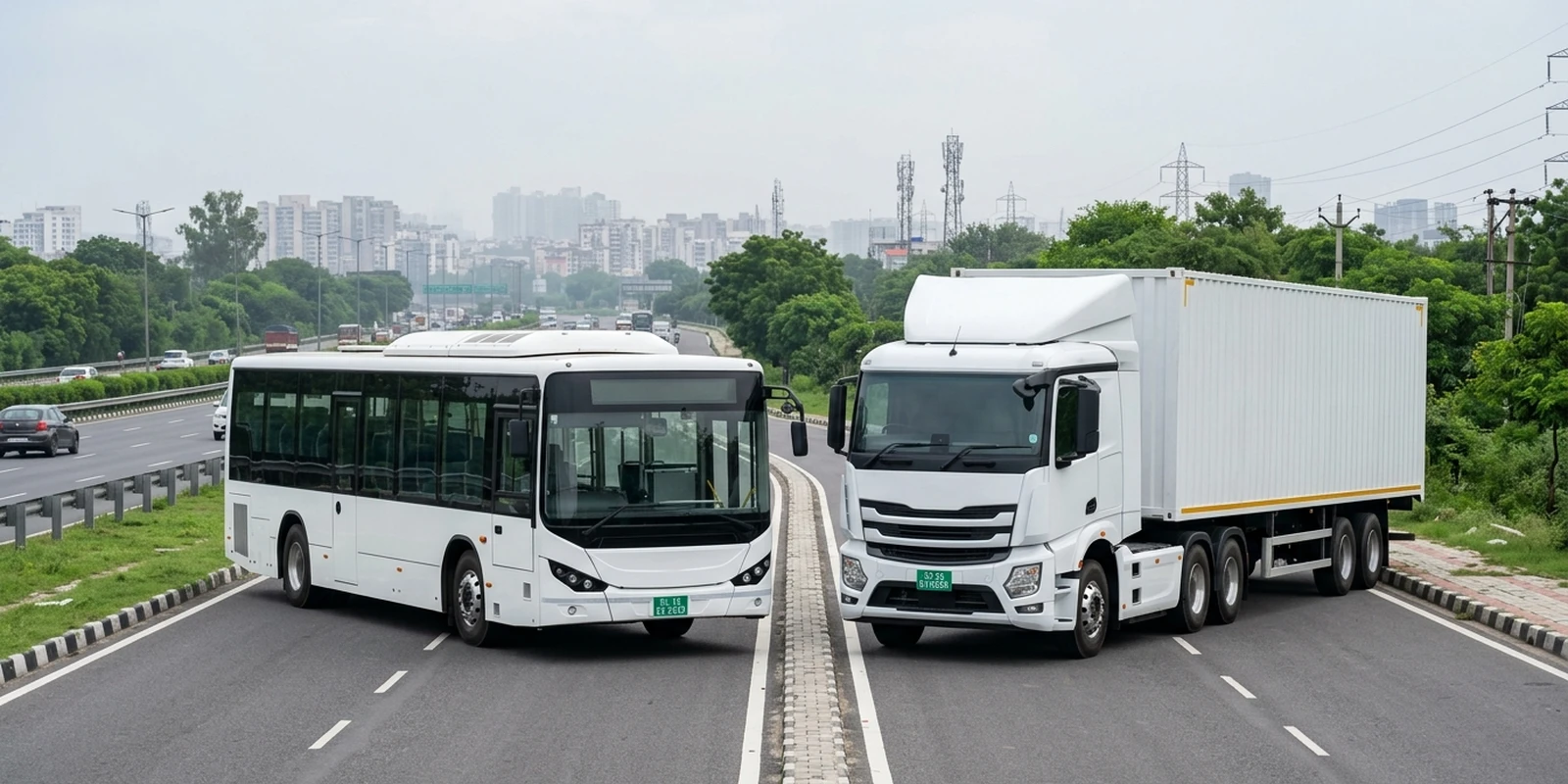
Delhi-NCR’s push to retire its oldest, most polluting commercial vehicles just picked up two more electric options. On 7 July 2026, the Ministry of Road Transport and Highways (MoRTH) signed Memoranda of Understanding with Olectra Greentech Limited and Montra Electric (through its business units IPLTech Electric and TIVOLT Electric Vehicles), bringing them into the PARIVARTAN scheme — the government’s programme to get old trucks and buses off Delhi-NCR roads and replace them with cleaner, newer vehicles, including EVs.
For fleet operators running trucks or buses in the National Capital Region, this is the second major update to the scheme in as many months, and it matters for a very practical reason: it widens the list of electric vehicle options that qualify for a stack of central and state incentives on top of the manufacturer discount — right as the Supreme Court’s crackdown on end-of-life vehicles makes staying on old diesel fleets increasingly risky and expensive.
What Is the PARIVARTAN Scheme?
PARIVARTAN — formally the Scheme for Support to NCRPB for Replacement of Old Trucks and Buses in Delhi-NCR — was cleared by the Union Cabinet in June 2026 with a total outlay of roughly ₹9,585 crore (about ₹5,041 crore from the Centre plus an estimated ₹1,601 crore in state tax concessions). It is funded through the National Capital Region Planning Board and jointly implemented by MoRTH and the Ministry of Petroleum & Natural Gas.
The scheme targets owners of BS-IV-or-older trucks and buses registered in Delhi-NCR — more than 1.9 lakh trucks and around 16,000 buses by government estimates — and gives them a financial path to replace those vehicles with BS-VI-compliant or electric alternatives. BS-III-or-older vehicles must be scrapped at Registered Vehicle Scrapping Facilities; BS-IV vehicles can either be scrapped or sold outside NCR in non-NCAP areas.
The timing isn’t a coincidence. Delhi-NCR has more than 50 lakh end-of-life vehicles on its roads, and the Commission for Air Quality Management estimates these account for up to 40% of transport-linked emissions in the region. On 17 December 2025, the Supreme Court modified its earlier stance to strip legal protection from end-of-life vehicles — diesel vehicles over 10 years old and petrol vehicles over 15 years — clearing the way for impoundment, fines (₹20,000 for a first offence, ₹50,000 for repeat offences), fuel-pump denial, and mandatory deregistration, enforced through ANPR cameras and GRAP Stage IV checkpoints. PARIVARTAN is the financial carrot that runs alongside that enforcement stick: it exists to make compliant replacement affordable before penalties bite.
Who Olectra Greentech and Montra Electric Bring to the Table
🚌 Olectra Greentech
India’s largest pure electric bus manufacturer (~41% market share), part of the Megha Engineering & Infrastructure group. Has delivered around 2,448 electric buses and 51 electric tippers to state transport undertakings including MSRTC, BEST, PMPML and TSRTC, and is now extending into electric tippers and trucks.
🚛 Montra Electric
A Murugappa Group venture operating through two units: IPLTech Electric (Manesar-based, maker of the RHINO 5538e — India’s first electric heavy commercial truck — serving cement, steel and earthmoving fleets) and TIVOLT Electric Vehicles (light and small commercial EVs such as the Eviator 350).
With Olectra and Montra Electric added, the roster of OEMs signed up to PARIVARTAN now includes Ashok Leyland, Switch Mobility, Tata Motors, Mahindra & Mahindra, SML Mahindra, Daimler India Commercial Vehicles, Eicher Trucks and Buses (VECV), Force Motors and Pinnacle Mobility Solutions — a combined 95%+ share of India’s truck and bus market. For a fleet operator comparing replacement options, that breadth means almost every serious OEM, electric or otherwise, is now inside the scheme’s discount structure.
The Discount Stack: What Fleet Operators Actually Save
PARIVARTAN layers three separate benefits on top of each other, and fleet operators evaluating a replacement purchase need to look at all three together rather than just the headline OEM discount:
🏭 OEM Discount
8%
Off ex-showroom price, capped at the ICE-equivalent discount for the same GVW category
🏛️ Central Support
5% + Fuel
Interest subvention plus fixed monthly fuel vouchers for five years
🏙️ State Concessions
Up to 100%
Motor vehicle tax concession for 10 years, plus registration fee waiver
Where the EV Math Gets Interesting
One detail is easy to miss in the announcement: the 8% OEM discount for an electric truck or bus is capped at whatever discount applies to an equivalent ICE vehicle in the same Gross Vehicle Weight category. In other words, PARIVARTAN doesn’t hand EVs a bigger upfront discount than diesel replacements — the OEM discount tier is fuel-agnostic by design.
That makes the other two layers — the 5% interest subvention with fuel vouchers, and the state tax/registration concessions — the actual differentiators for electric vehicles. An EV replacement carries a materially lower per-km running cost than a diesel truck or bus to begin with; layering a subsidised interest rate, five years of fixed vouchers, and up to a decade of tax relief on top changes the total-cost-of-ownership comparison well before an operator gets to the environmental case. For fleets already leaning electric, PARIVARTAN effectively de-risks the financing side of that decision rather than sweetening the purchase price directly.
The Bigger Picture: India’s Electric Truck and Bus Momentum
PARIVARTAN lands at a moment when commercial EV adoption in India is already accelerating on its own. India’s electric bus market is estimated at around $1.41 billion in 2026, up from $1.17 billion in 2025, and is projected to reach roughly $2.92 billion by 2030 — a 20% compound annual growth rate. Registrations back that up: 2,944 e-buses were registered between January and June 2026, up 40% year-on-year, with Delhi (around 4,244 cumulative units) and Maharashtra (around 4,038) leading deployment nationally.
Electric trucks are earlier in the curve but moving fast in specific use cases — cement, ports and mining fleets running fixed, high-utilisation routes are adopting fastest, with growth rates in the 27–35% range in those segments. PM E-DRIVE separately introduced India’s first dedicated e-truck subsidy in mid-2025, worth up to ₹9.6 lakh per vehicle for N2/N3 category trucks — a scheme that can, in principle, stack with state-level incentives like the ones now on offer through PARIVARTAN, depending on eligibility rules for each.
What Delhi-NCR Fleet Operators Should Do Next
If your fleet includes BS-IV-or-older trucks or buses registered in Delhi-NCR, the calculus has shifted from “should we replace these vehicles” to “how soon, and with what.” The Supreme Court’s December 2025 order means enforcement — impoundment, fines, fuel-pump denial — is now live, not theoretical, and ANPR-based checkpoints under GRAP Stage IV make old-vehicle detection largely automatic. Waiting is the expensive option; PARIVARTAN is designed to make replacing early the cheaper one.
- Check whether your existing OEM relationships are already covered — 11 manufacturers, including Olectra Greentech and Montra Electric, are now inside the scheme
- Model the full discount stack (OEM discount + interest subvention + fuel vouchers + state tax relief) against your specific route profile before choosing electric vs. BS-VI diesel
- For electric replacements, plan the charging infrastructure and duty-cycle fit before the vehicles arrive — range and charging-window constraints differ meaningfully between a city bus route and a long-haul truck route
For fleets running a mix of electric trucks and buses across multiple OEMs, the operational challenge shifts from procurement to management — tracking vehicles, drivers, and charging sessions across different chargers and networks from one place. That is the exact problem EV fleet vehicle management and charging management software are built to solve, and it becomes more relevant with every new OEM that joins schemes like PARIVARTAN.
Sources: Press Information Bureau, Government of India (PRID 2282223) | Cabinet approval, pmindia.gov.in | Olectra Greentech | Montra Electric / TI Clean Mobility
Electrifying Your Truck or Bus Fleet Under PARIVARTAN?
YoMobility helps fleet operators manage electric trucks and buses from multiple OEMs on one platform — real-time vehicle tracking, driver management, and charging across every network. Talk to our team before your next replacement order.
YoMobility EV-FMS
EV fleet management softwareRun every vehicle, driver, charge and payment from one platform. Charge on multiple networks, and get one invoice for all of it.
Resources
Keep reading
CAFE Norms 2027-2032 Are Final: What EV Super-Credits Mean For Fleet Buyers
💡 CAFE Norms 2027-2032: Key Highlights India’s CAFE norms 2027-2032 are now final. On 30 September 2026 the Ministry of […]
State EV Policy Scores Just Jumped: What The India Electric Mobility Index 2025 Means For Fleets
💡 India Electric Mobility Index 2025: Key Highlights India’s state EV scorecard moved a long way in twelve months. The […]
Electric Heavy Duty Truck In India: Deployments Grew 4x As NITI Aayog Launches PACT
💡 Electric Heavy Duty Truck In India: Key Highlights India deployed 826 electric freight vehicles in FY26, up from 201 […]
See YoMobility on your fleet
Tell us how many vehicles you run and where they charge. We'll show you how they'd run on one platform, with one invoice.
Or contact us