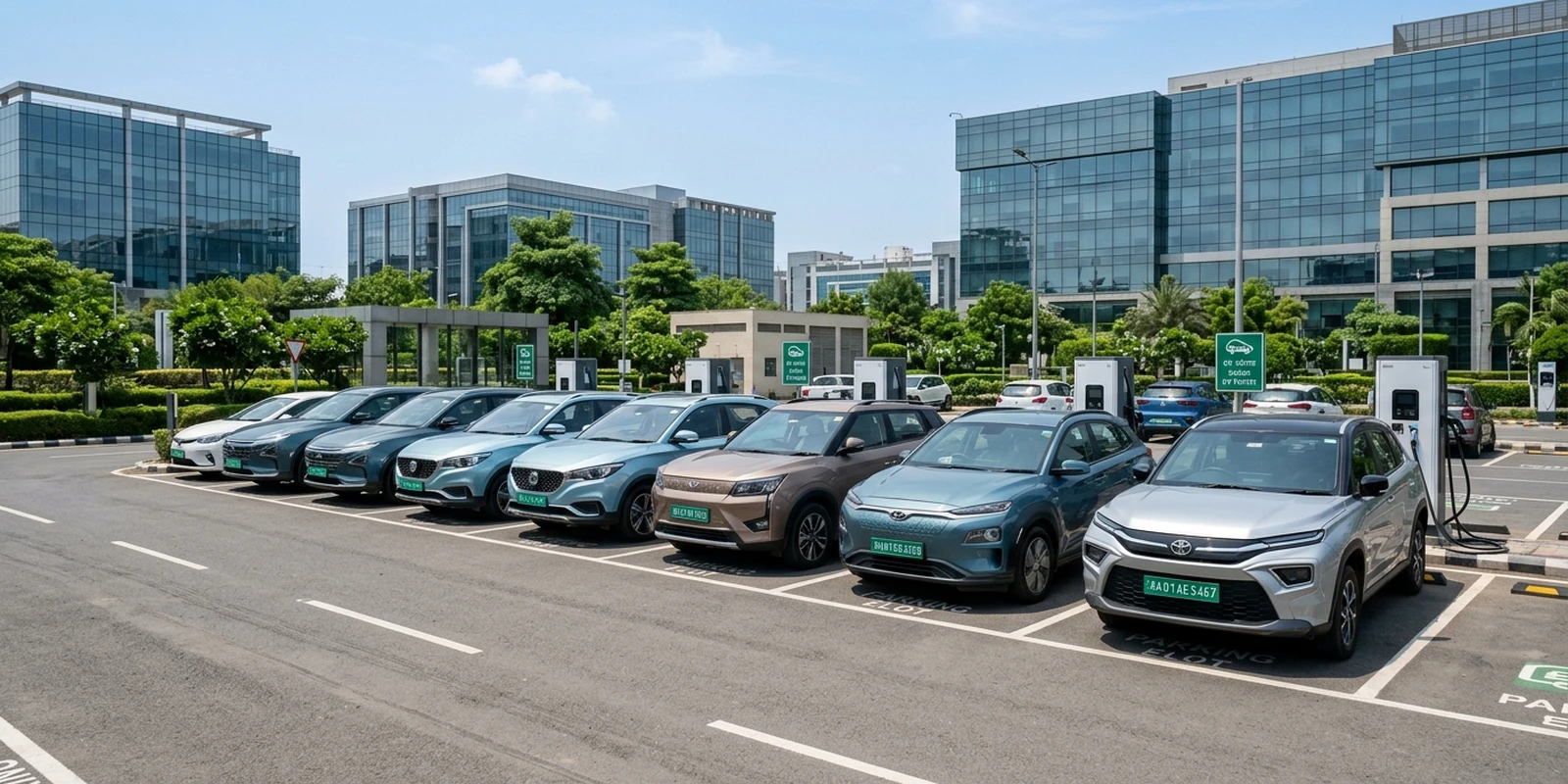
💡 EV Taxi Fleet Operations Guide: Key Highlights
- Range: A Tata Xpres-T EV’s ~200–220 km real-world range (24 kWh pack) covers roughly two typical city shifts before a top-up.
- Charging speed: DC fast charging restores 0–80% in ~1.5 hours; a full overnight AC charge takes ~11 hours at the depot.
- Scale already committed: Everest Fleet runs 2,000+ EV taxis across seven Indian metros, targeting 10,000 by 2026; Tata Motors and Uber have signed for 25,000 XPRES-T EVs nationwide.
- Charging infrastructure: Delhi is pushing toward a fast charger roughly every 5 km and thousands of new public points by 2026.
- Policy runway: India’s EV registrations crossed 2.5 million in FY2025-26 (+24% YoY) against a 30%-by-2030 target — most ride-hailing fleets are still mid-transition.
- The lever that ties it together: software that tracks SOC, assigns chargers and automates reimbursements turns these numbers into a repeatable daily schedule.
Buying the vehicles is the easy decision. This EV taxi fleet operations guide is for the manager who already has electric cabs on the road and needs a repeatable way to move drivers through morning peak, airport runs, city trips and breaks without a car running out of charge mid-shift. A 24 kWh taxi covers 200–220 km on a charge, and most urban shifts stay well inside that — the failure mode isn’t the battery spec, it’s the schedule around it.
This EV taxi fleet operations guide is written for urban taxi fleets working with aggregator platforms in metros like Delhi, Bengaluru, Mumbai and Hyderabad, running anywhere from 20 to 200+ Xpres-T, Nexon EV or similar vehicles. The logic scales the same way whether you’re running 15 cars or a multi-city fleet — only the tooling changes.
Map The 24-Hour Cycle Before You Set A Single Shift
An electric taxi’s day has fixed windows a diesel or CNG driver never had to plan around. A realistic cycle for a 50-car fleet in Bengaluru: depot charge-out at 5:30–6:30 am with every vehicle above 90% SOC; a 7–10 am peak of short city hops (5–15 km); an 11 am–4 pm lull that’s your best opportunity-charging window; a 5–9 pm evening peak; and a late tail of longer trips before vehicles return for overnight AC charging.
Airport runs don’t fit that rhythm — a round trip from most metro cores is 40–70 km, a third of a Xpres-T’s usable range in one booking, so it needs to be its own dispatch category, not left to whichever car is closest.
Segment vehicles by range at charge-out, not by driver seniority
Before a single trip is assigned, split the fleet into a “city-hop” pool and an “airport/long-trip” pool reserved for vehicles leaving the depot near full charge. Assigning by whichever driver showed up first — the default in most WhatsApp-group dispatch — is how a car ends up 25 km from the airport at 35% SOC.
Assign Vehicles And Chargers By SOC, Not By Rota
Most fleets that outgrow a spreadsheet do so at the charger, not on the road. Once you run more vehicles than depot chargers, “whoever parked first” is a worse rule than it sounds — a car at 60% SOC can wait two hours while a car at 15% cannot. A fleet operating system that lets supervisors monitor vehicle SOC in real time turns that decision from a walk-around inspection into a sorted list.
The same logic applies during the day: when a driver returns with 30 minutes free, the system should assign chargers automatically — routing them to whichever point is free and fastest for their current SOC, instead of a driver circling the lot looking for an open plug.
Queue chargers by lowest SOC first, not first-come-first-served
A simple rule — lowest SOC plugs in next, regardless of arrival order — stops your depot’s limited charger count from becoming the bottleneck that idles otherwise-available drivers.
Prevent Range-Related Trip Failures During Peak Hours
A “range-related trip failure” is any booking a driver has to cancel, cut short or refuse because the car can’t safely finish it — and it happens most during peak hours, when the pressure to accept every booking is highest. The fix isn’t a smarter driver; it’s a rule that never puts the decision in the driver’s hands.
Set SOC floors per trip type — a city hop under 15 km might be safe down to 20%, an airport run should never dispatch below 40–50% — and wire those floors into dispatch so a low-SOC vehicle simply isn’t offered a trip it can’t complete. Real-time fleet alert triggers that flag a vehicle crossing its floor mid-shift let a supervisor reroute or recall the car before the driver is stranded, not after.
Escalate low-SOC exceptions before the driver commits to the trip
An alert that fires after the booking is accepted is too late — the floor has to sit ahead of dispatch, not behind it.
Turn Driver Breaks Into Opportunity-Charging Windows
The 11 am–4 pm lull most urban taxi fleets see between peaks is dead time for bookings but valuable time for electrons. In practice, teams get the best result by aligning mandated driver meal and rest breaks with a 30–45 minute DC top-up at a public charger near a natural waiting point — a mall, a metro station, an airport queue — rather than treating charging and breaks as two separate interruptions.
Match break length to charger type
A 30-minute break suits a DC fast charger topping up 20–30% SOC; don’t send a driver to an AC point for a short break — they’ll return with barely more charge than they left with.
Automate Driver Reimbursements For Home And Public Charging
Many urban taxi fleets let drivers charge at home overnight on top of depot charging — it’s cheaper and frees up depot chargers for the vehicles that need them most. The cost is reconciliation: verifying what a driver spent on home electricity for the vehicle, separate from their household bill, and paying it back without a month of screenshots. Public charging has the same problem, multiplied across every CPO’s app and invoice format.
The fix is to automate driver reimbursements: capture kWh consumed per session (home or public), apply the correct tariff automatically, and settle payouts on a fixed cycle rather than on request — removing the manual reconciliation work finance teams otherwise absorb every payroll cycle.
Separate home-charging kWh from a driver’s household bill
A smart plug or a simple submitted-reading workflow is enough to isolate vehicle charging from household consumption — reimbursement only works if the underlying number is trustworthy, and a fixed weekly payout schedule is what actually gets drivers to charge at home instead of queuing at a public charger mid-shift.
An EV Taxi Fleet Operations Guide To Running One Platform, Not Four
Every rule above — segmenting vehicles at charge-out, queuing chargers by SOC, setting range floors, aligning breaks to charging windows, automating reimbursements — is simple on its own. The failure mode is running all five on different tools: a WhatsApp group for dispatch, a CPO app for charging status, a spreadsheet for reimbursements. A fleet operating system like YoMobility puts SOC, charger assignment, alerts and payments in one place, so a supervisor running 50 or 200 taxis through a peak hour works from one live view, not four.
That’s the real difference between running an electric taxi fleet and running an ICE fleet that happens to have electric cars in it: more moving parts, but nearly all of them visible in advance if the software surfaces them. Get the 24-hour cycle right once, and it repeats — that’s what a good EV taxi fleet operations guide is built to make routine.
Frequently Asked Questions
How much daily range does an electric taxi actually need in an Indian city?
Most urban shifts stay well under 200 km even with several city trips, so a Xpres-T EV’s ~200–220 km range covers a typical day with one top-up; airport and inter-city bookings are the exception that needs separate planning.
Can one electric taxi cover both airport runs and city hops in the same day?
Yes, but not interchangeably at any SOC — reserve airport and long-trip dispatch for vehicles above a set floor (40–50%) and route city hops to the rest of the pool.
How long does it take to charge an electric taxi between shifts?
A DC fast charger takes a Xpres-T-class taxi from empty to 80% in ~1.5 hours — enough for a midday top-up. A full overnight AC charge at the depot takes ~11 hours, which is why it’s the backbone of most fleet charging models.
How do fleets reimburse drivers who charge at home?
By isolating the kWh a vehicle consumes from the driver’s household bill, applying the fleet’s tariff, and settling the payout on a fixed schedule rather than case by case.
What causes most range-related trip failures in electric taxi fleets?
Dispatching by driver order or convenience rather than by SOC and trip-type floors — the assignment rule is almost always the problem, not the car.
Is overnight depot charging cheaper than public fast charging for taxi fleets?
Generally yes — concessional commercial EV tariffs make overnight AC charging the lowest-cost option per kWh, which is why most fleets treat it as the default and public/DC charging as a targeted top-up during breaks.
Sources: Business Standard — Tata Motors to supply 25,000 XPRES-T EVs to Uber | Business Standard — Everest Fleet’s EV expansion plans | Tata Motors — XPRES-T EV specifications | PIB / NITI Aayog — Electric Vehicles in India report | Delhi Government — Switch Delhi charging infrastructure
Manage Your Taxi Fleet’s Daily Operations Today
See how YoMobility tracks SOC, assigns chargers, prevents range-related trip failures and automates driver reimbursements — for taxi, last-mile and corporate fleets on one platform.
Book a Free DemoYoMobility EV-FMS
EV fleet management softwareRun every vehicle, driver, charge and payment from one platform. Charge on multiple networks, and get one invoice for all of it.
Resources
Keep reading
Electric Scooter For Delivery Fleets: Specs That Survive A Full Rider Shift
💡 Electric Scooter For Delivery Fleets: Summary An electric scooter for delivery and an electric scooter for commuting are usually […]
PM E-DRIVE Scheme In 2026: What Fleets Can Still Claim And What Already Closed
💡 PM E-DRIVE Scheme: Key Highlights If you are timing an electric vehicle purchase for a commercial fleet, the PM […]
CNG vs EV For Commercial Vehicles: The Comparison Indian Fleets Actually Face
💡 CNG vs EV For Fleets: Key Highlights This is for one reader: the fleet owner replacing a diesel light […]
See YoMobility on your fleet
Tell us how many vehicles you run and where they charge. We'll show you how they'd run on one platform, with one invoice.
Or contact us