Fleet Electrification Strategy: How To Scale From A 10-Vehicle Pilot To 200+ EVs
YBy YoMobility Team12 min read
No. Sanctioned capacity and installed capacity are very different things — 6,562 chargers had been approved under PM E-DRIVE with none installed as of the government’s August 2026 reply in the Lok Sabha. Build captive depot charging you control, and treat public networks as overflow for exception days rather than base-load capacity.
With a committed multi-year plan rather than repeated tranche approvals. Structured debt, leasing partners and OEM volume agreements all price better against commitment. Your negotiating leverage is operational data: documented uptime, energy cost per km and maintenance history from the first 50 vehicles is what moves you from a technology risk to an underwritable cash flow.
The phases are the same; the pinch points are not. Last-mile fleets return to a depot nightly, so depot power dominates. Urban and airport taxi fleets run long daily distances across shifts, so opportunity charging and driver behaviour dominate. Corporate transport has predictable schedules and long idle windows, which makes it the easiest to load-manage but the most sensitive to on-time arrival.
Plan Your Next Phase Before You Order The Vehicles
Tell us where you are today — pilot, 50 vehicles, or scaling past 200 — and YoMobility’s team will map the depot power, charging schedule and data you need in place before the next tranche lands, using your routes and your tariff.
Demand charges on sanctioned load. Fleets budget for energy units and forget that Indian commercial tariffs also bill the peak kVA you contract for. Unmanaged charging can push your required connection several times higher than managed charging for the exact same daily energy, and you pay that difference every month regardless of how much you drive.
No. Sanctioned capacity and installed capacity are very different things — 6,562 chargers had been approved under PM E-DRIVE with none installed as of the government’s August 2026 reply in the Lok Sabha. Build captive depot charging you control, and treat public networks as overflow for exception days rather than base-load capacity.
With a committed multi-year plan rather than repeated tranche approvals. Structured debt, leasing partners and OEM volume agreements all price better against commitment. Your negotiating leverage is operational data: documented uptime, energy cost per km and maintenance history from the first 50 vehicles is what moves you from a technology risk to an underwritable cash flow.
The phases are the same; the pinch points are not. Last-mile fleets return to a depot nightly, so depot power dominates. Urban and airport taxi fleets run long daily distances across shifts, so opportunity charging and driver behaviour dominate. Corporate transport has predictable schedules and long idle windows, which makes it the easiest to load-manage but the most sensitive to on-time arrival.
Plan Your Next Phase Before You Order The Vehicles
Tell us where you are today — pilot, 50 vehicles, or scaling past 200 — and YoMobility’s team will map the depot power, charging schedule and data you need in place before the next tranche lands, using your routes and your tariff.
Six to twelve months, and it should cover at least one full summer. You are testing range under peak air-conditioning load and battery behaviour in Indian heat, not just average cost per km. Ending a pilot in February and scaling in March is how fleets discover their range margin was seasonal.
Demand charges on sanctioned load. Fleets budget for energy units and forget that Indian commercial tariffs also bill the peak kVA you contract for. Unmanaged charging can push your required connection several times higher than managed charging for the exact same daily energy, and you pay that difference every month regardless of how much you drive.
No. Sanctioned capacity and installed capacity are very different things — 6,562 chargers had been approved under PM E-DRIVE with none installed as of the government’s August 2026 reply in the Lok Sabha. Build captive depot charging you control, and treat public networks as overflow for exception days rather than base-load capacity.
With a committed multi-year plan rather than repeated tranche approvals. Structured debt, leasing partners and OEM volume agreements all price better against commitment. Your negotiating leverage is operational data: documented uptime, energy cost per km and maintenance history from the first 50 vehicles is what moves you from a technology risk to an underwritable cash flow.
The phases are the same; the pinch points are not. Last-mile fleets return to a depot nightly, so depot power dominates. Urban and airport taxi fleets run long daily distances across shifts, so opportunity charging and driver behaviour dominate. Corporate transport has predictable schedules and long idle windows, which makes it the easiest to load-manage but the most sensitive to on-time arrival.
Plan Your Next Phase Before You Order The Vehicles
Tell us where you are today — pilot, 50 vehicles, or scaling past 200 — and YoMobility’s team will map the depot power, charging schedule and data you need in place before the next tranche lands, using your routes and your tariff.
Six to twelve months, and it should cover at least one full summer. You are testing range under peak air-conditioning load and battery behaviour in Indian heat, not just average cost per km. Ending a pilot in February and scaling in March is how fleets discover their range margin was seasonal.
Demand charges on sanctioned load. Fleets budget for energy units and forget that Indian commercial tariffs also bill the peak kVA you contract for. Unmanaged charging can push your required connection several times higher than managed charging for the exact same daily energy, and you pay that difference every month regardless of how much you drive.
No. Sanctioned capacity and installed capacity are very different things — 6,562 chargers had been approved under PM E-DRIVE with none installed as of the government’s August 2026 reply in the Lok Sabha. Build captive depot charging you control, and treat public networks as overflow for exception days rather than base-load capacity.
With a committed multi-year plan rather than repeated tranche approvals. Structured debt, leasing partners and OEM volume agreements all price better against commitment. Your negotiating leverage is operational data: documented uptime, energy cost per km and maintenance history from the first 50 vehicles is what moves you from a technology risk to an underwritable cash flow.
The phases are the same; the pinch points are not. Last-mile fleets return to a depot nightly, so depot power dominates. Urban and airport taxi fleets run long daily distances across shifts, so opportunity charging and driver behaviour dominate. Corporate transport has predictable schedules and long idle windows, which makes it the easiest to load-manage but the most sensitive to on-time arrival.
Plan Your Next Phase Before You Order The Vehicles
Tell us where you are today — pilot, 50 vehicles, or scaling past 200 — and YoMobility’s team will map the depot power, charging schedule and data you need in place before the next tranche lands, using your routes and your tariff.
💡 Fleet Electrification Strategy: Key Highlights
The binding constraint moves at every phase. At 10 vehicles it is duty-cycle fit, at 50 it is depot power, at 200+ it is capital structure and the org chart. A plan that only solves the first one stalls at the second.
Grid capacity is the long pole, not vehicle supply. A new HT connection from an Indian DISCOM can take 3–18 months, and major network reinforcement 18–36 months — which is why depot power work must start a phase before you need it.
Charger approvals are not charger availability. 6,562 public chargers had been sanctioned under PM E-DRIVE with none yet installed as of the government’s August 2026 statement to the Lok Sabha. Plan captive depot charging, not scheme timelines.
Managed charging changes the size of your electricity connection. Fifty light EVs charging unmanaged can pull ~370 kW; the same energy staggered across a 10-hour window needs about 100 kW — a 3.7× difference in sanctioned load.
Financing gets cheaper only after you have data. NITI Aayog and RMI size India’s EV finance opportunity at ₹3.7 lakh crore by 2030; lenders price your paper off proven uptime and residual value, both of which the pilot exists to evidence.
Most Indian fleets do not fail at electrification — they stall at it. A ten-van pilot runs cleanly for six months, the cost-per-km looks good in the review deck, and then nothing moves for two years. The reason is rarely the vehicles. It is that a fleet electrification strategy which works at ten vehicles is simply not the same document that works at two hundred, and most organisations only discover this after they have committed to the second tranche.
This guide is written for the CXO or head of mobility who is about to sign that second tranche — whether you run last-mile delivery vans, an urban or airport taxi fleet, or corporate employee transport. The phases below are deliberately unequal in character: the pilot is an evidence exercise, the 50-vehicle fleet is an operations exercise, and the move past 200 is a finance and organisation-design exercise. Treat all three as “buy more vehicles” and you will buy the wrong ones.
The macro tailwind is real. India recorded roughly 2.3 million EV sales in 2025 according to the IEA’s Global EV Outlook 2026, and PM E-DRIVE had supported 2.65 million vehicles by 22 July 2026. But national totals do not charge your vans. What follows is the phase-by-phase view of what actually binds, what it costs, and where an AI-driven fleet operating system takes risk off the table rather than adding a dashboard nobody opens.
Why EV Pilots Stall Before They Become Fleets
The stall is structural, not a failure of will. A pilot is designed to be low-risk: a handful of vehicles on the easiest routes, charged on an existing connection, run by whoever volunteers. Every one of those choices is the right call at ten vehicles and a trap at fifty, because the pilot quietly proves the wrong thing. It proves that ten EVs can work on your best routes. It does not prove that your depot can power them, that your maintenance vendor can support them, or that your balance sheet can carry them.
The three constraints that swap places
In practice, teams meet the same three constraints in the same order. Duty-cycle fit dominates the pilot: can this vehicle finish the day’s kilometres with margin? Depot power dominates the 50-vehicle phase: can you get, and afford, the sanctioned load to turn a parking bay into a charging bay? Capital and organisation dominate everything after 200: who underwrites the asset, who owns uptime, and who is accountable when energy cost becomes your second-largest line item after driver wages.
⚡
3–18 months
Typical wait for a new HT/33 kV DISCOM connection in India — the single longest lead time in any depot plan.
🔋
6,562
Public chargers sanctioned under PM E-DRIVE with zero installed as of the government’s August 2026 Lok Sabha reply.
🚚
55 of 5,643
E-trucks supported against the PM E-DRIVE target — heavy segments are still early, so plan around light commercial EVs first.
The three phases at a glance
Phase 1 — Pilot (up to 10)
Phase 2 — Learning fleet (10–50)
Phase 3 — Scale (50–200+)
What you are buying
Evidence
Repeatability
Capacity
Binding constraint
Duty-cycle fit and range confidence
Depot power and charging discipline
Capital structure and organisation
Funding source
Opex / innovation budget
Asset finance or leasing, priced on pilot data
Structured debt, leasing partners, OEM tie-ups
Infrastructure move
Existing connection, 2–3 AC points
Apply for the HT connection now, install managed AC bank
Load-managed depot with staged DC, plus solar or storage where the tariff justifies it
Organisation
One owner, part-time
A named EV supervisor and a trained mechanic
Energy P&L owner, dedicated ops desk, driver-training loop
Biggest risk
Proving the wrong thing on easy routes
Peak demand charges nobody modelled
Vehicles arriving before power does
The phase table most Indian fleets rebuild after the fact — the funding and infrastructure rows are the ones usually planned one phase too late.
Phase 1 — The 10-Vehicle Pilot: Buy Evidence, Not Vehicles
Ten vehicles will never give you a statistically robust dataset for two hundred. That is fine — a pilot’s job is not to prove the model works, it is to falsify your assumptions cheaply. Design it to break things. If your last-mile routes average 90 km a day, put the pilot on the 130 km routes. If your taxis run airport shifts, pilot the fleet on airport shifts, not on the predictable corporate contract that everyone agrees will be fine.
The five numbers to instrument from day one
Capture actual energy consumed per kilometre (not the brochure figure), charging window utilisation, peak simultaneous draw, vehicle availability at shift start, and true cost per drop or per trip including energy, driver, and downtime. Fleets that skip peak draw during the pilot are the ones that get a demand-charge surprise in Phase 2. If you are not sure which metrics survive contact with a real depot, our breakdown of EV fleet KPIs maps each one to the decision it actually informs.
Funding: keep it opex, keep it reversible
At ten vehicles, do not fight for capex approval. Lease, rent, or run an OEM-supported trial. The point is optionality: you want the freedom to change vehicle model between Phase 1 and Phase 2, and you almost certainly will. Lenders price EV fleet paper off residual-value confidence and proven uptime — neither of which you can show yet. NITI Aayog and RMI have argued for exactly this sequencing, noting that lower cost of capital follows demonstrated asset performance in a market they size at ₹3.7 lakh crore of EV finance by 2030.
The one infrastructure decision you cannot defer
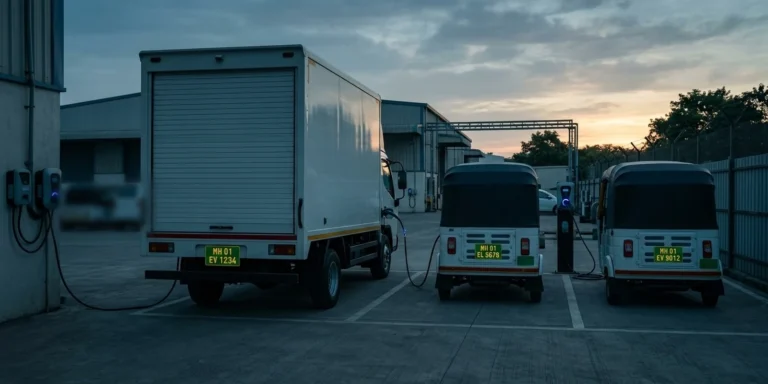
Two or three AC points on your existing connection will carry ten vehicles. But this is the phase to start the DISCOM conversation, because the sanctioned-load application you file today is the power you get in twelve months. Filing it in Phase 2, when you need it, is the single most common scheduling error in Indian fleet electrification.
Phase 2 — 50 Vehicles: Where Your Fleet Electrification Strategy Gets Stress-Tested
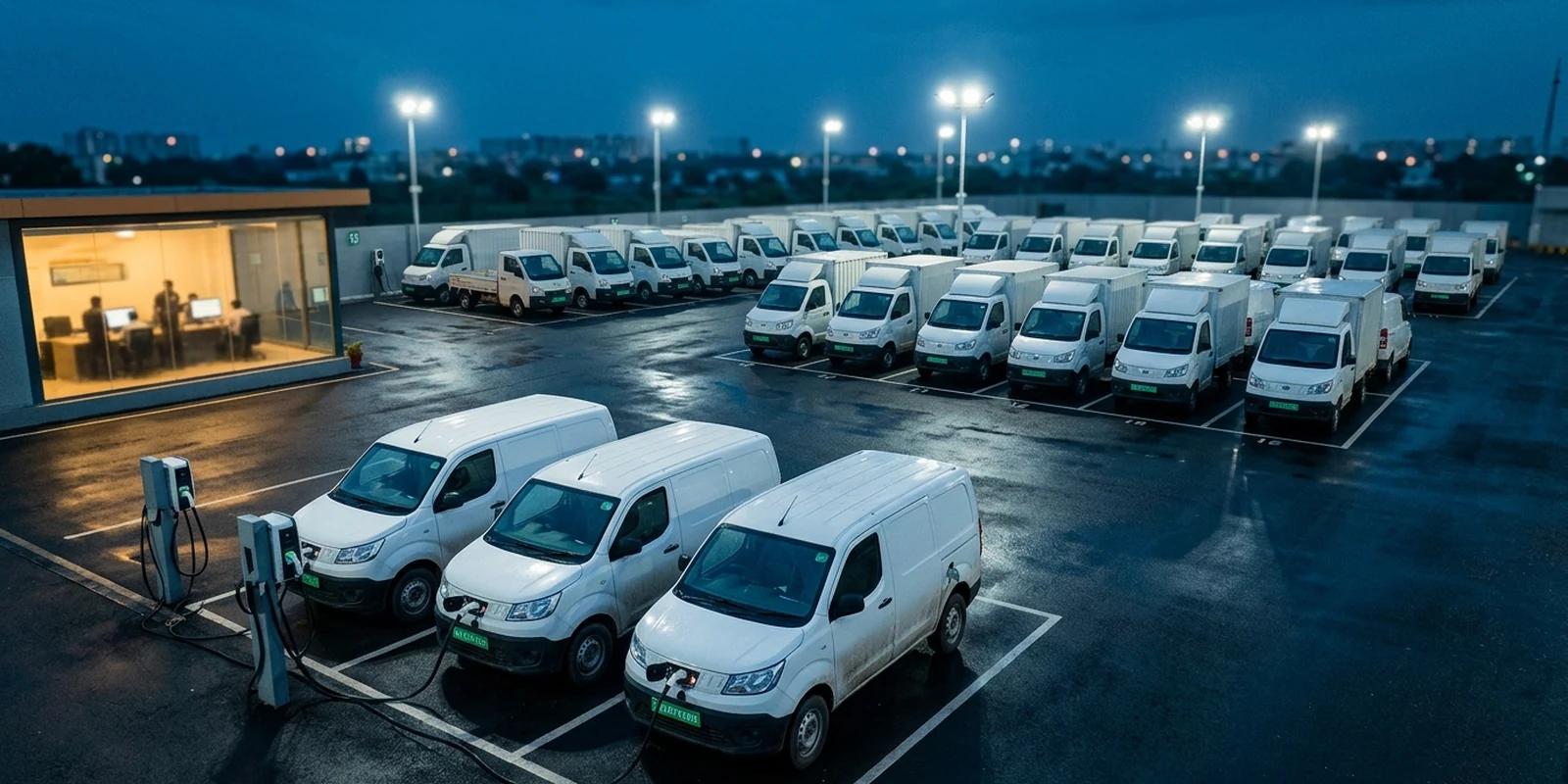
Fifty vehicles is where the arithmetic stops being forgiving. Take a light electric commercial van needing a 20 kWh overnight top-up. Fifty of them is 1,000 kWh of energy — a fixed number. What is not fixed is the rate at which you deliver it. Plug all fifty into 7.4 kW AC points at 8 pm and you are asking the grid for roughly 370 kW simultaneously. Stagger the same 1,000 kWh across a 10-hour window and the depot needs about 100 kW. Same vehicles, same energy, same morning readiness — and a 3.7× difference in the sanctioned load you pay demand charges on every single month.
⚠️ The mistake that costs a full quarter
Vehicles have a 6–12 week lead time. Depot power has a 3–18 month lead time, stretching to 18–36 months where network reinforcement is required. Fleets that order vehicles and power in the same month end up parking new EVs they cannot charge. Sequence the connection application at least one phase ahead of the vehicle order — always.
Make managed charging non-negotiable now
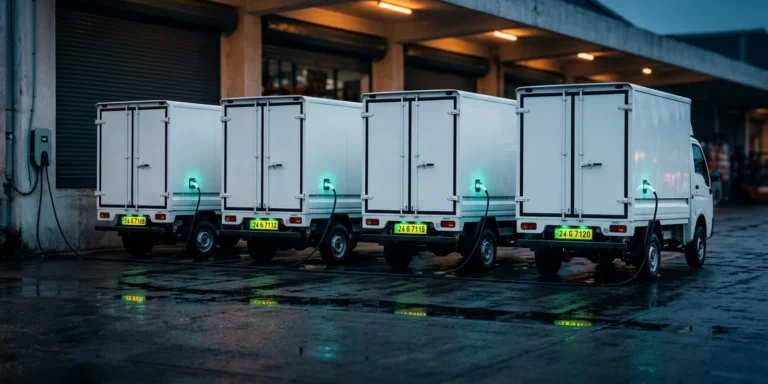
Load management is not a Phase 3 refinement; it is what makes Phase 3 affordable. Smart charging management that sequences sessions against departure times, tariff windows, and available sanctioned load is the difference between a depot that scales and one that needs a second connection at 80 vehicles. Note also that you should not build this plan around public infrastructure arriving on schedule: 6,562 chargers were sanctioned under PM E-DRIVE with none installed as of the government’s August 2026 statement to Parliament. Captive depot charging is the controllable asset; public charging is a contingency.
Funding: this is when the data pays you back
By 50 vehicles you have twelve months of real uptime, energy-cost and maintenance history. That history is the asset you take to lenders and leasing partners — it converts an unpriceable technology bet into an underwritable cash flow. Fleets that instrumented Phase 1 properly negotiate materially better terms here than fleets presenting OEM brochures. Our walkthrough of EV fleet TCO in India covers how to structure that number segment by segment.
Organisation: name one person, not a committee
Fifty vehicles needs a named EV supervisor who owns morning readiness, plus at least one mechanic trained on high-voltage systems. This is also where day-to-day EV fleet operations stop being improvised and start needing written routines — who checks the overnight charge report, who escalates a failed session at 3 am, who signs off a vehicle as shift-ready.
Phase 3 — Past 200 Vehicles: Capital, Grid And The Org Chart
Beyond roughly 200 vehicles, electrification stops being a mobility project and becomes an energy business you happen to run alongside a transport business. Energy typically becomes the second-largest operating line after driver cost, which changes who needs to be in the room. The fleet electrification strategy at this scale is mostly three decisions: how the assets are financed, how many depots and of what power rating, and who owns the energy P&L.
Capital: stop buying vehicles one tranche at a time
Tranche-by-tranche procurement is expensive at this size. Structured facilities, leasing partnerships and OEM volume agreements all price better against a committed multi-year plan than against repeated one-off asks. Policy support helps at the margin — PM E-DRIVE carries a ₹10,900 crore outlay and has been extended to 31 March 2028 for e-trucks and e-buses — but scheme incentives should be treated as upside in your model, never as the thing that makes the business case work.
Infrastructure: think network, not depot
At 200+ vehicles, a single mega-depot is usually the wrong answer — it concentrates grid risk and adds deadhead kilometres. Two or three medium depots placed against route geography, each with load-managed charging and staged DC for exception cases, generally beats one large site. Solar and storage start to pay where your tariff structure is peak-heavy. The design principles are covered in more depth in our guide to EV-ready depot design.
Organisation: the roles that must exist
Three roles reliably appear in fleets that get past 200 without chaos: an energy manager who owns tariff strategy and demand charges; a fleet operations desk running exceptions in real time across depots; and a driver enablement lead, because driving style moves energy consumption by double-digit percentages and no amount of software fixes an untrained driver. Board-level reporting also becomes non-optional here — consolidated fleet analytics covering cost per km, uptime and CO₂ avoided is what turns an operations story into a sustainability disclosure.
Where an AI operating system removes risk at each phase
The honest version: software does not de-risk Phase 1 much — ten vehicles can be managed on a spreadsheet, though instrumenting them properly is what makes Phase 2 cheaper. It de-risks Phase 2 heavily, because load-managed charging directly determines the sanctioned load you commit to. And it is structurally required by Phase 3, where no human desk can sequence several hundred charging sessions against tariff windows, departure times and grid limits every night. That is the case for running the whole estate on a fleet operating system like YoMobility rather than stitching together telematics, chargers and payments per depot. It is also worth reading alongside the known EV fleet transition risks, since the mitigation for most of them is simply doing the next phase’s homework one phase early.
Frequently Asked Questions
Six to twelve months, and it should cover at least one full summer. You are testing range under peak air-conditioning load and battery behaviour in Indian heat, not just average cost per km. Ending a pilot in February and scaling in March is how fleets discover their range margin was seasonal.
Demand charges on sanctioned load. Fleets budget for energy units and forget that Indian commercial tariffs also bill the peak kVA you contract for. Unmanaged charging can push your required connection several times higher than managed charging for the exact same daily energy, and you pay that difference every month regardless of how much you drive.
No. Sanctioned capacity and installed capacity are very different things — 6,562 chargers had been approved under PM E-DRIVE with none installed as of the government’s August 2026 reply in the Lok Sabha. Build captive depot charging you control, and treat public networks as overflow for exception days rather than base-load capacity.
With a committed multi-year plan rather than repeated tranche approvals. Structured debt, leasing partners and OEM volume agreements all price better against commitment. Your negotiating leverage is operational data: documented uptime, energy cost per km and maintenance history from the first 50 vehicles is what moves you from a technology risk to an underwritable cash flow.
The phases are the same; the pinch points are not. Last-mile fleets return to a depot nightly, so depot power dominates. Urban and airport taxi fleets run long daily distances across shifts, so opportunity charging and driver behaviour dominate. Corporate transport has predictable schedules and long idle windows, which makes it the easiest to load-manage but the most sensitive to on-time arrival.
Plan Your Next Phase Before You Order The Vehicles
Tell us where you are today — pilot, 50 vehicles, or scaling past 200 — and YoMobility’s team will map the depot power, charging schedule and data you need in place before the next tranche lands, using your routes and your tariff.
Fleet Electrification Strategy
💡 Fleet Electrification Strategy: Key Highlights
The binding constraint moves at every phase. At 10 vehicles it is duty-cycle fit, at 50 it is depot power, at 200+ it is capital structure and the org chart. A plan that only solves the first one stalls at the second.
Grid capacity is the long pole, not vehicle supply. A new HT connection from an Indian DISCOM can take 3–18 months, and major network reinforcement 18–36 months — which is why depot power work must start a phase before you need it.
Charger approvals are not charger availability. 6,562 public chargers had been sanctioned under PM E-DRIVE with none yet installed as of the government’s August 2026 statement to the Lok Sabha. Plan captive depot charging, not scheme timelines.
Managed charging changes the size of your electricity connection. Fifty light EVs charging unmanaged can pull ~370 kW; the same energy staggered across a 10-hour window needs about 100 kW — a 3.7× difference in sanctioned load.
Financing gets cheaper only after you have data. NITI Aayog and RMI size India’s EV finance opportunity at ₹3.7 lakh crore by 2030; lenders price your paper off proven uptime and residual value, both of which the pilot exists to evidence.
Most Indian fleets do not fail at electrification — they stall at it. A ten-van pilot runs cleanly for six months, the cost-per-km looks good in the review deck, and then nothing moves for two years. The reason is rarely the vehicles. It is that a fleet electrification strategy which works at ten vehicles is simply not the same document that works at two hundred, and most organisations only discover this after they have committed to the second tranche.
This guide is written for the CXO or head of mobility who is about to sign that second tranche — whether you run last-mile delivery vans, an urban or airport taxi fleet, or corporate employee transport. The phases below are deliberately unequal in character: the pilot is an evidence exercise, the 50-vehicle fleet is an operations exercise, and the move past 200 is a finance and organisation-design exercise. Treat all three as “buy more vehicles” and you will buy the wrong ones.
The macro tailwind is real. India recorded roughly 2.3 million EV sales in 2025 according to the IEA’s Global EV Outlook 2026, and PM E-DRIVE had supported 2.65 million vehicles by 22 July 2026. But national totals do not charge your vans. What follows is the phase-by-phase view of what actually binds, what it costs, and where an AI-driven fleet operating system takes risk off the table rather than adding a dashboard nobody opens.
Why EV Pilots Stall Before They Become Fleets
The stall is structural, not a failure of will. A pilot is designed to be low-risk: a handful of vehicles on the easiest routes, charged on an existing connection, run by whoever volunteers. Every one of those choices is the right call at ten vehicles and a trap at fifty, because the pilot quietly proves the wrong thing. It proves that ten EVs can work on your best routes. It does not prove that your depot can power them, that your maintenance vendor can support them, or that your balance sheet can carry them.
The three constraints that swap places
In practice, teams meet the same three constraints in the same order. Duty-cycle fit dominates the pilot: can this vehicle finish the day’s kilometres with margin? Depot power dominates the 50-vehicle phase: can you get, and afford, the sanctioned load to turn a parking bay into a charging bay? Capital and organisation dominate everything after 200: who underwrites the asset, who owns uptime, and who is accountable when energy cost becomes your second-largest line item after driver wages.
⚡
3–18 months
Typical wait for a new HT/33 kV DISCOM connection in India — the single longest lead time in any depot plan.
🔋
6,562
Public chargers sanctioned under PM E-DRIVE with zero installed as of the government’s August 2026 Lok Sabha reply.
🚚
55 of 5,643
E-trucks supported against the PM E-DRIVE target — heavy segments are still early, so plan around light commercial EVs first.
The three phases at a glance
Phase 1 — Pilot (up to 10)
Phase 2 — Learning fleet (10–50)
Phase 3 — Scale (50–200+)
What you are buying
Evidence
Repeatability
Capacity
Binding constraint
Duty-cycle fit and range confidence
Depot power and charging discipline
Capital structure and organisation
Funding source
Opex / innovation budget
Asset finance or leasing, priced on pilot data
Structured debt, leasing partners, OEM tie-ups
Infrastructure move
Existing connection, 2–3 AC points
Apply for the HT connection now, install managed AC bank
Load-managed depot with staged DC, plus solar or storage where the tariff justifies it
Organisation
One owner, part-time
A named EV supervisor and a trained mechanic
Energy P&L owner, dedicated ops desk, driver-training loop
Biggest risk
Proving the wrong thing on easy routes
Peak demand charges nobody modelled
Vehicles arriving before power does
The phase table most Indian fleets rebuild after the fact — the funding and infrastructure rows are the ones usually planned one phase too late.
Phase 1 — The 10-Vehicle Pilot: Buy Evidence, Not Vehicles
Ten vehicles will never give you a statistically robust dataset for two hundred. That is fine — a pilot’s job is not to prove the model works, it is to falsify your assumptions cheaply. Design it to break things. If your last-mile routes average 90 km a day, put the pilot on the 130 km routes. If your taxis run airport shifts, pilot the fleet on airport shifts, not on the predictable corporate contract that everyone agrees will be fine.
The five numbers to instrument from day one
Capture actual energy consumed per kilometre (not the brochure figure), charging window utilisation, peak simultaneous draw, vehicle availability at shift start, and true cost per drop or per trip including energy, driver, and downtime. Fleets that skip peak draw during the pilot are the ones that get a demand-charge surprise in Phase 2. If you are not sure which metrics survive contact with a real depot, our breakdown of EV fleet KPIs maps each one to the decision it actually informs.
Funding: keep it opex, keep it reversible
At ten vehicles, do not fight for capex approval. Lease, rent, or run an OEM-supported trial. The point is optionality: you want the freedom to change vehicle model between Phase 1 and Phase 2, and you almost certainly will. Lenders price EV fleet paper off residual-value confidence and proven uptime — neither of which you can show yet. NITI Aayog and RMI have argued for exactly this sequencing, noting that lower cost of capital follows demonstrated asset performance in a market they size at ₹3.7 lakh crore of EV finance by 2030.
The one infrastructure decision you cannot defer
Two or three AC points on your existing connection will carry ten vehicles. But this is the phase to start the DISCOM conversation, because the sanctioned-load application you file today is the power you get in twelve months. Filing it in Phase 2, when you need it, is the single most common scheduling error in Indian fleet electrification.
Phase 2 — 50 Vehicles: Where Your Fleet Electrification Strategy Gets Stress-Tested
Fifty vehicles is where the arithmetic stops being forgiving. Take a light electric commercial van needing a 20 kWh overnight top-up. Fifty of them is 1,000 kWh of energy — a fixed number. What is not fixed is the rate at which you deliver it. Plug all fifty into 7.4 kW AC points at 8 pm and you are asking the grid for roughly 370 kW simultaneously. Stagger the same 1,000 kWh across a 10-hour window and the depot needs about 100 kW. Same vehicles, same energy, same morning readiness — and a 3.7× difference in the sanctioned load you pay demand charges on every single month.
⚠️ The mistake that costs a full quarter
Vehicles have a 6–12 week lead time. Depot power has a 3–18 month lead time, stretching to 18–36 months where network reinforcement is required. Fleets that order vehicles and power in the same month end up parking new EVs they cannot charge. Sequence the connection application at least one phase ahead of the vehicle order — always.
Make managed charging non-negotiable now
Load management is not a Phase 3 refinement; it is what makes Phase 3 affordable. Smart charging management that sequences sessions against departure times, tariff windows, and available sanctioned load is the difference between a depot that scales and one that needs a second connection at 80 vehicles. Note also that you should not build this plan around public infrastructure arriving on schedule: 6,562 chargers were sanctioned under PM E-DRIVE with none installed as of the government’s August 2026 statement to Parliament. Captive depot charging is the controllable asset; public charging is a contingency.
Funding: this is when the data pays you back
By 50 vehicles you have twelve months of real uptime, energy-cost and maintenance history. That history is the asset you take to lenders and leasing partners — it converts an unpriceable technology bet into an underwritable cash flow. Fleets that instrumented Phase 1 properly negotiate materially better terms here than fleets presenting OEM brochures. Our walkthrough of EV fleet TCO in India covers how to structure that number segment by segment.
Organisation: name one person, not a committee
Fifty vehicles needs a named EV supervisor who owns morning readiness, plus at least one mechanic trained on high-voltage systems. This is also where day-to-day EV fleet operations stop being improvised and start needing written routines — who checks the overnight charge report, who escalates a failed session at 3 am, who signs off a vehicle as shift-ready.
Phase 3 — Past 200 Vehicles: Capital, Grid And The Org Chart
Beyond roughly 200 vehicles, electrification stops being a mobility project and becomes an energy business you happen to run alongside a transport business. Energy typically becomes the second-largest operating line after driver cost, which changes who needs to be in the room. The fleet electrification strategy at this scale is mostly three decisions: how the assets are financed, how many depots and of what power rating, and who owns the energy P&L.
Capital: stop buying vehicles one tranche at a time
Tranche-by-tranche procurement is expensive at this size. Structured facilities, leasing partnerships and OEM volume agreements all price better against a committed multi-year plan than against repeated one-off asks. Policy support helps at the margin — PM E-DRIVE carries a ₹10,900 crore outlay and has been extended to 31 March 2028 for e-trucks and e-buses — but scheme incentives should be treated as upside in your model, never as the thing that makes the business case work.
Infrastructure: think network, not depot
At 200+ vehicles, a single mega-depot is usually the wrong answer — it concentrates grid risk and adds deadhead kilometres. Two or three medium depots placed against route geography, each with load-managed charging and staged DC for exception cases, generally beats one large site. Solar and storage start to pay where your tariff structure is peak-heavy. The design principles are covered in more depth in our guide to EV-ready depot design.
Organisation: the roles that must exist
Three roles reliably appear in fleets that get past 200 without chaos: an energy manager who owns tariff strategy and demand charges; a fleet operations desk running exceptions in real time across depots; and a driver enablement lead, because driving style moves energy consumption by double-digit percentages and no amount of software fixes an untrained driver. Board-level reporting also becomes non-optional here — consolidated fleet analytics covering cost per km, uptime and CO₂ avoided is what turns an operations story into a sustainability disclosure.
Where an AI operating system removes risk at each phase
The honest version: software does not de-risk Phase 1 much — ten vehicles can be managed on a spreadsheet, though instrumenting them properly is what makes Phase 2 cheaper. It de-risks Phase 2 heavily, because load-managed charging directly determines the sanctioned load you commit to. And it is structurally required by Phase 3, where no human desk can sequence several hundred charging sessions against tariff windows, departure times and grid limits every night. That is the case for running the whole estate on a fleet operating system like YoMobility rather than stitching together telematics, chargers and payments per depot. It is also worth reading alongside the known EV fleet transition risks, since the mitigation for most of them is simply doing the next phase’s homework one phase early.
Frequently Asked Questions
Six to twelve months, and it should cover at least one full summer. You are testing range under peak air-conditioning load and battery behaviour in Indian heat, not just average cost per km. Ending a pilot in February and scaling in March is how fleets discover their range margin was seasonal.
Demand charges on sanctioned load. Fleets budget for energy units and forget that Indian commercial tariffs also bill the peak kVA you contract for. Unmanaged charging can push your required connection several times higher than managed charging for the exact same daily energy, and you pay that difference every month regardless of how much you drive.
No. Sanctioned capacity and installed capacity are very different things — 6,562 chargers had been approved under PM E-DRIVE with none installed as of the government’s August 2026 reply in the Lok Sabha. Build captive depot charging you control, and treat public networks as overflow for exception days rather than base-load capacity.
With a committed multi-year plan rather than repeated tranche approvals. Structured debt, leasing partners and OEM volume agreements all price better against commitment. Your negotiating leverage is operational data: documented uptime, energy cost per km and maintenance history from the first 50 vehicles is what moves you from a technology risk to an underwritable cash flow.
The phases are the same; the pinch points are not. Last-mile fleets return to a depot nightly, so depot power dominates. Urban and airport taxi fleets run long daily distances across shifts, so opportunity charging and driver behaviour dominate. Corporate transport has predictable schedules and long idle windows, which makes it the easiest to load-manage but the most sensitive to on-time arrival.
Plan Your Next Phase Before You Order The Vehicles
Tell us where you are today — pilot, 50 vehicles, or scaling past 200 — and YoMobility’s team will map the depot power, charging schedule and data you need in place before the next tranche lands, using your routes and your tariff.