
The Future of Urban Mobility
💡 The Future of Urban Mobility: Key Highlights
- Vehicles are no longer the constraint. India logged a record 2.3 million EV sales in the latest IEA tracking year; electric three-wheelers now take close to 70% of all 3W sales.
- Shared infrastructure is. Just over 29,000 public charging stations were installed nationally as of February 2026, against a PM E-DRIVE target of roughly 72,300 charge points.
- The three urban fleet types have complementary duty cycles — last-mile overnight, corporate through the solar window, taxis opportunistically in between.
- Sizing them separately wastes roughly 44% of sanctioned load: 710 kW standalone versus about 400 kW shared, for the same 4,780 kWh a day.
- Time, not technology, is the tariff lever. Ministry of Power rules price grid supply at 0.7× the Average Cost of Supply inside the solar window and 1.3× outside it — a 1.9× spread on the same unit.
- Grid sanction sets the calendar, not charger procurement: a new substation or mains extension carries a 90-day regulatory window.
Ask three fleet operators inside the same Indian metro what the future of urban mobility looks like and you will get three unrelated answers. The last-mile logistics head is thinking about cost per drop. The taxi fleet manager is thinking about utilisation between airport runs. The corporate transport lead is thinking about employee turn-up times and BRSR disclosures. All three are electrifying. All three are building their own charging, their own energy contract and their own payment stack — inside the same 30 kilometres of city.
That duplication is the real story of the next five years, and it applies to all three segments this post covers: last-mile delivery, urban taxi, and corporate employee transport. The argument is narrow and it is testable. The constraint on urban fleet electrification in India is no longer the vehicle. It is how many separate, under-used depots one city can afford to build before those fleets start sharing a single operating layer.
Three Fleet Types, One City, Three Separate Build-Outs
Start with what has actually been solved. India added a record 2.3 million electric vehicles in the latest year tracked by the IEA Global EV Outlook, and electric three-wheelers now account for close to 70% of all three-wheeler sales in the country — roughly 800,000 units, growing about 15% year on year. For the last-mile segment, vehicle supply stopped being the bottleneck some time ago. A fleet head in Delhi can order 120 electric cargo three-wheelers today and take delivery on a schedule that would have been fantasy in 2022.
What has not scaled at the same rate is everything the vehicle plugs into. As of February 2026 India had installed just over 29,000 public charging stations, the figure the Minister of State for Heavy Industries gave in a written Lok Sabha reply. PM E-DRIVE is funding roughly 72,300 additional charge points, with capital subsidies covering 70% to 100% of cost depending on location type. Those are real numbers moving in the right direction. They are also national numbers, and no fleet operates nationally on a Tuesday afternoon.
EVs sold in India in the latest full year tracked by the IEA
Electric share of India’s three-wheeler sales, on roughly 800,000 units
Public charging stations installed nationally as of February 2026
Charge points targeted under PM E-DRIVE, subsidised 70–100%
The asymmetry shows up most sharply in the taxi segment. Vahan registration data shows the electric share of new taxi registrations in Delhi fell from 53.2% in FY23 to 18.6% in FY25. Taxis did not get worse; the economics did. A last-mile van and a corporate shuttle both return to a depot the operator controls. A taxi earns money by being where the demand is, which means charging on infrastructure it does not own, at prices it does not set, in queues it cannot see. Read the electric taxi fleet business case alongside that number and the pattern is clear: the segment with the weakest access to shared charging is the segment that stalled.
So the city ends up with three depots, three sanctioned-load contracts, three tariff exposures and three reconciliation processes, serving vehicles that are frequently parked within four kilometres of each other. Each build-out is rational on its own. Together they are the most expensive way to electrify a city.
Why the Future of Urban Mobility Is a Shared-Load Problem
Here is how to think about it. The three segments do not compete for charging capacity nearly as much as operators assume, because their duty cycles are close to complementary. That is not a soft observation — it is the entire economic case for what the future of urban mobility looks like at city scale.
| Segment | Illustrative fleet | Energy per vehicle/day | Charging window | Vehicles idle |
|---|---|---|---|---|
| Last-mile delivery | 120 electric cargo 3W, Delhi | ~9 kWh | 22:00–06:00, depot AC | Overnight only |
| Urban taxi | 100 electric sedans, Bengaluru | ~25 kWh | Opportunistic, peaks 11:00–15:00 and 20:00–23:00 | Rarely — utilisation is the business |
| Corporate transport | 60 electric vans, Pune | ~20 kWh | After the morning drop, 10:00–17:00 | 10:00–17:00, every working day |
Three urban fleet types, three duty cycles. The corporate fleet is idle during precisely the hours the grid wants load, and the last-mile fleet during the hours it does not.
Now add the tariff structure, because in India the clock sets the price. Under the Ministry of Power’s consolidated guidelines for EV charging infrastructure, supply to a charging station is billed on a single-part tariff that cannot exceed the Average Cost of Supply until 31 March 2028 — and within that cap, distribution licensees charge 0.7× ACoS during solar hours and 1.3× outside them. The same kilowatt-hour costs about 1.9 times more at 20:00 than at 13:00. No new technology is required to capture that spread. Only knowledge of which vehicles are free to move.
The sanctioned-load arithmetic, done twice
Run the three fleets above as separate build-outs. The last-mile depot needs about 1,080 kWh a night across 120 vehicles; spread over an eight-hour window on 3.3 kW AC points, that sizes to roughly 200 kW of sanctioned load. The taxi fleet needs about 2,500 kWh a day and, because it cannot wait, sizes for six 60 kW DC chargers — around 360 kW. The corporate fleet needs about 1,200 kWh and sizes for roughly 150 kW. Standalone, that is approximately 710 kW of sanctioned load across three sites to move 4,780 kWh a day — an average utilisation of about 28%.
Now run them as one pool. The peaks barely overlap: last-mile overnight, corporate through the solar window, taxis opportunistically in the gaps. A shared hub carrying the same daily energy sizes to roughly 400 kW — about 44% less sanctioned load, at close to 50% utilisation. The specific numbers are illustrative and your city will differ. The shape will not. Sanctioned load is billed as a fixed monthly demand charge whether an electron flows or not, which makes complementary duty cycles the cheapest grid capacity a city has available to it.
What a City-Scale Fleet Operating System Actually Coordinates
“One OS for the city” is easy to say and meaningless unless you specify what it decides. In the future of urban mobility that is worth building toward, the operating layer owns four coordination problems that no single fleet can solve alone.
This is the city-scale layer. Its two companions cover the layers underneath: the strategy case for keeping that layer open is in why a vendor-agnostic EV operating system wins, and the hands-on build order — chargers, telematics, payments, data ownership — is in the EV fleet system integration guide. Nothing in this post works without those two.
1. Vehicles and duty cycles, as one schedule
The OS needs state of charge, next committed trip and earliest release time for every vehicle across all three fleets — not as three dashboards, but as one queue. A corporate van sitting at 62% with no booking until 17:40 is dispatchable charging capacity. A taxi at 19% with a confirmed airport run in 25 minutes is not. That distinction is the whole product. A fleet operating system like YoMobility exists to make it in software rather than over WhatsApp.
2. Charging capacity as a shared pool, not three private ones
Shared capacity only works if allocation is enforceable. That means reservation with penalties, priority tiers that reflect who is paying for the connection, and load management that can throttle a session mid-charge without stranding a vehicle. This is ordinary charging management applied across owners instead of within one, and on the charge point operator side it is what YoCharge’s charging management platform handles for the hub itself.
3. Energy: tariff windows, on-site solar and sanctioned load
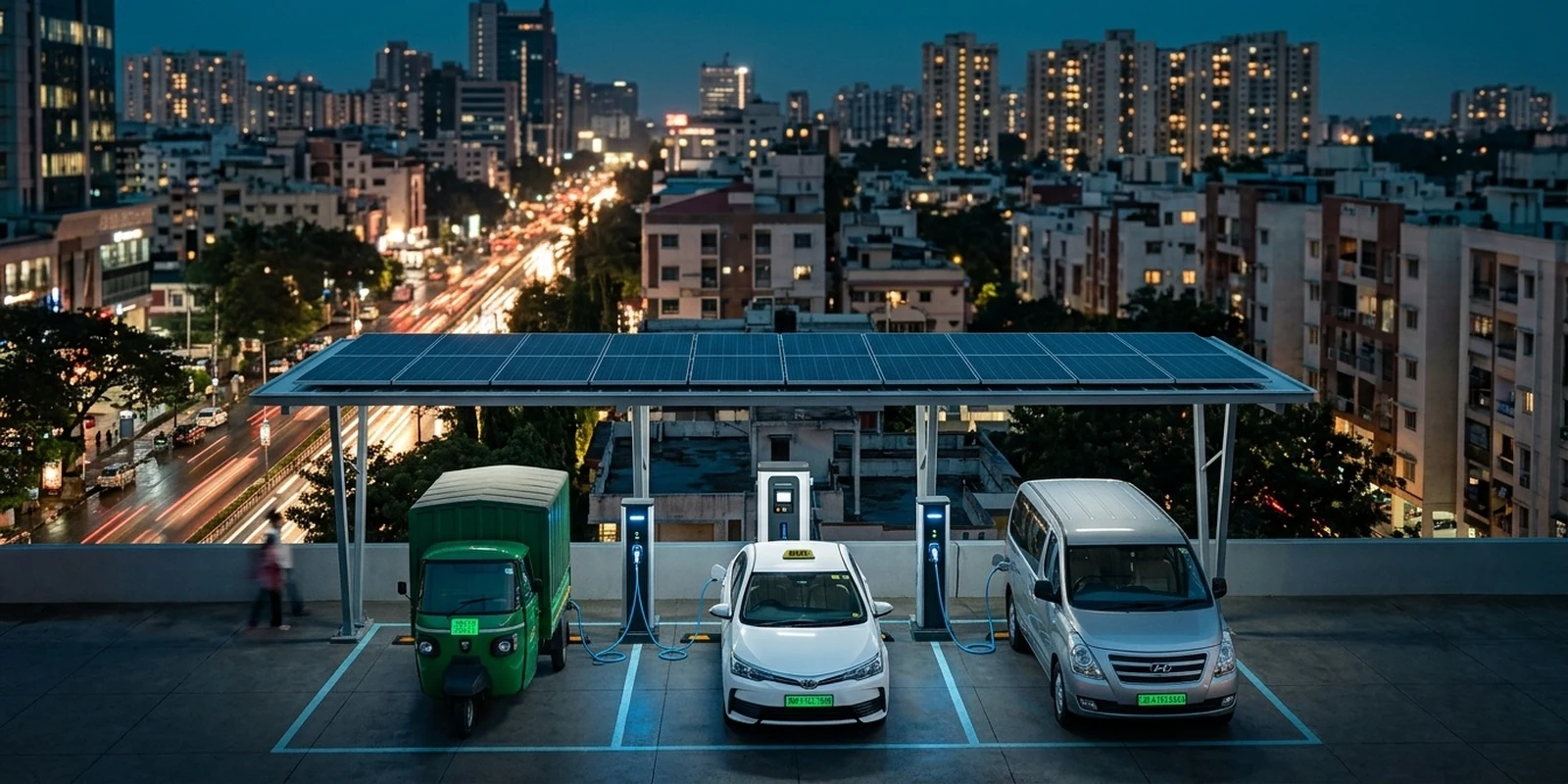
The 0.7×/1.3× ACoS split is only the floor. Add a solar canopy over the hub and the midday window gets cheaper still; add a modest battery and the overnight last-mile block can be part-served from stored solar rather than drawn at full sanctioned load. Every one of those decisions depends on knowing, hours ahead, how much energy each fleet will need and when. Forecast quality is what converts a tariff structure into a margin.
4. Payments: settling one session across three owners
A shared hub means a single charging session has a vehicle owner, a driver, an energy buyer and a site host who may all be different legal entities. Somebody has to split that session into GST-correct lines and settle it without a month-end spreadsheet. Fleets that treat this as an accounting afterthought discover it is the actual blocker — which is why fleet payment management belongs in the design, not the retrofit. Corporate operators running a mixed vehicle mix should read this alongside the mixed corporate EV fleet strategy.
The Constraints That Decide How Fast This Arrives
None of the above is speculative technology. All of it is buildable today. What decides the timeline is a short list of Indian constraints that no amount of software removes.
Grid sanction sets the calendar, not charger procurement
Ministry of Power rules give distribution licensees three days to energise a new connection in a metropolitan area, seven in other municipal areas and fifteen in rural ones — but ninety days where the DISCOM must extend distribution mains or commission a new substation first. A 400 kW hub in a dense metro almost always lands in the ninety-day bucket. Plan backwards from the substation, not from the charger lead time, and start the DISCOM conversation before the site lease is signed.
Financing still prices the residual, not the vehicle
Lenders discount a commercial EV because there is no liquid resale market for a four-year-old electric cargo three-wheeler in India yet. That shows up as shorter tenors and thinner advance rates than the diesel equivalent, which is why operating-lease and battery-as-a-service structures are spreading faster than outright purchase — both move residual risk off the operator’s balance sheet. Shared infrastructure helps in a way that is easy to miss: it makes the utilisation assumption inside a lease underwriting model far less speculative, because utilisation stops depending on one fleet’s demand forecast.
Charging density is a city problem, not a national one
29,000 stations is the wrong denominator for any operational decision. What matters is how many chargers sit inside your fleet’s actual operating polygon, how many are working on a given morning, and how many you can reserve. A last-mile fleet in one metro corridor and a taxi fleet across the same city face completely different densities. Measure yours before you budget for anything.
Policy is turning taxi electrification into a schedule
The Motor Vehicle Aggregator Guidelines, 2025, issued by the Ministry of Road Transport and Highways in July 2025, let state governments set annual targets for onboarding electric vehicles into aggregator fleets, with states advised to adopt the framework from 1 October 2025. That converts taxi electrification from a voluntary commitment into a dated obligation — and a dated obligation is what makes shared charging bankable, because a lender can finally underwrite the demand curve. Roughly 14,000 e-buses sanctioned under PM E-DRIVE for cities above four million people will land on the same distribution networks in the same years.
What Fleet Operators Should Do in the Next 18 Months
You do not need to wait for a city to organise itself. Four moves are available to a single operator now, and each one is worth doing even if the shared hub never materialises.
Plot every charger inside your actual operating area, with owner, connector type and observed uptime. Most operators discover 30–40% more usable capacity than their depot plan assumed.
Log 60 days of state of charge, idle windows and kWh per vehicle. You cannot negotiate a shared-load arrangement with a fleet whose free hours you have never measured.
Open the conversation with the nearest complementary fleet — a corporate operator if you run last-mile, a last-mile operator if you run corporate. Split the demand charge by contracted kW, not by vehicle count.
Any platform you sign must split one charging session across separate legal entities with correct GST treatment. Retrofitting this costs a quarter of engineering time and a month-end close.
The cities that get this right will not look futuristic. They will look like ordinary Indian metros where a delivery three-wheeler, a taxi and an employee shuttle happen to share a canopy, a transformer and a settlement ledger — and where nobody built three of each. That is the unglamorous version of the future of urban mobility, and it is the version that pencils out. Modelling what your own fleet’s free hours are worth against a neighbouring fleet’s peak is a conversation worth having with real numbers rather than assumptions.
Frequently Asked Questions
It means the city block, not your fleet, becomes the unit of infrastructure planning. Last-mile, taxi and corporate fleets have complementary charging windows, so a shared hub carries the same daily energy on roughly 44% less sanctioned load than three separate depots in an illustrative 280-vehicle model. The operator-level implication: your idle hours have market value to a fleet whose peak they cover.
Because you are usually not competitors. A last-mile logistics operator and a corporate employee-transport provider serve different customers and peak at opposite ends of the day. What they share is a demand charge neither can fully utilise alone. The structure that works in practice is splitting the sanctioned-load charge by contracted kW with reservation priority attached, so each party pays for capacity rather than for vehicles.
Ministry of Power guidelines price grid supply to charging stations at 0.7 times the Average Cost of Supply during solar hours and 1.3 times outside them, capped at ACoS until 31 March 2028 – a 1.9 times spread on an identical unit of energy. A 60-van corporate fleet drawing roughly 1,200 kWh a day captures a material share of that simply by charging in the 10:00-17:00 window it is already idle in.
Grid sanction, not chargers. Ministry of Power rules require a DISCOM to energise a new connection within three days in a metro area, but allow ninety days where distribution mains must be extended or a new substation commissioned. Any hub in the 300-500 kW range in a dense Indian city typically triggers the ninety-day path, so start the substation conversation before the site lease.
The requirement that breaks most existing setups is multi-party settlement: one charging session resolving to different vehicle owners, energy buyers and site hosts with correct GST treatment. Single-tenant fleet tools assume one payer. Check that first, then check whether the platform can reserve and prioritise capacity it does not own. Those two capabilities decide whether shared infrastructure is operable or theoretical.
Sources: IEA — Global EV Outlook 2026 | Ministry of Heavy Industries — Lok Sabha reply on public charging stations | PM E-DRIVE — charging infrastructure rollout guidelines | Ministry of Power — EV charging infrastructure guidelines and standards | Business Standard — Motor Vehicle Aggregator Guidelines, 2025
Manage Your Fleet’s Charging, Energy and Payments in One Place
Tell us your city, your segment and your fleet size. We will model your idle hours against a neighbouring fleet’s peak and show you what shared sanctioned load would actually save you — before you commit capex.