
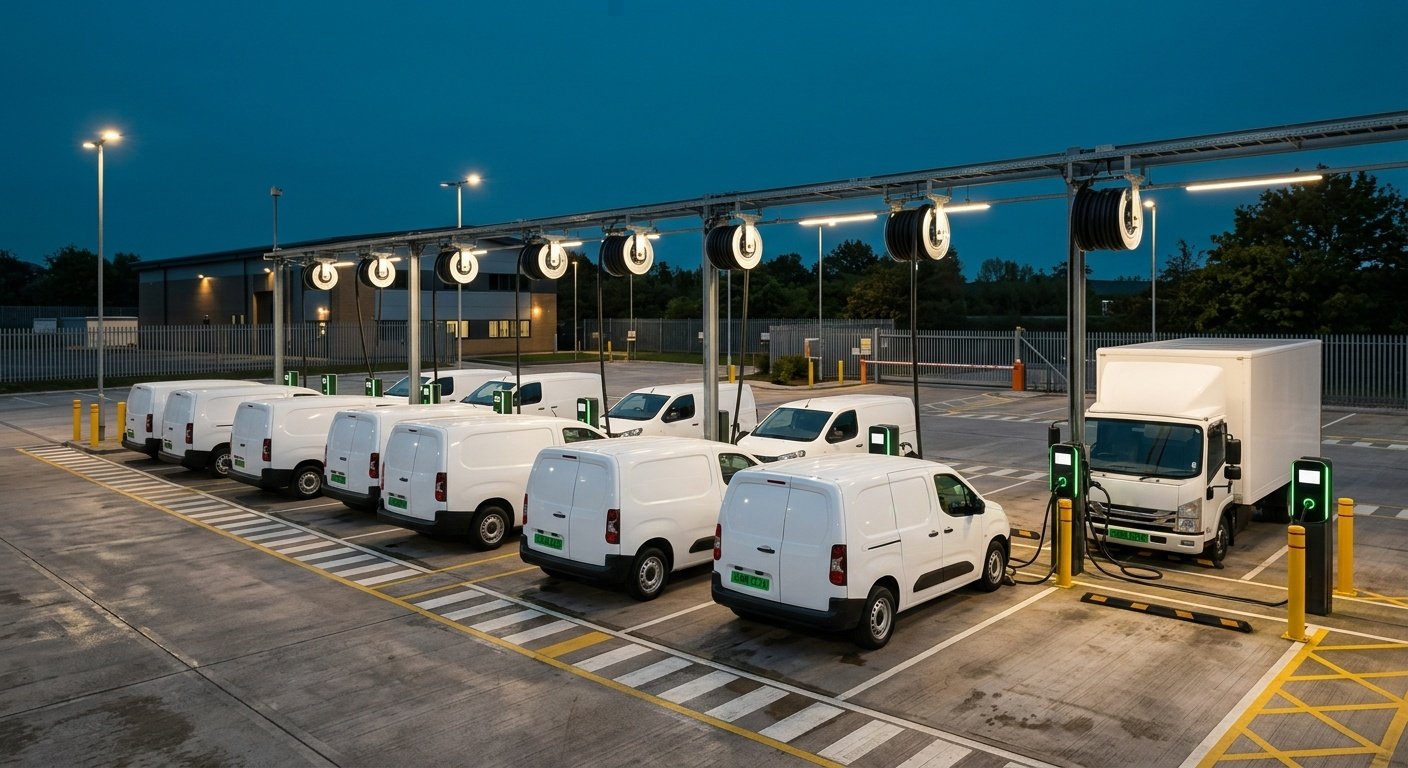
EV Depot Operations Guide: Layout, Power And Software
💡 EV Depot Operations Guide: Key Highlights
- Dwell window decides charger mix — any bay with more than ~4 hours of dwell time is cheaper and simpler to run on 7–22 kW AC than on DC fast charging.
- A 50-port AC depot typically needs a 300–500 kVA transformer, not 50× the per-port rating — a realistic overnight diversity factor of 0.5–0.7 is what actually gets drawn.
- Overhead cable management, not floor cable, is the safety baseline for any yard where vehicles and staff share the same tarmac.
- RFID/vehicle-ID should sit on the vehicle, not the driver — it keeps charging sessions, billing and access logs tied to the asset regardless of who’s driving that shift.
- New chargers must speak OCPP 1.6J/2.0.1 under the Ministry of Power’s 2024 guidelines — this is what lets one dashboard run hardware from multiple vendors.
- Last-mile warehouses and corporate transport hubs need different blueprints — same six decisions, different answers.
Fleet electrification succeeds or stalls at the depot. Buy the right vehicles and you can still lose two hours a day to a supervisor manually guessing which van has enough charge for the next run. This EV depot operations guide is written for the person who has to run that yard, not the CXO deciding whether to electrify. It covers six decisions in order: charger mix, parking layout and power, cable management and signage, access control, software integration, and how those choices differ between a last-mile warehouse and a corporate transport hub. (If you’re still at the site-selection and financing stage, our EV depot design strategy guide covers that upstream decision — this piece picks up once the site is chosen and it’s time to build the operating plan.)
Charger Mix: How Many AC Ports vs DC Fast Chargers You Actually Need
Start from dwell time, not from vehicle specs. Level 2 AC chargers deliver 7–22 kW and recharge a typical commercial EV in 4–8 hours; DC fast chargers run 50–350 kW and can take a battery from 20% to 80% in 30–60 minutes. But most mainstream commercial EVs sold in India — Tata Ace EV, Nexon EV and similar — only accept 25–30 kW on DC even when plugged into a 60 kW or 120 kW unit, so paying for a bigger DC charger than your vehicles can use is money left on the table. The practical rule: any bay with a dwell window longer than about four hours should run on AC. It’s dramatically cheaper in both hardware and electrical infrastructure, and it’s gentler on battery health than repeated fast charging.
Last-Mile Warehouse Depot
Take a 40-van last-mile operation running out of a Bhiwandi warehouse. Each van covers roughly 100–120 km a day and consumes 25–35 kWh. Vans return between 8 pm and 10 pm and don’t leave again until 6 am the next morning — an 8–10 hour dwell window. That’s a pure AC depot: 40× 7.4 kW AC ports, full recharge overnight, and maybe two 30 kW DC ports held in reserve for a van that comes back late from a peak-season surge or a breakdown reroute. DC fast charging as the primary strategy here would be solving a problem this fleet doesn’t have.
Corporate Transport Hub
A corporate transport hub in Gurugram running 25 sedans and a couple of 20-seat shuttles for employee pickup/drop looks different: vehicles come back between shift changes, sometimes with a dwell window as short as two to three hours before the next run. Here the mix flips — most vehicles still charge overnight on AC, but 3–4 DC fast chargers are needed to top up vehicles caught mid-shift, especially on split-shift days with a midday office-hours run sandwiched between the morning and evening peaks.
| Attribute | Level 2 AC Charging | DC Fast Charging |
|---|---|---|
| Typical power output | 7–22 kW | 50–350 kW |
| Time for a meaningful charge | 4–8 hours | 30–60 minutes (20%→80%) |
| Best fit | Dwell window > 4 hours (overnight depot) | Short dwell windows, mid-shift top-ups, backup capacity |
| Relative hardware + install cost | Low | 5–10× higher per port |
| Battery health impact | Minimal | Higher heat/degradation if used routinely |
Parking Layout And Power Distribution That Scales
Layout decisions made on day one either let you add 20 more vehicles next year with a weekend of work, or force a re-dig of the whole yard. Two things matter most: bay orientation and how you size the electrical supply.
Bay Layout: Back-In vs Pull-Through
Back-in bays with the charger mounted on a pedestal between two vehicles let one charger serve two bays and keep cable runs short — the standard choice for vans and cars. Pull-through bays cost more per vehicle in yard footprint but remove the need to reverse a loaded truck at the end of a shift, which matters for heavier last-mile vehicles and for corporate shuttles where a tired driver reversing near pedestrians is a real risk to design around, not just an inconvenience.
Sizing The Transformer Without Overpaying
The single most expensive mistake in depot design is sizing the electrical connection for every vehicle charging at full power at the same time — a scenario that almost never happens in practice. Industry data puts a realistic overnight diversity factor at 0.5–0.7 of theoretical maximum demand. For the 40-van warehouse above: 40 ports × 7.4 kW = 296 kW theoretical maximum; at a 0.6 diversity factor, actual peak draw is closer to 178 kW. Rounding up for headroom and future growth, that depot is comfortably served by a 300 kVA dedicated transformer rather than something sized for the full 296 kW — the difference is a meaningful chunk of the project’s capital cost. A 50-port AC depot in general lands in the 300–500 kVA range once diversity is applied correctly; get a DISCOM load-flow study done before committing to a transformer size, not after.
Cable Management And Physical Safety On The Yard
A depot yard mixes moving vehicles, walking staff, and live electrical cable — cable management is not a cosmetic choice, it’s the difference between a clean audit and an insurance claim.
Trip Hazards And Cable Routing
Overhead retractable cable reels — the same principle used at fuel pump islands — keep cable off the tarmac entirely and are worth the extra cost over loose floor cable in any depot with foot traffic. Where overhead mounting isn’t possible, route cable through raised, ramped cable-protector troughs, never bare across a walkway, and keep a clear pedestrian lane physically separated from the charging aisle with bollards or painted buffer zones — not just paint, since paint alone doesn’t stop a reversing vehicle.
Signage And Compliance Checklist
The Ministry of Power’s 2024 revised EV charging infrastructure guidelines set the baseline even for a private depot that never serves the public: every charging outlet needs a bonded protective-earth conductor with ground-fault interruption and earth-continuity monitoring that automatically shuts off supply if the earth path fails, in line with IS 17017. On top of that, treat these as non-negotiable for any depot: fire extinguishers rated for electrical fires at every charging cluster, charging equipment kept under weatherproof cover, high-visibility hazard signage at each bay (voltage warning, no-smoking, emergency shutoff location), and a documented emergency shutdown procedure your staff has actually rehearsed — not just laminated and forgotten on a wall.
Access Control: Who Can Charge, Where, And When
Access control at a depot is doing two jobs at once: keeping unauthorized vehicles and people off the yard, and making sure every charging session is attributable for cost allocation and billing.
Vehicle ID vs Driver ID At The Charger
Attach the RFID tag or identifier to the vehicle, not to an individual driver’s badge. Commercial fleets run multiple drivers per vehicle across shifts, and tying charging authorization to the asset — not the person swiping in that day — keeps energy cost, session history and maintenance data cleanly attached to the right van or car regardless of who’s behind the wheel. A separate ANPR camera or barrier-gate RFID reader at the yard entrance handles the coarser question of which vehicles are allowed on site at all.
Time-Slotting Bays For Off-Peak Tariffs
Once vehicles and bays are individually addressable, you can enforce charging windows rather than just permissions — routing bulk overnight charging into the DISCOM’s lower time-of-use band and reserving daytime DC capacity strictly for vehicles that actually need a mid-shift top-up. This is also where the corporate-hub case earns back some of its higher DC spend: fewer vehicles are allowed onto fast chargers at all, which keeps both the electricity bill and the transformer sizing in check.
Software Integration: Turning The Depot Into A Control Layer
Everything above — chargers, layout, safety systems, access control — is hardware and process. It only becomes an operations advantage once it’s visible in one place.
OCPP And Multi-Vendor Hardware
Under the Ministry of Power’s 2024 guidelines, all new chargers must support the Open Charge Point Protocol (OCPP 1.6J or 2.0.1) for backend communication. In practice that means you are not locked to a single charger manufacturer: a depot can mix AC units from one vendor with DC fast chargers from another and still run both from one charging management dashboard, instead of logging into three separate vendor apps to find out which bay is free.
One Dashboard: Chargers, Vehicles, Access And Payments
The real gain shows up when charger status, live state-of-charge from vehicle tracking, access-control logs and driver reimbursements sit in one screen instead of four. A supervisor doing the 6 am dispatch check should be able to see in ten seconds which vans are charged and ready, which bay is stuck mid-session, and which driver’s home-charging claim is pending — without walking the yard or calling three different people. That’s the operational case for treating the depot as a single control layer rather than a set of independently managed systems: a fleet operating system like YoMobility sits across the chargers, the vehicles and the access logs so the depot runs on data instead of on a supervisor’s memory of who parked where.
A Sample EV Depot Operations Guide: Last-Mile Warehouse vs Corporate Hub
Putting the six decisions side by side makes the segment differences concrete:
| Decision | Last-Mile Warehouse (40 vans) | Corporate Transport Hub (25 cars + 2 shuttles) |
|---|---|---|
| Charger mix | ~95% AC, 2 DC ports as backup | ~70% AC overnight, 3–4 DC for mid-shift top-ups |
| Bay layout | Back-in, pedestal-between-two-vehicles | Mixed back-in (cars) + pull-through (shuttles) |
| Transformer sizing | ~300 kVA (0.6 diversity on 296 kW theoretical) | ~250–350 kVA (higher DC share, fewer vehicles) |
| Dwell window | 8–10 hours, overnight | 2–3 hours between shifts, plus overnight |
| Access control priority | High-volume vehicle-ID at gate + bay | Time-slotting for DC bays is the priority |
| Software priority | Charger uptime + driver reimbursement | Live SOC visibility for mid-shift readiness |
Neither blueprint is more “advanced” than the other — they’re two correct answers to two different duty cycles. What they share is the same underlying requirement: a depot that runs on documented decisions and live data, not on tribal knowledge held by whoever has been there longest.
Frequently Asked Questions
How many chargers does a 50-vehicle EV depot actually need?
Fewer than 50. Because vehicles don’t all arrive and leave at the same time, a realistic overnight diversity factor of 0.5–0.7 means peak simultaneous demand is well below the theoretical maximum. Most 50-vehicle depots run comfortably on 35–45 AC ports plus a small number of DC ports for exceptions, sized against actual return-time data rather than fleet headcount.
What transformer capacity does an EV depot need?
A managed 50-port AC depot typically needs a 300–500 kVA dedicated transformer once a realistic diversity factor is applied — not the full theoretical sum of every port’s rating. Always confirm with a DISCOM load-flow study before finalizing, since actual feeder capacity and existing site load vary.
How do you prevent cable trip hazards at an EV depot?
Overhead retractable cable management keeps cable off the tarmac entirely and is the safest option where vehicles and staff share the yard. Where overhead mounting isn’t feasible, route cable through raised cable-protector troughs and keep pedestrian lanes physically separated from the charging aisle with bollards, not paint alone.
Do private fleet depots need to follow CEA/Ministry of Power charging guidelines?
The Ministry of Power’s 2024 guidelines are written primarily for public charging infrastructure, but the underlying electrical-safety requirements — earthing per IS 17017, ground-fault interruption, and OCPP-compliant new chargers — are the standard any competent electrical contractor and insurer will expect at a private depot too. Treat them as the compliance floor, not a public-charging-only rule.
Can one software platform control chargers, vehicles and access together at a depot?
Yes, provided the chargers are OCPP-compliant — mandatory for new installations under the 2024 guidelines. That protocol-level standardization is what lets a fleet operating system like YoMobility sit across multi-vendor chargers, vehicle telematics, access logs and driver payments in a single dashboard instead of separate vendor apps for each piece.
Sources: Ministry of Power — Guidelines and Standards for EV Charging Infrastructure, 2024 | PIB — Revised Consolidated Guidelines & Standards for EV Charging Infrastructure | Wikipedia — Open Charge Point Protocol (OCPP)
Manage Your Fleet’s Depot Operations Today
See how YoMobility unifies chargers, vehicles, access control and payments into one depot control layer — book a walkthrough with our team.
Book a Free Demo