
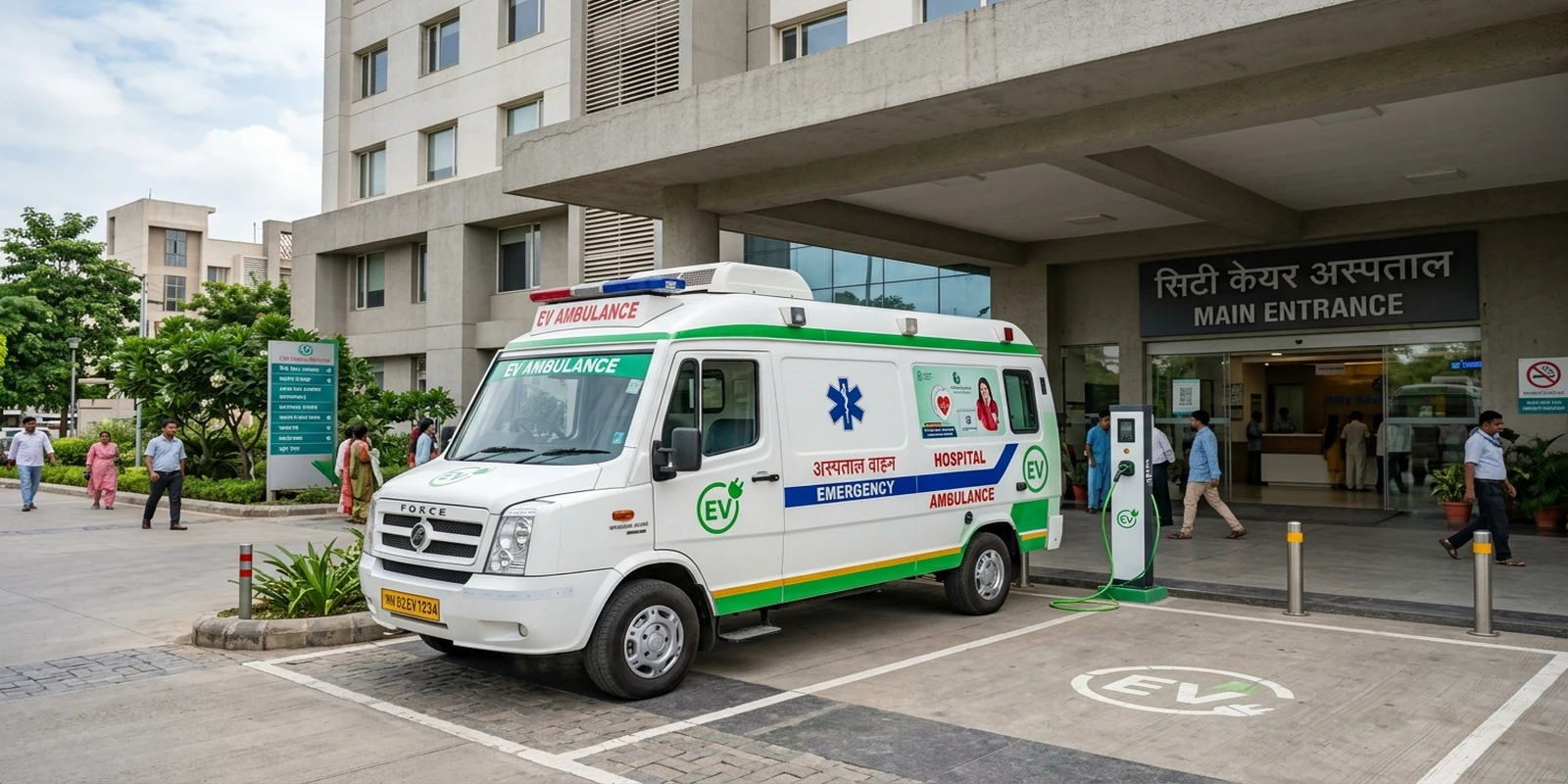
💡 Electric Ambulance Adoption: Key Highlights for Operators
- Government subsidy of up to ₹12–15 lakh per ambulance under PM e-DRIVE — stackable with NHM procurement funds
- Electric ambulances reduce per-km operating costs by 60–70% vs diesel equivalents
- Minimum 140 km range per charge covers full-shift urban ambulance operations without mid-day charging
- 5-year/1,25,000 km warranty on battery, motor and vehicle reduces maintenance risk significantly
- YoMobility manages charging, driver operations, and fleet tracking — from a single dashboard across 9+ CPO networks
India has just made the largest single financial commitment to electric ambulances in the country’s history. With ₹500 crore allocated and 3,811 ambulances targeted under the PM e-DRIVE Scheme (Gazette Notification S.O. 3191(E), June 2026), the financial case for switching to electric ambulances has never been stronger. But the opportunity comes with a window — targets are set for FY27 and FY28 — and operators who move early will benefit most.
This article is specifically for hospital administrators, private ambulance fleet operators, NGOs, and state health agencies who want to understand how to take advantage of this scheme, what the transition to electric ambulances actually looks like operationally, and how YoMobility can help manage your electric ambulance fleet once it’s on the road.
The Financial Case: Why Now Is the Right Time
Before the PM e-DRIVE notification, electric ambulances carried a significant price premium over diesel equivalents. That premium has now been substantially offset by government incentives. Consider a typical BLS ambulance scenario:
⚡ Electric Ambulance (Type C BLS, 40 kWh battery)
- Ex-factory price: ~₹30 lakh (base vehicle)
- PM e-DRIVE subsidy: up to ₹10.5–12 lakh (35% cap or ₹30k×40kWh)
- Net cost after subsidy: ~₹18–20 lakh
- Fuel cost: ₹1–1.50/km (electricity)
- Maintenance: 50% lower than diesel
🛢️ Diesel Ambulance (equivalent BLS)
- Purchase price: ~₹16–20 lakh
- No government subsidy
- Net cost: ₹16–20 lakh
- Fuel cost: ₹4–6/km (diesel)
- Higher maintenance, engine overhaul costs
An ambulance running 100 km per day for 300 operational days a year will save approximately ₹1.5–2 lakh annually in fuel costs alone when switching from diesel to electric. Over a 5-year vehicle life, that is ₹7.5–10 lakh in fuel savings — on top of the upfront subsidy. The net cost difference between a subsidised electric BLS ambulance and its diesel equivalent is now marginal, while the operational savings are compounding.
For government buyers and NGOs, the scheme is stackable with NHM funding. An NHM-funded ambulance procurement can layer PM e-DRIVE incentives on top, making the net cost to the state significantly lower than a diesel alternative.
Operational Benefits of Electric Ambulances
Beyond the financial case, electric ambulances offer tangible operational advantages that matter specifically to ambulance operators:
- Quieter operation: Electric drivetrains are significantly quieter than diesel engines. For paramedics working in the ambulance compartment, and for patients in transit, reduced noise reduces stress and improves clinical assessment conditions.
- No fumes in the vehicle bay: Hospital ambulance bays are enclosed or semi-enclosed. Diesel idling creates harmful exhaust exposure for paramedics, hospital staff, and patients near the bay. Electric ambulances eliminate this entirely.
- Instant torque for emergency response: Electric motors deliver full torque immediately, meaning faster acceleration from standstill — critical in emergency response situations.
- Lower maintenance downtime: Fewer moving parts means fewer scheduled maintenance events. A typical diesel ambulance requires engine servicing every 10,000–15,000 km. Electric powertrains have no oil changes, no timing belt replacements, and no exhaust system maintenance — reducing the frequency of ambulances being taken off the road for servicing.
Planning Your Charging Infrastructure
The most common concern ambulance operators raise about electrification is charging. A vehicle that is plugged in cannot respond to emergencies. This concern, while valid, is solvable with proper fleet and charging management.
The PM e-DRIVE scheme mandates a minimum range of 140 km per charge for eligible ambulances. Most urban ambulance operations cover 80–120 km per shift. This means a single overnight charge at depot is sufficient for a full day’s urban operations — identical to how diesel ambulances are refuelled at night. The key is ensuring your depot charging infrastructure is operational before the fleet arrives.
For hospitals and operators who need multi-shift capability or serve longer routes, access to public CPO charging networks during shift breaks is important. YoMobility’s charging management platform connects your ambulance fleet to 9+ CPO networks across India including Statiq, Chargezone, Bolt.earth, Pulse Energy and others — so your drivers can charge at any compatible public station and the cost is consolidated into a single invoice.
How YoMobility Helps Manage Your Electric Ambulance Fleet
Deploying electric ambulances is the first step. Managing them efficiently at fleet scale — ensuring every vehicle is charged, every driver is accountable, and every charging cost is tracked — requires purpose-built fleet management software. YoMobility’s platform is designed exactly for this.
⚡ Charging Management
Monitor and control charging sessions across your depot chargers and public CPO networks. Schedule overnight charging automatically. Know exactly which ambulances are charged and ready for the next shift — before the shift starts.
🚑 Vehicle Tracking
Real-time GPS location, State of Charge (SOC), and vehicle health for every ambulance in your fleet. Dispatch the nearest vehicle with sufficient charge for the job. Know which ambulances need charging before they run out on a call.
👤 Driver Management
Onboard drivers, assign vehicles, track shift start/end, and monitor driving behaviour. Per-driver charging accountability ensures no unauthorised charging and helps you attribute energy costs accurately across your fleet.
📊 Payments & Analytics
Consolidated billing across all CPO networks — one invoice for Finance. Per-vehicle energy cost tracking for budget management. CO₂ savings reports for ESG and CSR reporting, relevant for hospitals with sustainability mandates.
Step-by-Step: Electrifying Your Ambulance Fleet
- Assess your fleet’s daily operational range. Calculate average km per shift per ambulance. If it’s consistently under 120 km, you can electrify immediately with available vehicles.
- Identify eligible ambulance categories. Determine which of your ambulances are Type B (PTV), Type C (BLS) or Type D (ALS) — all three are covered under the scheme.
- Get your depot charging infrastructure in place. A standard AC charger (3.3–7.2 kW) at your ambulance bay is sufficient for overnight charging. DC fast chargers can be added for multi-shift operations.
- Check empanelled manufacturers on the PM e-DRIVE portal (pmedrive.heavyindustries.gov.in). Only vehicles from empanelled OEMs qualify for the subsidy.
- Complete Aadhaar e-KYC at the dealership. The subsidy is applied upfront at the point of purchase — you do not need to claim reimbursement separately.
- Deploy fleet management software before your first EV arrives. YoMobility’s EV fleet management platform can be configured before delivery, so your charging and driver management is operational from day one.
For State Health Agencies and NHM Procurement Officers
State government departments, SHAs (State Health Agencies), and NHM programme managers have a particularly favourable position under this scheme. The gazette notification explicitly states that PM e-DRIVE incentives are available in addition to support received under the National Health Mission or other government healthcare schemes. This stacking provision is rare and significant: it means your existing NHM ambulance procurement budget can go significantly further when you select electric vehicles.
The notification also confirms that eligibility under PM e-DRIVE does not by itself constitute operational approval for NHM deployment — procuring agencies must still ensure compliance with MoHFW/NAS operational guidelines and ambulance fit-out requirements. However, this is a straightforward compliance step, not a barrier. All three eligible ambulance types (B, C, D) are defined under the same AIS-125 standard that NAS/NHM deployments already follow.
Sources: Gazette Notification S.O. 3191(E) — PM e-DRIVE Electric Ambulances | Ministry of Heavy Industries | PM e-DRIVE Official Portal
Ready to Electrify Your Ambulance Fleet?
YoMobility helps you manage charging, tracking, driver operations and billing for your electric ambulance fleet — from day one. Talk to our team about your electrification plan.