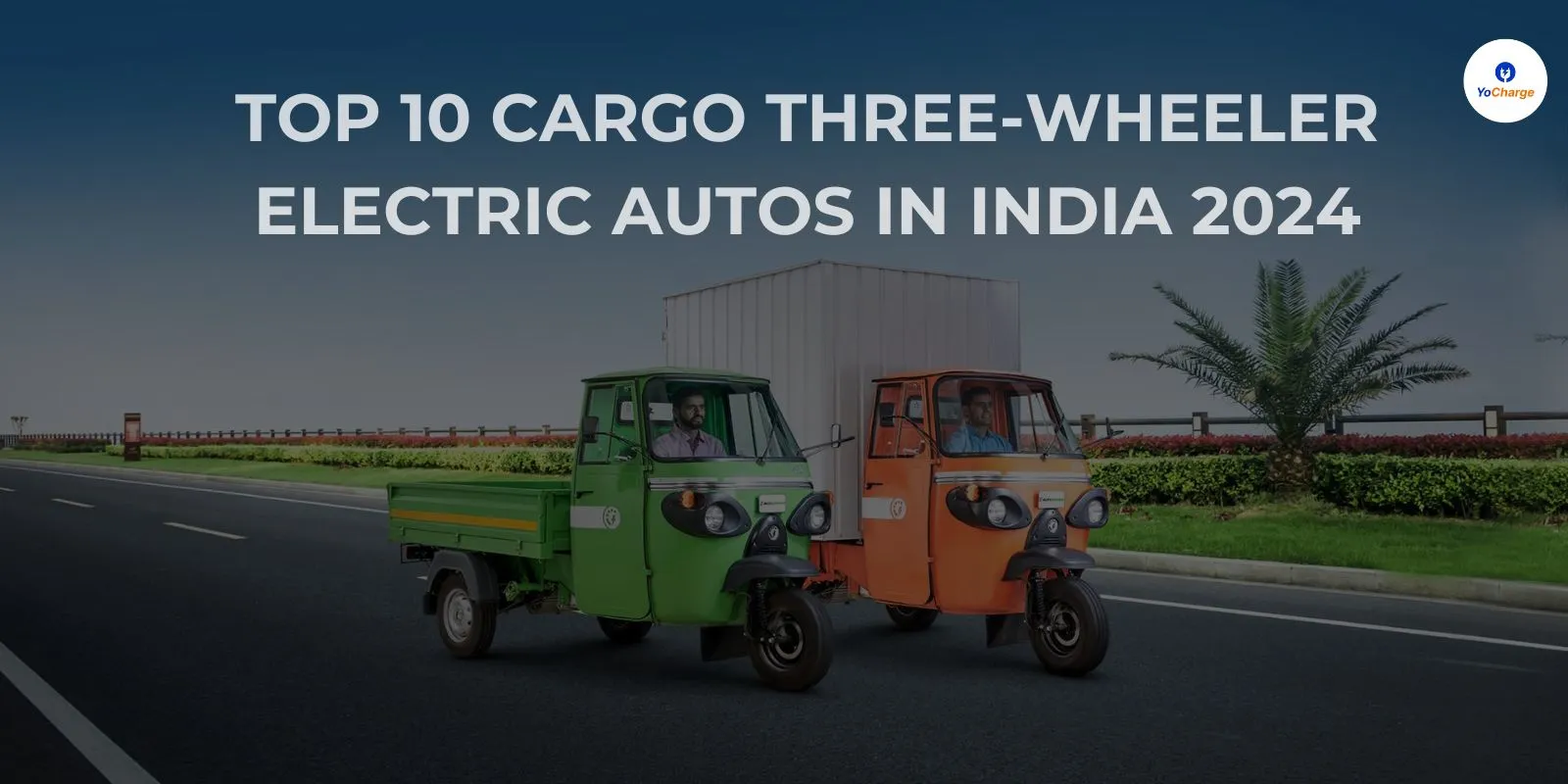
AI-Powered Routing For Last-Mile EV Fleets
💡 AI Routing For Last-Mile EV Fleets: Key Highlights
- India’s electric LCV sales crossed 9,000 units in 2025, up over 50% year-on-year — yet EVs are still only about 1% of total LCV sales, per the IEA’s Global EV Outlook 2026.
- The Tata Ace EV and Mahindra Zeo alone account for roughly 80% of India’s electric LCV volume — both built around short, predictable last-mile routes, not long-haul range.
- UPS’s ORION engine — a diesel-fleet benchmark, not an EV one — trims 6–8 miles per route per day and was projected to save $300–400 million a year once fully deployed, per INFORMS.
- A route that’s optimal for a diesel van can strand an EV mid-route if the plan ignores battery state of charge and charger location.
- Peer-reviewed EV-routing research now builds “battery status uncertainty” directly into the optimization model, instead of checking range as an afterthought.
AI routing for last-mile EV fleets is a different planning problem than routing a diesel or CNG fleet — range, charger location, and delivery windows have to be solved together, not checked one at a time. A combustion-fleet planner only asks “what’s the fastest sequence of drops?” An EV planner has to ask that while tracking remaining battery, whether a charger will be free when needed, and whether a charging detour blows through a delivery window. For e-commerce, quick-commerce, and grocery fleets running electric vans and three-wheelers across Indian metros, getting this wrong doesn’t mean a longer day — it means a vehicle stranded short of its depot.
Why Standard Routing Software Fails Electric Last-Mile Fleets
Most route-optimization software was built for ICE fleets, where the only hard constraints are payload, delivery windows, and traffic. Bolt an EV onto that model and the software will route it 60 km on 45 km of range, because it was never designed to check. This is the single most common failure teams report when they electrify a last-mile fleet without changing how routes get planned.
The Four Constraints an EV Route Must Solve at Once
A genuinely charge-aware route reconciles four variables at once: remaining state of charge (SOC) per vehicle, the location and real-time availability of chargers on or near the route, each stop’s delivery window, and current traffic — which changes energy consumption in ways a static distance calculation never captures. Drop any one and the “optimal” route stops being optimal the moment a vehicle hits the road. A 90-vehicle quick-commerce fleet in Bengaluru, for example, sees SOC drain 30–40% faster than manufacturer estimates once stop-start traffic and payload are factored in — a gap a distance-only planner never sees coming.
What Happens When Routing Ignores Battery State
Academic work on the “electric vehicle routing problem” increasingly treats range anxiety as a problem to solve mathematically, not patch operationally — recent research builds battery-status uncertainty directly into a two-stage optimization, so a route is proposed only if feasible under realistic energy variance. In practice, that’s the difference between a van running dry two stops from a customer and a system that recommends a five-minute top-up first. For a 50-van fleet in Delhi, even a handful of stranded-vehicle incidents a week — each costing a missed SLA window and driver overtime — dents cost per drop.
How AI-Powered Routing Actually Works for EV Fleets
AI-powered routing doesn’t replace the constraint list above — it learns to solve it faster and adapt to it in real time, instead of re-running a static plan once a day. That matters more for EV fleets than diesel ones, because the penalty for a wrong call is higher: a diesel van low on fuel makes a quick stop; an EV low on charge in the wrong place can be down for 30–45 minutes.
Static Planning vs Adaptive, Learning-Based Routing
A static planner generates one route per vehicle per day and assumes the world holds still. An adaptive system recalculates continuously as orders arrive, traffic shifts, or a charger goes offline — and it learns from history, recognizing that a segment (a steep approach, constant stop-start traffic) always drains more charge than distance suggests, then pricing that in. This is part of why India’s electric LCV market has clustered around short-range, purpose-built vehicles: the Tata Ace EV and Mahindra Zeo alone account for roughly 80% of electric LCV sales, per the IEA’s Global EV Outlook 2026 — a bet that only pays off if routing keeps every day’s distance inside that envelope.
The Signals the System Needs — SOC, Charger Status, Traffic, Delivery Windows
None of this works without live data: per-vehicle SOC and consumption history, charger status across depot and public networks, traffic conditions, and every delivery window on the manifest. The scale of the opportunity is visible even without an EV in the picture — UPS’s ORION system, built for a combustion fleet, covers over 70% of its 55,000 US routes and trims 6–8 miles off the average route per day, per INFORMS. An EV fleet running the same optimization captures that fuel efficiency, plus a layer unique to electric operations: fewer failed deliveries from range miscalculation, and less overtime detouring to a charger a smarter plan would have avoided.
The Strategic Payoff: Fewer Failed Deliveries, Less Overtime, Lower Cost Per Drop
For a CXO evaluating whether charge-aware routing is worth the investment, the case rests on three linked numbers: failed-delivery rate, driver overtime hours, and cost per drop. All three move together once routing treats battery and charger constraints as first-class inputs instead of someone else’s problem.
Quantifying the Overtime and Failed-Delivery Reduction
Take a 50-van last-mile operation running roughly 400 daily drops. If even 3–4% of routes hit a charge-related failure — a missed window from an unplanned charging detour, or a drop reassigned because a vehicle can’t make it back — that’s 12–16 failed or delayed deliveries a day, each carrying rebooking cost and non-productive driver hours. Shift that fleet onto routing that treats SOC and charger availability as constraints, and most of those failures disappear before the vehicle leaves the depot.
Segment-Specific Gains — E-Commerce vs Grocery and Quick-Commerce
The gains differ by segment. E-commerce fleets running scheduled, higher-payload windows benefit most from route density — packing more drops per charge cycle by sequencing stops around remaining range, not just geography. Grocery and quick-commerce fleets, on tighter SLAs with lighter two- and three-wheelers, benefit more from real-time re-routing around chargers and traffic, since a missed 10-minute window can mean a lost order, not a late one. Either way, the fleet that wins isn’t the one with the longest-range vehicles — it’s the one whose routing keeps every vehicle inside a range it can deliver on.
Building the Business Case for Fleet Leaders
Adopting AI-powered, charge-aware routing is not a single software swap — it’s a change in what data your operation tracks and acts on daily. Fleet leaders who get the most out of it treat the rollout as a measured pilot, not a one-shot migration.
What to Measure Before You Switch
Before touching the routing layer, baseline four numbers for 2–4 weeks: cost per drop, missed or failed-delivery rate, driver overtime tied to charging detours, and charger utilization. Without this baseline, it’s hard to prove ROI later or catch a bad rollout early. An AI operating system like YoMobility ties vehicle tracking and charging management data into one view, so the baseline and the post-rollout comparison come from a single source, not three spreadsheets.
Rollout Sequencing — Pilot Routes First
Start with 10–15 routes representing your hardest constraint combination — longest distance, tightest windows, sparsest charger coverage — rather than the easiest ones. If charge-aware routing holds on your worst routes, it holds on the rest by default. Expand in 4–6 week phases, re-measuring the same four numbers, folding in the remaining routes once failed-delivery rate and overtime trend down. A fleet operating system like YoMobility runs this sequencing directly — pulling live SOC, charger, and delivery-window data into one routing layer instead of a patchwork of telematics, a charging app, and a dispatch spreadsheet.
Frequently Asked Questions
What makes routing for a last-mile EV fleet different from routing a diesel or CNG fleet?
A diesel or CNG planner only solves for distance, payload, and time windows. An EV planner must also solve for real-time battery state of charge and charger location — a mathematically shortest route can still be physically impossible for a vehicle that lacks the range to complete it.
How much can AI-powered routing reduce cost per delivery for an EV fleet?
It varies by fleet size and route density, but the two levers are consistent: fewer failed or reassigned deliveries from charge-related misses, and less distance and driver time on unplanned charging detours. Non-EV benchmarks like UPS’s ORION show AI routing alone can trim several miles per route per day at fleet scale; EV fleets add avoided range failures on top.
Does adopting AI routing mean replacing our existing dispatch software?
Not necessarily. Charge-aware routing logic can sit alongside existing order-management and dispatch tools as the layer that decides route feasibility before dispatch confirms it — it needs live access to SOC, charger status, and delivery-window data, not a wholesale system replacement.
How long before an operations team sees measurable results after switching to charge-aware routing?
Most fleets running a phased pilot (10–15 routes, 4–6 week phases) see a measurable drop in charge-related failed deliveries within the first phase. Overtime-hour and cost-per-drop improvements typically show up over the following two to three phases as route-history learning compounds.
Sources: IEA, Global EV Outlook 2026 | ICCT, Electrifying Last-Mile Delivery: A TCO Analysis | INFORMS, UPS ORION Case Study | ScienceDirect, EV Routing Problem With Battery Status Uncertainty
Manage Your Fleet’s Routing Today
See how YoMobility unifies vehicle SOC, charging status, and delivery windows into one AI-powered routing layer for your last-mile EV fleet.
Book a Free DemoYoMobility EV-FMS
EV fleet management softwareRun every vehicle, driver, charge and payment from one platform. Charge on multiple networks, and get one invoice for all of it.
Resources
Keep reading
Driver Monitoring System For EV Fleets: What The Camera Sees And What It Should Change
💡 Driver Monitoring System: Summary A driver monitoring system is usually bought as a camera and judged on detection: does […]
EV Battery Replacement Cost For Fleets: What Drives The Quote — And When Replacing Is The Wrong Call
💡 EV Battery Replacement Cost: Key Highlights The EV battery replacement cost is the largest single repair bill a fleet […]
Electric Scooter For Delivery Fleets: Specs That Survive A Full Rider Shift
💡 Electric Scooter For Delivery Fleets: Summary An electric scooter for delivery and an electric scooter for commuting are usually […]
See YoMobility on your fleet
Tell us how many vehicles you run and where they charge. We'll show you how they'd run on one platform, with one invoice.
Or contact us