Manage Your Fleet’s EV Maintenance Today
See how depot teams track service history, downtime and cost per kilometre for every vehicle in one place.
Every business case for going electric leans on the same line: EV fleet maintenance costs less than diesel. That is true. What it does not tell a depot supervisor is that the workshop never gets simpler — it gets different. Work your team has done for twenty years disappears, and work nobody is trained for replaces it.
This guide is for ops managers and workshop supervisors at last-mile, urban taxi and corporate fleets. If you are still deciding how to acquire the vehicles, our companion piece on whether to lease or buy your electric fleet covers that. This one starts the day they land.
The subtraction is the part everyone gets right. An electric drivetrain deletes the oil change, fuel and air filters, spark or glow plugs, the timing belt, the exhaust and AdBlue system, and on most commercial EVs the clutch and gearbox. The US Department of Energy’s Alternative Fuels Data Center puts it plainly: EVs need less maintenance because they have “fewer moving parts and fluids to change,” and brake wear is “significantly reduced due to regenerative braking.”
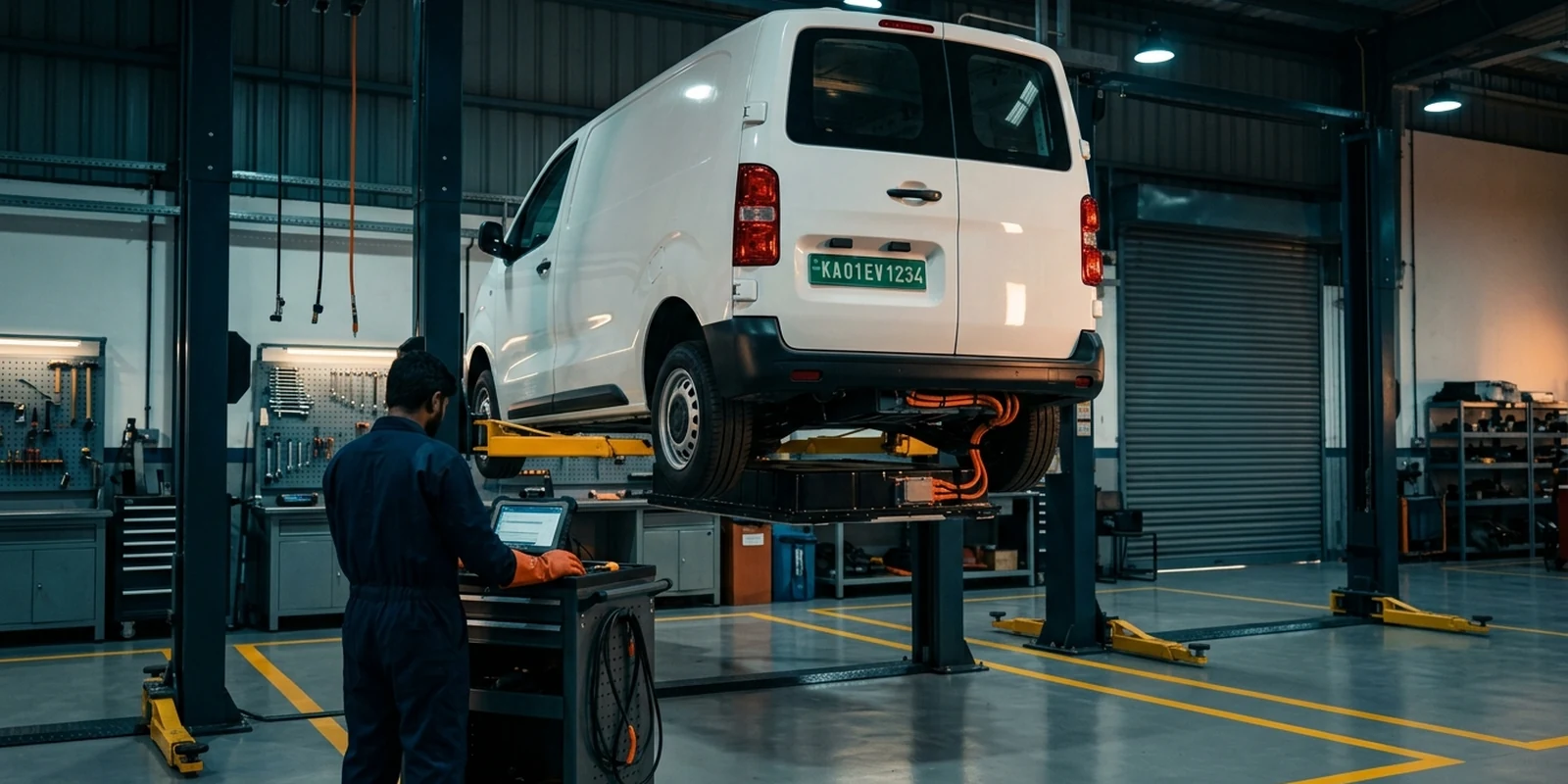
The addition is where fleets get caught out. A liquid-cooled traction battery has a coolant circuit to check on schedule. High-voltage cabling, connectors and the pack enclosure need insulation-resistance testing and torque checks — work a standard workshop toolkit cannot do. And tyres wear faster, because instant torque and a few hundred extra kilograms act on the same contact patch.
Regen is so effective in stop-start duty that friction brakes are barely used, so discs and calipers corrode and seize from disuse. Fleets that copy the diesel trigger — “inspect at 40,000 km” — find seized calipers at 18 months.
The hard India-specific numbers come from WRI India’s TCO work on electric bus procurement. Its model puts annual maintenance for a 12-metre AC electric bus at ₹4,57,589, against ₹10,34,054 for a low-end AC diesel bus and ₹17,23,212 for a high-end one — 56% to 73% lower. Buses are the heavy end of the spectrum, but the reason for the gap scales down to vans and three-wheelers unchanged.
The more useful finding is the spread, not the average. WRI’s sensitivity analysis shows a ±50% error in the maintenance assumption moves an e-bus’s cost per kilometre by only 3–4%, but a diesel bus’s by 8–11%. On a diesel fleet, maintenance is a live budget risk to manage. On an electric fleet it stops being a swing factor.
The risk moves rather than disappears. For 50 electric cargo vans working out of one Delhi depot, the exposure is no longer “what will repairs cost this quarter” but “how many vehicle-days will I lose waiting for a part or a technician.” For the full cost picture, see our EV fleet TCO breakdown for Indian operators.
On a diesel fleet the oil change is the metronome: every 10,000 or 15,000 kilometres the vehicle comes in, and brakes, filters and fluids get inspected on the back of that visit. Delete the oil change and you delete the metronome. Fleets discover this six months in, when nobody can say when a van was last inspected.
What replaces it is three separate clocks. A calendar clock governs high-voltage inspection, brake condition, coolant and cabin filter — every six or twelve months regardless of distance. A distance clock governs tyre rotation and alignment, at shorter intervals than diesel. A condition clock, read from the vehicle’s own data, governs battery items: cell balance, pack temperature history and state-of-health trend.
State of health only shows up as a trend across months, so log it from week one or the baseline is gone for good. Two vans with identical odometers can differ materially in pack condition — one fast-charged daily at 40°C, the other trickle-charged overnight.
Everything past the service disconnect is a competence gate, not a preference: high-voltage work needs a trained technician, insulated tooling and a documented lockout procedure — and that skill base is still being built in India, which is another way of saying it is scarce. A 2025 Directorate General of Training programme covered, in phase one, a 240-hour advanced EV technician course at four National Skill Training Institutes and a 90-hour course at twelve ITIs.
| Model | Fits when | What you give up |
|---|---|---|
| In-house workshop | 100+ vehicles, one or two OEMs, one or two depots | You carry HV training, tooling, and the paperwork keeping the battery warranty intact |
| OEM AMC | Fleet in warranty, or spread across cities you cannot staff | Turnaround control, and pricing leverage at renewal |
| Third-party multi-brand | Mixed-OEM fleets; cheaper on tyres, brakes, consumables | A warranty argument the first time anyone opens the HV system |
The split is usually right. Keep daily checks, tyres, brakes and body repairs in-house, where turnaround is measured in hours and no warranty is at stake. Contract high-voltage and battery work to whoever holds the warranty — the premium buys a documented service history and removes the liability argument if a pack fails in year four. Our depot operations manual covers the bay layout.
Here is the arithmetic that reframes the topic. A van off the road eleven days waiting on a ₹4,000 sensor costs a last-mile operator far more than a diesel needing a ₹40,000 repair finished the same afternoon. Once repair spend has halved, lead time — not repair cost — is the operating variable. Yet most EV maintenance conversations are still held in rupees per service, not vehicle-days lost.
Commercial EV service networks in India remain thin outside the major metros, so a single-make fleet inherits its OEM’s coverage map. Let that map shape depot siting: a depot four hours from the nearest authorised HV service point is a design decision, whether or not you made it deliberately.
Every decision above is a data decision, and a folder of invoices answers none of them. Capture five things per vehicle, not per fleet: maintenance cost per kilometre, downtime days per quarter, repeat-fault rate by component, parts wait time logged separately from repair time, and the state-of-health trend.
That fourth field is the one most fleets skip — and the one that says whether the problem is the workshop or the supply chain. Capturing it per vehicle is what EV vehicle tracking and fleet reporting exist to do, and a fleet operating system like YoMobility ties service history to the vehicle record already holding charging sessions and route data — so cost per kilometre becomes a number you read, not one you reconstruct at year-end.
Yes, and the gap is large. WRI India’s model shows ₹4.58 lakh of annual maintenance on a 12-metre AC electric bus against ₹10.34–17.23 lakh for diesel — 56% to 73% lower. The saving comes from far fewer wearing parts, so it scales down to vans and three-wheelers.
Run three clocks, not one: high-voltage inspection, brakes, coolant and cabin filter on a six- or twelve-month calendar; tyre rotation on distance; battery items on condition. OEM schedules vary widely in India, so confirm per model.
Most fleets should do both. An in-house bay makes sense above roughly 100 vehicles at one or two depots, handling tyres, brakes and running repairs. High-voltage and battery work belongs with the warranty holder — the documented service history outweighs the labour saving.
Copying the diesel schedule across. Two failures follow: brakes inspected on a distance trigger that never fires, so calipers seize from underuse; and no state-of-health baseline captured early, so degradation cannot be evidenced later.
Sources: WRI India — E-Bus Procurement TCO | US DOE — EV Maintenance and Safety | PIB — DGT EV technician training | ICCT — TCO Calculator
See how depot teams track service history, downtime and cost per kilometre for every vehicle in one place.
YoMobility EV-FMS
EV fleet management softwareRun every vehicle, driver, charge and payment from one platform. Charge on multiple networks, and get one invoice for all of it.
Resources
💡 Driver Monitoring System: Summary A driver monitoring system is usually bought as a camera and judged on detection: does […]
💡 EV Battery Replacement Cost: Key Highlights The EV battery replacement cost is the largest single repair bill a fleet […]
💡 Electric Scooter For Delivery Fleets: Summary An electric scooter for delivery and an electric scooter for commuting are usually […]
Tell us how many vehicles you run and where they charge. We'll show you how they'd run on one platform, with one invoice.
Or contact us