CAFE-III Fuel Economy Norms Explained: What India’s Draft 2027 Rules Mean for Fleets
By Shaurya Rathore5 min read
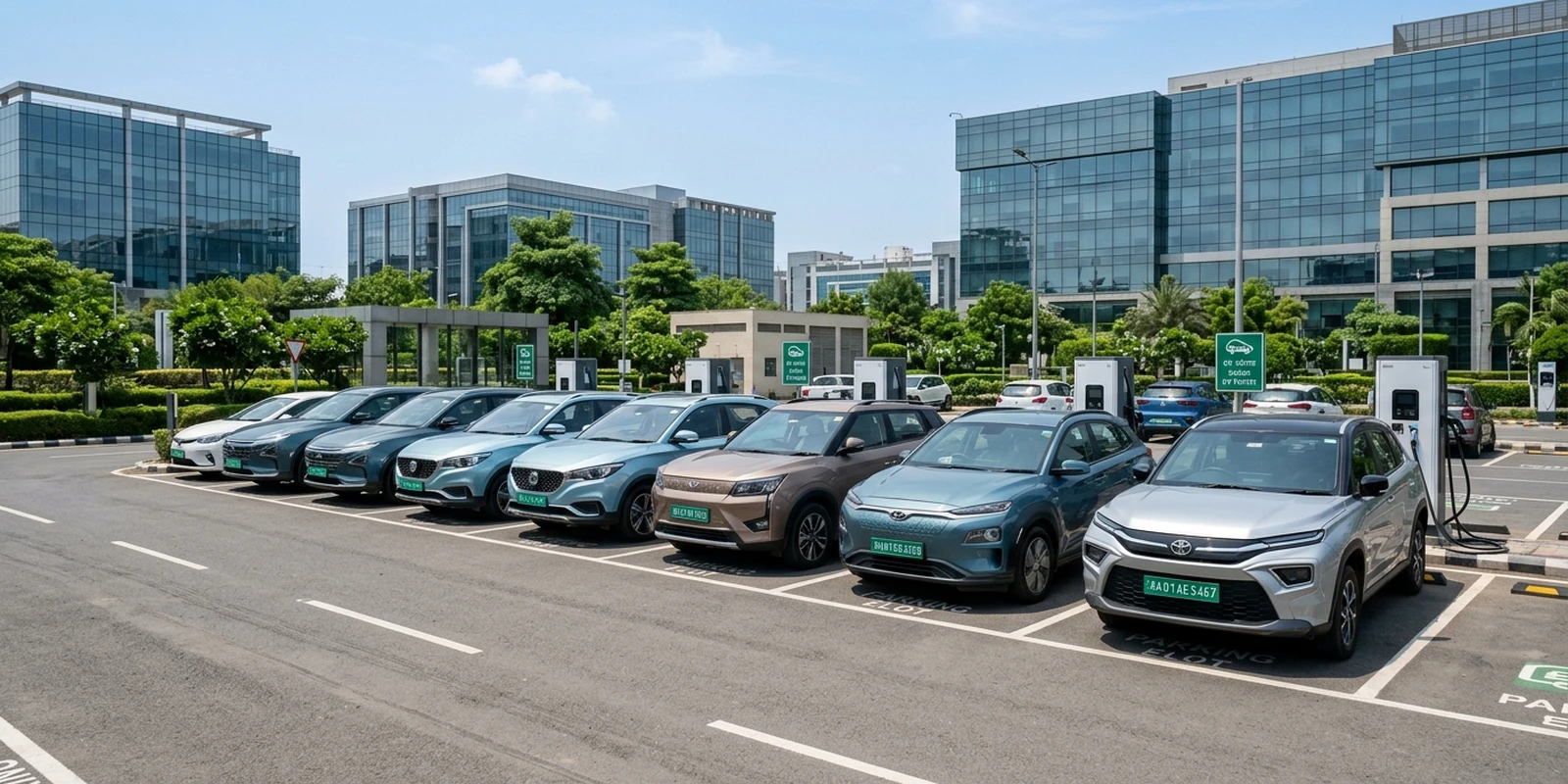
On 16 July 2026, the Ministry of Power circulated the draft Corporate Average Fuel Economy 2027 Norms — CAFE-III — for stakeholder consultation, the third and toughest round of fuel-efficiency rules India’s car industry has faced. For fleet operators, the headline isn’t the litres-per-100km number. It’s what OEMs will have to do to their model lineups to hit it — and that has direct consequences for which electric vehicles show up in fleet catalogues over the next five years.
What a “Corporate Average” Fuel Economy Rule Actually Regulates
CAFE norms don’t set a limit for any single car. They set a sales-weighted average across everything an OEM sells in a given year. A manufacturer can keep selling a thirsty SUV as long as enough small cars, hybrids, CNG models or EVs elsewhere in its lineup pull the fleet average back down to the regulatory line. That structure is precisely why CAFE targets function as an indirect electrification mandate: the cheapest way for a large OEM to hit a tightening average is to sell more zero- and low-emission vehicles, not to re-engineer every individual model.
CAFE-III is the successor to CAFE-II, which expires on 31 March 2027. Where CAFE-II required roughly 4.78 l/100km by 2022 and tightened further toward the end of its cycle, the new draft pushes the target down to 3.3273 l/100km by 2031-32 — a meaningfully steeper trajectory that industry commentary has already flagged as the toughest fuel-economy regime Indian carmakers have faced.
The New Twist: Ethanol and Biofuel Get a Compliance Credit
Unlike CAFE-II, the draft CAFE-III norms explicitly recognise the carbon-neutrality of ethanol, biofuel and Compressed Bio-Gas (CBG) by allowing OEMs to apply a specified reduction to a vehicle’s declared tailpipe CO₂ before compliance is assessed. For ethanol, an 8% carbon-neutrality factor is proposed; for CBG and biofuel, the reduction scales with the actual blending level in use. In effect, a flex-fuel or CBG-capable vehicle gets to count as cleaner than its raw tailpipe number suggests, which gives OEMs another lever — alongside EVs and hybrids — to hit the fleet average.
That’s a deliberate policy choice: India’s E20 ethanol-blending programme is already at nationwide scale (see our explainer on the Ethanol Blended Petrol Programme), so CAFE-III is being written to reward the fuel-blending pathway alongside electrification rather than treating EVs as the only route to compliance. For fleet operators, that matters because it means OEMs have more than one way to satisfy the regulator — the push toward EVs will be real, but it won’t be the only compliance lever manufacturers pull.
Why This Is an EV-Availability Story, Not Just a Regulatory One
For a corporate fleet buyer, CAFE-III’s real relevance shows up two or three years from now, in the showroom. As the fleet-average target keeps tightening through 2031-32, OEMs with EVs, hybrids and flex-fuel models already in development have a straightforward path to compliance; OEMs without them face a harder one. That typically shows up as: more EV variants added to existing model lines, faster EV launch cadences from manufacturers who were previously EV-cautious, and pricing that increasingly favours electrified trims as OEMs try to pull their fleet average down cheaply.
None of this happens overnight — the consultation window runs to 6 August 2026, and the norms won’t bind until the 2027-28 model year. But procurement teams planning fleet refresh cycles two to three years out should treat CAFE-III as a leading indicator of which OEMs are about to get serious about EVs, and which are likely to lean on ethanol/CBG credits instead.
Key Findings
- Applicability: M1 category passenger vehicles manufactured or imported for sale in India, 2027-28 through 2031-32.
- Target trajectory: fuel consumption tightens from 3.996 l/100km (94.76 gCO₂/km) in 2027-28 to 3.3273 l/100km (78.90 gCO₂/km) in 2031-32.
- Succession: replaces CAFE-II, which expires 31 March 2027.
- New compliance lever: ethanol (8% carbon-neutrality factor), biofuel and CBG now count toward an OEM’s declared CO₂, in addition to EVs and hybrids.
- Consultation window: feedback accepted until 6 August 2026, addressed to the Ministry of Power’s Energy Conservation division or the Bureau of Energy Efficiency.
- Enforcement mechanism unchanged: compliance is measured as a sales-weighted fleet average per manufacturer, not a per-vehicle limit — meaning EV/hybrid mix directly offsets less-efficient models elsewhere in an OEM’s range.
What It Means for Fleet Operators
If your fleet refresh cycle runs two to three years, CAFE-III’s 2027-28 start date lands right inside your next procurement window. Two implications are worth building into fleet planning now. First, expect a wider spread of EV and hybrid variants from OEMs currently under-represented in electrification — CAFE-III raises the cost of not having them. Second, don’t assume every OEM responds the same way: manufacturers with strong flex-fuel or CBG portfolios have a real alternative compliance path, so fleet EV availability may improve unevenly across brands rather than uniformly across the market.
Either way, the operational math for an electrified fleet doesn’t change with CAFE-III — it’s still about keeping vehicles charged, tracked and reported on. Vehicle management and CO₂ and energy consumption reporting are exactly the layer that turns a regulatory tailwind like this into a fleet strategy, rather than a headline you read once and forget.
Source: Press Information Bureau, Government of India — Ministry of Power, 16 July 2026 (Release ID 2285256).
YoMobility EV-FMS
EV fleet management softwareRun every vehicle, driver, charge and payment from one platform. Charge on multiple networks, and get one invoice for all of it.
Resources
Keep reading
CAFE Norms 2027-2032 Are Final: What EV Super-Credits Mean For Fleet Buyers
💡 CAFE Norms 2027-2032: Key Highlights India’s CAFE norms 2027-2032 are now final. On 30 September 2026 the Ministry of […]
State EV Policy Scores Just Jumped: What The India Electric Mobility Index 2025 Means For Fleets
💡 India Electric Mobility Index 2025: Key Highlights India’s state EV scorecard moved a long way in twelve months. The […]
Electric Heavy Duty Truck In India: Deployments Grew 4x As NITI Aayog Launches PACT
💡 Electric Heavy Duty Truck In India: Key Highlights India deployed 826 electric freight vehicles in FY26, up from 201 […]
See YoMobility on your fleet
Tell us how many vehicles you run and where they charge. We'll show you how they'd run on one platform, with one invoice.
Or contact us