
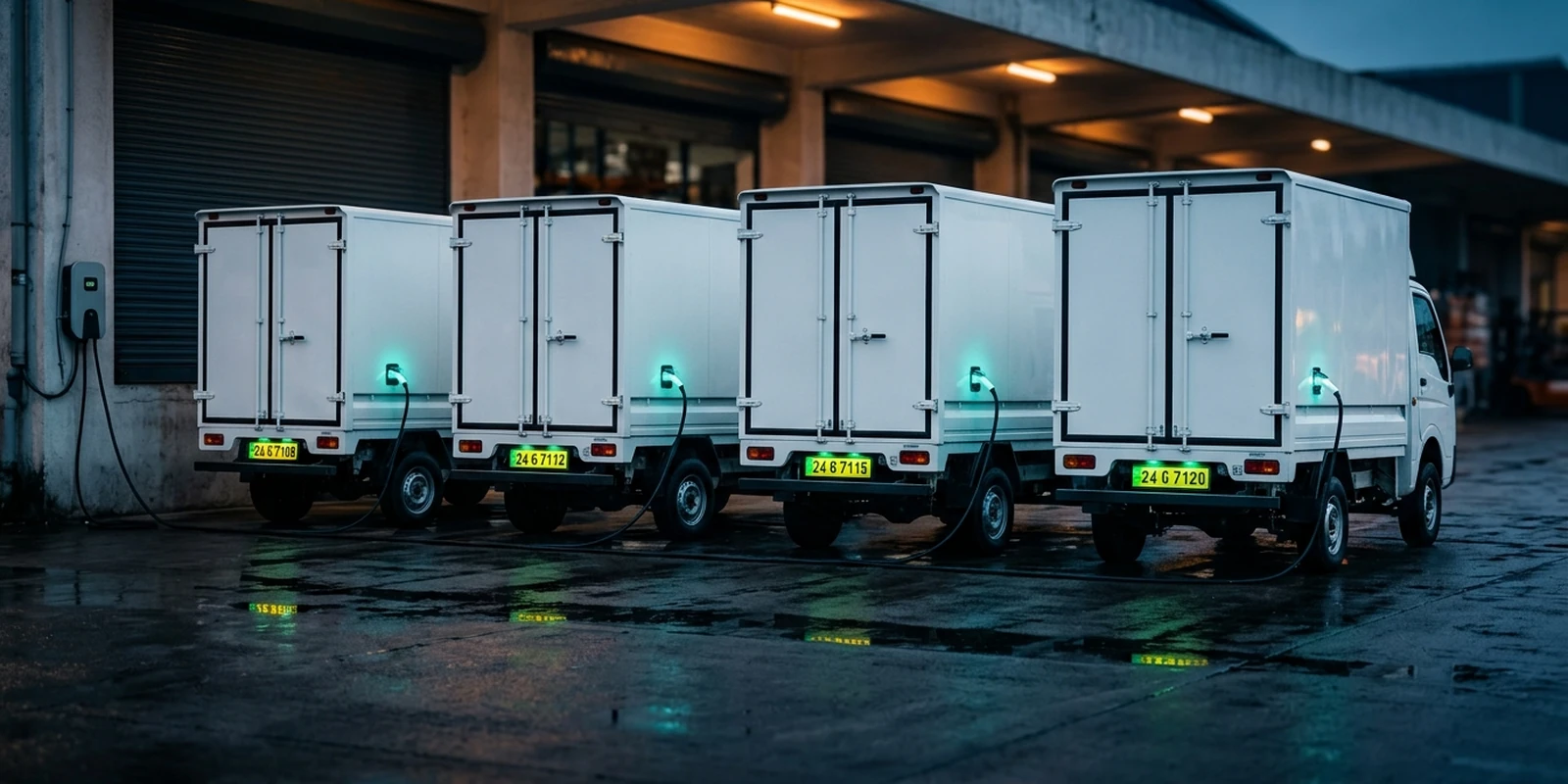
CNG vs EV For Commercial Vehicles
💡 CNG vs EV For Fleets: Key Highlights
- Running cost is a formula, not a headline — CNG price ÷ (km per kg × kWh per km) gives your crossover electricity tariff.
- Only one input is yours to move — the depot tariff. Time-of-Day rules set peak at 1.20× normal, solar hours 20% below.
- CNG is always someone else’s forecourt — just over 9,000 stations nationally. Only electric refuels where the vehicle parks.
- Delhi’s rules separate both fuels from older diesel, not from each other — but permits and GST do: electric goods vehicles are permit-exempt from July 2026, and GST is 5% against 18%.
This is for one reader: the fleet owner replacing a diesel light or intermediate commercial vehicle — the 1-to-3.5-tonne pickups, vans and tippers that do the work of Indian logistics. If you are shopping for a CNG hatchback, stop here: the CNG vs EV question changes completely once the vehicle is an earning asset with a duty cycle and a payload.
Every article on this subject compares diesel with electric. That is not the comparison at the dealership: on most Indian LCV routes the incumbent replacement is already CNG. So the real question is CNG vs EV, and the answer is conditional — two fleets on identical routes can rationally buy different fuels, and what separates them is not the vehicle.
CNG vs EV Running Cost Is A Formula, Not A Headline Number
What survives any price movement is the arithmetic — four numbers, two of which you own.
| Number | Where it comes from | Can you move it? |
|---|---|---|
| CNG price, ₹/kg | Your city gas distributor, on its own cadence | No |
| Your CNG mileage, km/kg | Your refuelling and odometer records, not the brochure | Barely |
| Landed tariff, ₹/kWh | Depot connection: energy charge, demand charge, losses | Yes — substantially |
| Your EV consumption, kWh/km | Metered charger energy ÷ kilometres driven | Somewhat |
Only one of the four is genuinely negotiable.
CNG costs the gas price divided by your kilometres per kilogram; electric costs the landed tariff multiplied by your kilowatt-hours per kilometre. Set them equal and you get the number worth carrying: crossover tariff = CNG price ÷ (km per kg × kWh per km). At 20 km/kg and 0.15 kWh/km the denominator is 3, so your crossover is today’s gas price divided by three. Use metered inputs: fleet analytics on charger and odometer data gives a defensible kWh/km inside a month.
The gas side moves without asking you
Distributors buy much of their CNG feedstock at administered prices, and that allocation is a policy lever: the cheaper domestic gas allocated to the CNG segment was cut by roughly a fifth in October 2024 and again in 2025. The dispenser price follows on their timetable, with nothing to negotiate.
The electricity side is the one you can work
Under the Electricity (Rights of Consumers) Amendment Rules, 2023, Time-of-Day tariffs apply to commercial and industrial consumers above 10 kW maximum demand — any real depot. Peak is at least 1.20 times the normal tariff and solar hours at least 20% below it, across an eight-hour window your state commission sets. The same kilowatt-hour costs roughly 1.5 times more at the wrong hour, and which hour your vehicles draw it is a scheduling decision — which is what a fleet operating system like YoMobility automates. For residuals, maintenance and financing see EV fleet total cost of ownership in India; this post stops at fuel versus fuel.
Refuelling Versus Charging Is An Availability Question
For a high-utilisation vehicle this usually decides the purchase, in both directions. CNG is structurally always someone else’s forecourt. The network is large and growing — PPAC’s count puts India just over 9,000 CNG stations as on 30 June 2026, against roughly 7,600 eighteen months earlier — but every kilogram is dispensed on a third party’s premises, in their queue, at their hours. Only electric refuels where the vehicle stands still anyway.
Measure dwell time, not station count
The business-case number is not stations near your routes. It is minutes per vehicle per day lost to refuelling — detour, queue, fill, return — times vehicles times operating days, and it usually exceeds the fuel-price gap you are arguing about. Pull it from the timestamped stops already in vehicle management.
It cuts both ways. A vehicle returning to a yard you control for six or more continuous hours turns that figure into zero, and electric wins decisively. A two-shift vehicle with a 40-minute handover and no home yard cannot, and a ten-minute gas fill beats any charging strategy — for that duty cycle CNG is the right answer, not a compromise.
Payload And Range: Compare The RC, Not The Brochure
Both options buy energy with weight: cylinders take mass and often intrude on the load area, packs take mass and money. For the exact variant you would buy, take gross vehicle weight minus kerb weight from the registration certificate — brochure payload is frequently quoted for a base diesel trim sharing nothing but a name. That subtraction is the number your loading supervisor collides with.
Do the same with range, on your routes rather than a certified figure. Log a month of duty cycles and ask one question: does the 90th-percentile day fit inside usable range at the 90th-percentile load, in your hottest month? If yes, range is not your constraint; if no, electrify the subset where it is. CNG’s range advantage is real, but it is paid back at the forecourt.
The Regulatory Horizon Over A Seven-Year Asset
You will hold this asset for most of a decade, and the regulatory risk is more nuanced than the assumption that electric is favoured and everything else doomed.
Where the two fuels are treated the same
In India’s strictest air-quality regime, CNG is not the loser — diesel is. The Commission for Air Quality Management banned entry of BS-III-and-below commercial goods vehicles into Delhi from 1 November 2025, except those registered there; CNG and electric both sit on the clean side. The same holds for last-mile operators: aggregators, delivery service providers and e-commerce fleets may induct only CNG and electric three-wheelers, with no diesel or petrol induction from 1 January 2026. If your case for electric rests on CNG being legislated off your routes, test that first.
Where they are not
Three differences are live, and all favour electric. Permits: a MoRTH gazette notification dated 6 July 2026 exempts battery-operated goods and passenger transport vehicles from the Section 66(1) permit requirement for seven years, conditional on an AIS-140 tracking device; CNG is not on that list. GST: since 22 September 2025 goods transport vehicles attract 18%, down from 28%, while electric vehicles stay at 5% — thirteen points of capex per unit. Subsidy: PM E-DRIVE’s e-truck incentive, ₹5,000 per kWh or 10% of ex-factory price capped at ₹9.6 lakh, applies only above 3.5 tonnes GVW. All three are policy-granted and time-boxed, while CNG’s position moves with a gas allocation policy already tightened twice.
A CNG vs EV Decision Rule You Can Apply This Week
Four tests, in order — the first is a gate, the rest refinements.
- Do you control a parking location where the vehicle sits idle six or more continuous hours, with a sanctioned load? If no, buy CNG — everything electric is good at depends on it.
- Compute your crossover tariff and compare it with your landed depot tariff, demand charges apportioned. If electricity is not comfortably below it, energy cost is not your reason to switch.
- Does the 90th-percentile day fit inside usable range at the 90th-percentile load? If not, electrify the subset where it does, not the whole fleet.
- Check GVW and geography last. Above or below 3.5 tonnes decides which incentives exist; entering a restricted city decides which restrictions bite. These adjust the answer, never produce it.
Pass one to three and electric is very likely cheaper to run and administratively lighter. Fail test one and CNG is the correct purchase today — the question becomes when a depot connection is possible, because that is the event that changes your answer. The sequencing afterwards is our guide to fleet electrification strategy.
Frequently Asked Questions
It depends on four numbers specific to your fleet, so any published answer is stale within weeks. Divide your local CNG price by your logged km per kg times your kWh per km. If your landed depot tariff is below that crossover figure, electric is cheaper per kilometre.
No. A gazette notification dated 6 July 2026 exempts battery-operated goods and passenger transport vehicles from the Section 66(1) permit requirement for seven years, provided the vehicle carries an AIS-140 tracking device. CNG vehicles are not covered.
Yes. The restriction effective 1 November 2025 bars BS-III-and-below commercial goods vehicles not registered in Delhi; CNG and electric both remain permitted. Current rules separate cleaner fuels from older diesel, not CNG from electric. Verify your route and class before purchase — these directions are amended often.
Its e-truck component supports vehicles above 3.5 tonnes GVW, at ₹5,000 per kWh or 10% of ex-factory price, whichever is lower, capped at ₹9.6 lakh and conditional on a scrapping certificate. Most LCVs fall below that threshold.
Sources: PPAC — CGD Network | PIB — Time of Day Tariff | PIB — CAQM Air Pollution Measures | MHI — PM E-DRIVE e-Truck Portal | Autocar Professional — permit exemption | Business Standard — gas allocation cuts
Manage Your Fleet’s Fuel Choice Today
Talk to YoMobility about modelling your own crossover tariff, depot dwell time and duty cycles — so the CNG versus electric decision is made on your numbers, not someone else’s averages.