
💡 Key Highlights
- Israel’s Electreon has deployed the world’s first commercial wireless charging terminal for public buses — 23 buses, 89.3% efficiency, 99% uptime
- Wireless charging cuts peak grid demand by more than 50% and can give buses 60–100 km of extra range daily without any plug-in
- India is at the early pilot stage, with IIT Madras, CDAC, and KSEB exploring wireless charging for EVs
- The technology is most relevant to fixed-route commercial fleets — exactly the operators YoMobility serves
- Even today, fleet operators can prepare by upgrading their charging session monitoring and energy management
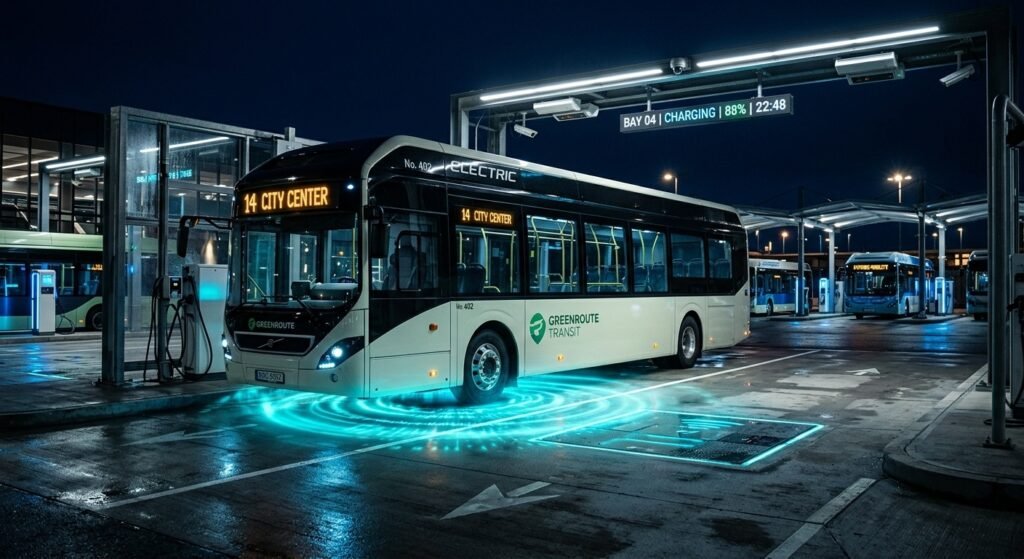
The way electric buses charge is about to change. Wireless EV charging for electric buses — once a concept confined to research labs — is now a commercial reality. Israel’s Electreon has deployed the world’s first commercial wireless charging terminal for public buses, and the results are turning heads across the global fleet management industry. For India’s rapidly growing EV bus sector, this is not a distant future technology. It is a signal of where fleet operations are heading — and a reason to get your charging infrastructure strategy right, starting now.
What Happened in Israel? The World’s First Commercial Wireless Bus Charging Terminal
In December 2023, Israeli startup Electreon unveiled the world’s first commercial wireless charging terminal for public buses at a depot in Rosh HaAyin, central Israel. The project, funded by Israel’s Ministry of Transportation and Rosh HaAyin Municipality at a cost of approximately ₪5.8 million (~$1.6 million USD), deployed 23 electric buses equipped with wireless charging receivers.
The operator — Electra Afikim, Israel’s fourth-largest public bus operator — integrated buses from manufacturers HIGER, Ankai, and Sunwin. After 18 months of commercial service, the numbers speak for themselves:
- 89.3% energy transfer efficiency — competitive with wired AC charging systems
- 99% operational uptime — essentially no charging failures across the fleet
- 60 km extra range from overnight depot charging; up to 100 km additional from daytime opportunity charging at terminals
- Buses ending their service day with ~50% battery remaining — zero range anxiety for depot managers
- Peak grid demand cut by over 50%, directly reducing electricity costs and grid connection charges
Building on this success, Electreon launched a second project in April 2025 at the Ovnat terminal in Petah Tikva, embedding wireless charging pads beneath passenger boarding bays so buses charge automatically while passengers board and alight. In parallel, Tel Aviv’s Dan Bus Company signed a $9.4 million, 5-year contract to supply 200 buses with wireless charging technology — a deployment that will make it one of the largest wireless-charged transit fleets in the world.
How Wireless EV Charging for Electric Buses Actually Works
The technology behind wireless EV charging for electric buses is called Resonant Inductive Power Transfer (RIPT). Here’s how it works in simple terms:
- Copper coils are embedded beneath the surface of a depot floor, bus stand, or road segment
- An alternating current through these coils generates an oscillating magnetic field
- A receiver coil mounted on the underside of the bus captures this field and converts it to electricity
- That electricity charges the battery pack — with no physical connection, no cables, and no driver action required
Modern resonant systems can transfer power efficiently across air gaps of up to 25 cm, tolerating the imperfect parking alignment typical of real depot operations. Electreon’s buses operate with a 17 cm gap. There are two deployment modes: stationary charging (in depots and terminal bays, commercially deployed today) and dynamic charging (coils embedded in the road itself, enabling charging while moving — currently in pilot stage globally).
Power levels for heavy-duty buses range from 100 kW (KAIST’s OLEV buses in South Korea) to 250 kW (WAVE/InductEV’s system used in California), with Electreon’s latest France motorway test achieving peak outputs above 300 kW. For comparison, a standard 50 kW DC fast charger takes 1–2 hours per bus. A 250 kW wireless system can add over 130 km of range in an 8-hour overnight shift — without a single plug-in.
Real-World Fleet Impact: Why Fixed-Route Operators Should Pay Attention
The benefits of wireless EV charging are most pronounced for fixed-route commercial fleet operators — city bus companies, corporate shuttles, logistics providers with defined depot-to-route patterns. Here is why:
Antelope Valley Transit Authority (AVTA) in California became the first all-electric, zero-emission transit agency in North America in March 2022. Forty-seven of its 65 BYD buses are charged using WAVE’s 250 kW wireless system across 12 charging centers. The result: fuel costs are 50–70% lower than their former diesel fleet, saving over $1 million annually. CO₂ avoided: 2,700 metric tonnes per million miles. These are not projections — these are live fleet numbers from a commercial deployment.
For fleet managers, the operational advantages go beyond energy cost:
- No missed charge-ups: Buses charge automatically on parking. No driver intervention, no broken connectors, no human error.
- Smaller battery packs: With continuous top-up from depot pads and route-side opportunity charging, buses need significantly smaller batteries — reducing vehicle cost and extending battery lifespan through shallower discharge cycles.
- Grid cost reduction: Intelligent wireless charging systems spread load across the day, cutting peak demand charges that typically represent 30–50% of a fleet’s electricity bill.
- Depot space efficiency: No charging columns, no cable management — buses park normally in existing bays and charge automatically.
Where Does India Stand on Wireless EV Charging?
India is at the early stage of wireless EV charging development, but the building blocks are being laid. In April 2025, CDAC (Centre for Development of Advanced Computing, Thiruvananthapuram) and VNIT Nagpur jointly developed India’s first indigenous wireless EV charger — a 1.5 kW system using silicon carbide transistors operating at 88 kHz, achieving ~90% charge efficiency. The technology has been transferred for commercialisation by the Ministry of Electronics and Information Technology (MeitY).
IIT Madras is testing dynamic wireless charging for electric buses using inductive power transfer. Kerala State Electricity Board (KSEB) has announced plans for India’s first wireless EV charging road on key highways. Ashok Leyland, in partnership with Hitachi, is exploring depot-based wireless charging for commercial vehicles.
The context matters here. India currently has one public charger per 235 EVs — well below global benchmarks. Under the PM E-DRIVE scheme, 10,900 e-buses are being deployed across five major Indian cities. Depot operations for these buses will require reliable, scalable charging — and the operational failures of missed plug-ins, cable damage, and driver dependency are real problems fleet operators face today. Wireless charging, even at the stationary depot level, directly addresses these pain points.
The Challenges: What’s Holding Wireless Charging Back
It would be incomplete to discuss this technology without acknowledging its current limitations. Dynamic in-road wireless charging costs approximately $2 million per mile of equipped road (Detroit pilot benchmark) — a significant infrastructure investment. Energy efficiency, while improving, still trails wired DC fast chargers by 5–7 percentage points. Coil misalignment reduces charging rates. And critically, international standards for heavy-duty wireless charging (SAE J2954/2) and dynamic road charging (SAE J2954/3) are still in development, creating vendor lock-in risk for early adopters.
Sweden’s national evaluation, published in December 2024, concluded that a national electric road network was not cost-effective at scale — a sobering counterpoint to the technology’s early commercial wins. Like any emerging infrastructure, wireless charging will require careful cost-benefit analysis specific to each fleet’s route density, depot configuration, and grid access.
Preparing Your Fleet Today: Data-Driven Charging Management
Whether or not your fleet adopts wireless charging in the next 12 months, the operational lesson from Israel and California is clear: the fleets that win are the ones with complete visibility over their charging operations. Missed sessions, inefficient scheduling, and unmonitored energy costs are problems that exist with or without the technology upgrade.
YoMobility’s Charging Management module gives fleet operators real-time visibility across every charging session — regardless of which network or charger type is being used. From remote session monitoring to consolidated invoicing across multiple CPO networks, the platform ensures that when wireless charging does arrive at your depot, your data infrastructure is already in place to measure, manage, and optimise it. Combined with Reports & Analytics, fleet managers can track energy consumption per vehicle, identify charging inefficiencies, and build the baseline data needed to make the business case for any charging infrastructure investment.
The future of EV fleet charging is wireless, automatic, and data-driven. Israel has proved the technology works at commercial scale. India’s fleet operators have the opportunity to leapfrog a generation of charging infrastructure — but only if they build the operational and data foundation today.
Manage Your Fleet’s Charging Operations Today
See how YoMobility’s EV-FMS platform gives you real-time visibility across every charging session, network, and vehicle in your fleet.